Luxury travel today is less about being seen and more about where you choose to look. The most seasoned travelers are editing not just their itineraries, but their attention span—paring it down to spaces, moments, and details that feel deliberately chosen rather than algorithmically suggested. In this world, prestige isn’t measured by how far you fly, but by the precision of what you refuse to overlook.
Below are five exclusive, quietly influential insights shaping how high‑end travelers design their journeys now—subtle levers that rarely appear on brochures, yet define the difference between an expensive trip and a truly elevated one.
1. The Shift From Room Category to Spatial Composition
For the experienced traveler, “suite versus room” is no longer the operative question. The real conversation is about spatial composition: how a room is arranged to support the specific way you live, work, and unwind on the road.
Travelers who understand this rarely start with square footage; they begin with how they intend to use the space. A corner suite with suboptimal sightlines might be less valuable than a smaller, impeccably zoned room with a work nook, a reading chair with natural light, and a dining table that can transform into a private tasting space. They look at adjacency—proximity to discreet exits, spa levels, or private lounges—and at the choreography of movement from bed to bath to balcony.
They pay attention to liminal zones: entry vestibules that buffer sound, closets large enough to keep luggage out of sight, and bathrooms where mirrors and lighting are positioned for both function and calm. The most discerning guests often ask for floor plans in advance, or at minimum, photographs from multiple angles. What they are really curating is not a category, but a daily rhythm—privacy where it matters, openness where it restores, and a layout that makes every return to the room feel like a reset, not a compromise.
2. The New Benchmark: Emotional Climate, Not Just Microclimate
Weather has always mattered in travel—sunlight, humidity, wind. But the new elite filter is the emotional climate of a place: how a destination feels to inhabit during a certain week, season, or event cycle.
Sophisticated travelers don’t simply check average temperatures; they study a city’s cultural barometer. They avoid dates where a place is oversubscribed by festivals or mass‑market events, even if the weather is perfect. A mild Mediterranean week loses its allure when cruise ships triple the density of a harbor town, or when corporate conventions commandeer all the best restaurants for private buyouts.
Instead, they quietly orbit the shoulder of peak season—those discreet windows when local life is in full voice but visitor volume is dialed down. They ask concierges, private guides, and local friends not just when to go, but when residents exhale. They track art openings, harvest periods, and lesser‑known cultural rituals that soften the city’s pulse rather than spike it.
Emotional climate also extends to the feel of the resort or hotel on specific days. Some luxury guests now request arrival dates based on property “mood”—avoiding weekends favored by wedding parties, or scheduling midweek stays when resident chefs and spa directors are more available and unhurried. In this lens, luxury becomes less about fixed amenities and more about timing your way into a more relaxed version of the same place.
3. Curated Friction: The Intentional Imperfection of the Itinerary
The most refined itineraries are no longer seamless; they are intentionally punctuated with small, curated frictions. Not the chaotic kind—missed flights, overpacked days—but the kind that prompts you to notice more, to earn your experience just enough that it leaves a deeper imprint.
Seasoned travelers are quietly resisting the fully choreographed, minute‑by‑minute agenda. Instead, they design days with one or two anchored commitments—perhaps a private appointment at a gallery, a booked‑in-advance table at an under‑the‑radar restaurant, or a time‑sensitive excursion—and deliberately leave the rest structurally open. The gaps are not oversights; they are carefully protected margins where serendipity is allowed to operate.
Curated friction might be as simple as choosing a property slightly outside the central district, requiring a short drive or boat transfer that becomes its own daily ritual. It might mean opting for a boutique hotel with an exceptional team but fewer automated systems, where relationships with staff form organically over the course of a stay. It might involve walking segments in a city where car transfers would be easier, just to experience the cadence of its streets between the “hero” experiences.
This approach values meaningful texture over constant ease. The underlying insight: an experience that asks you to participate—navigate, decide, engage—often feels more personal, and therefore more luxurious, than one that is merely presented to you on a tray.
4. The Private Economy of Time: Hidden Luxuries Between Departures
Truly experienced travelers know that the most wasteful form of luxury is unused time that feels trapped—hours lost in airports, lobbies, and transfer lounges that don’t match the quality of the journey they bookended. As a result, they are redesigning the connective tissue between destinations with the same care as the destinations themselves.
Elite flyers increasingly treat their pre‑flight and post‑arrival windows as distinct experiences to be curated, not endured. They invest in services that compress uncertainty (expedited security, private terminals, meet-and-greet immigration escorts) not only to save minutes, but to protect the psychological clarity around a trip. They know that arriving with a quiet mind is as important as arriving on time.
Equally, they are attuned to micro‑environments: where they will spend the 90 minutes before boarding, the half‑hour waiting for a driver, the early morning before an intercity transfer. A well‑chosen hotel near an airport with a serious spa program can turn a layover into a restorative interlude instead of a logistical compromise. An airline’s lounge with proper workspaces and culinary standards becomes less a perk and more a recurring, portable office.
What emerges is a private economy of time: a personal ledger where every segment—drive, check‑in, lounge, transfer—is either depleting or replenishing. Those who manage it well report arriving at destinations not just earlier or more refreshed, but more receptive—better able to register nuance, engage deeply, and ultimately feel that the trip has a coherent emotional arc rather than a series of disconnected frames.
5. Signature Quiet: Crafting a Personal, Portable Ritual Set
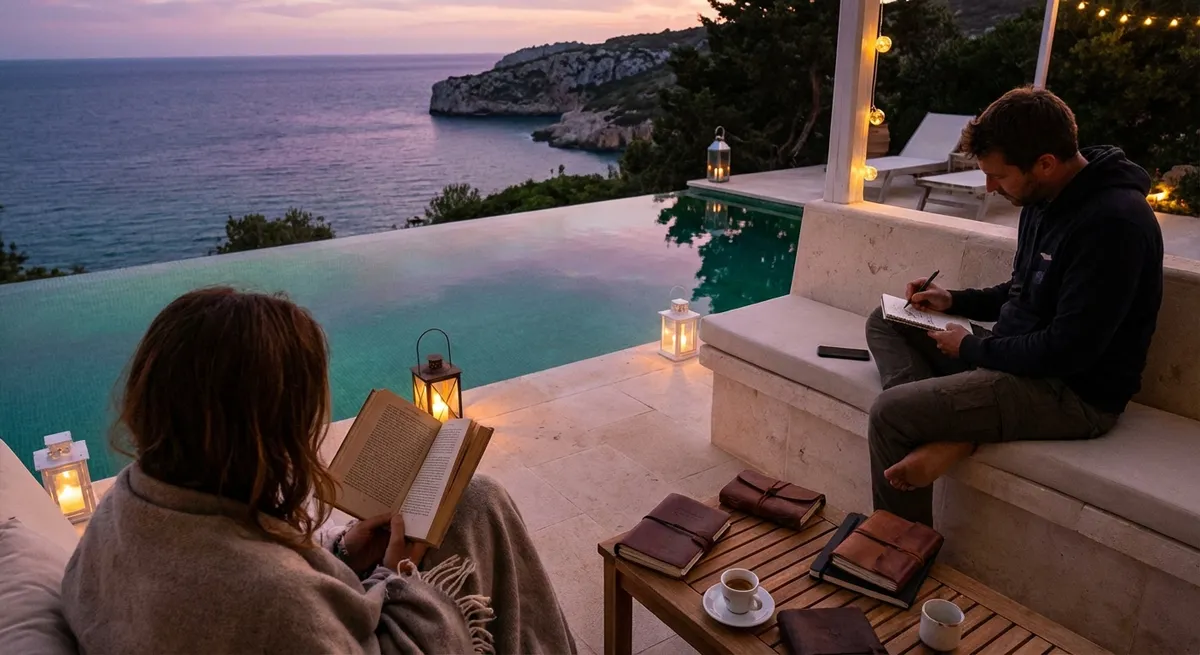
At the highest level, luxury travel becomes less about what a property offers and more about the rituals you carry with you—those portable signatures that make any unfamiliar room feel instantly like your version of comfort.
Frequent luxury travelers often maintain a discrete “ritual kit” that travels with them: perhaps a preferred scent to re‑tune the room’s atmosphere, a particular style of loungewear, a travel candle snuffed strictly before sleep, or a specific tea service setup requested from in‑room dining on arrival. Over time, these rituals become a form of mobile architecture—reliable shapes in the day that anchor the unfamiliar.
They also learn to brief hotels and private staff at a granular level, not in the language of demands, but of preferences that shape mood. Turn‑down at a precise time to align with calls across time zones. Glassware tailored to how they actually drink (stemless for late‑night water, proper stems for wine, a real espresso cup rather than a generic mug). Preferred pillow density, of course, but also blackout preferences, bedside charging layouts, and the small but telling detail of how luggage is stored—visible, or never in sight.
This is not about dramatizing minutiae. It is about engineering familiarity so that attention is liberated for what truly matters in a place: the view, the cuisine, the conversations, the landscape. In this sense, the most advanced form of luxury travel is deeply personal. Properties are chosen for their ability to receive, interpret, and enhance these quiet rituals—not merely for their brand name or star rating.
Conclusion
The future of luxury travel isn’t louder, shinier, or even more remote. It is more precise. It lives in the layout of a room rather than its category, in emotional climate rather than forecast, in carefully protected gaps rather than overfilled days. It hides in the way you pass through airports, the degree to which time feels like an ally instead of an adversary, and in the private rituals that make any destination feel intentionally yours.
For travelers who think this way, every journey becomes a kind of soft choreography: a series of considered decisions about where to place attention, where to invite friction, and where to insist on ease. The reward is not just a luxurious trip, but a travel life that feels authored—quietly, intelligently, and unmistakably in your own hand.
Sources
- [World Travel & Tourism Council – High Net Worth Travelers Report](https://wttc.org/research/insights/high-net-worth-travel) – Analysis of behaviors and expectations among high-net-worth and ultra-high-net-worth travelers
- [Virtuoso – Luxe Report](https://www.virtuoso.com/travel/articles/virtuoso-luxe-report) – Industry insight into evolving luxury travel trends and preferences
- [Forbes Travel Guide – What Defines Luxury Travel Today](https://www.forbestravelguide.com/forbes-travel-guide-stories/what-defines-luxury-travel-today) – Overview of current standards and guest expectations in luxury hospitality
- [Condé Nast Traveler – Why Shoulder Season Is the Smartest Time to Travel](https://www.cntraveler.com/story/why-shoulder-season-is-the-best-time-to-travel) – Discussion of timing, seasonality, and traveler experience
- [Harvard Business Review – The Value of Customer Experience in Travel](https://hbr.org/2014/09/the-value-of-customer-experience-quantified) – Research on how nuanced service and experience design affect perceived value and loyalty
Key Takeaway
The most important thing to remember from this article is that this information can change how you think about Luxury Travel.