The world’s most exclusive resorts operate on a wavelength that rarely appears in brochures. For the traveler accustomed to first-class cabins and black-card concierge lines, true luxury is no longer about visible opulence; it is about the precision with which an experience anticipates your preferences, protects your privacy, and orchestrates a sense of effortless ease. At this level, the question is not where you are staying, but how the property thinks, responds, and quietly reshapes itself around you.
Below, we explore five under-the-radar dimensions of elite resorts—subtle markers that signal you are not simply a guest, but part of a very small circle for whom the experience was designed.
1. The Architecture of Ease: Invisible Design That Serves You
In a genuinely top-tier resort, design does not exist to be photographed; it exists to disappear into comfort. The corridors feel intuitively short, sightlines open without fanfare, and your path from suite to sea or terrace to spa is strangely frictionless. This is the result of meticulous spatial choreography: acoustic insulation that protects privacy without feeling sealed, lighting scenes that adapt almost imperceptibly from sunrise to nightcaps, and materials chosen as much for touch and temperature as for aesthetics.
Luxury travelers who know what to look for will notice small but telling cues. Flooring that never echoes high-heeled footsteps in corridors. Suites oriented to capture morning light where you work and evening glow where you unwind. Public spaces that feel animated yet never crowded, thanks to carefully calculated seating radii and circulation flows. Even the choice of fragrance—if there is any—is subdued, layered, and engineered to fade rather than insist. The most exclusive properties make you feel instantly settled, not because you recognize the brand, but because the environment seems to recognize you.
2. Precision Privacy: How True Luxury Manages to Stay Unseen
For those accustomed to a public life—executives, founders, artists, and public figures—privacy is not a perk; it is a baseline requirement. At elite resorts, confidentiality is engineered into every operational layer. Staff are trained not only in service protocols but in discretion as a core competency: names are confirmed quietly, arrivals and departures are choreographed away from main thoroughfares, and guest histories are handled with a level of security more akin to a private bank than a hotel front desk.
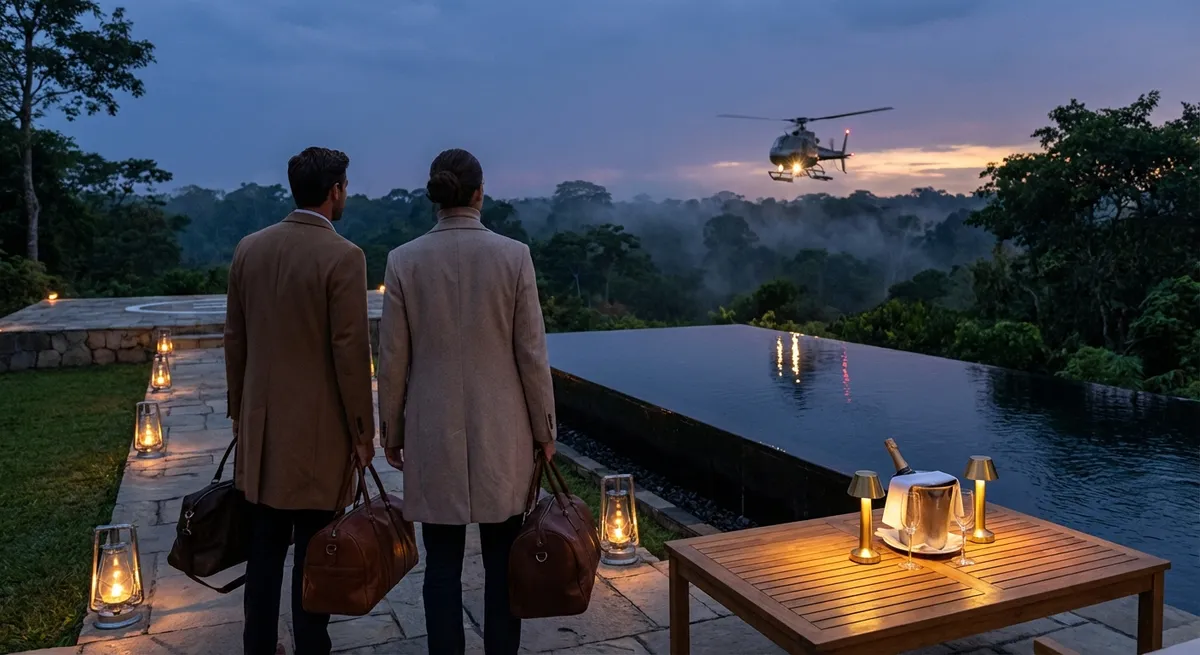
The most discerning resorts operate on a principle of selective visibility. You may notice that check-in occurs in-suite or in a private salon rather than at a front desk. Room keys are delivered before you reach the property, via digital credentials or coordinated arrival through your driver. Housekeeping routines align with your rhythms—learned over the first 24 hours—so that you simply never encounter a cart in the hallway. For those traveling in a professional capacity, meeting rooms might be disguised as residential salons, and sensitive conversations are protected by sound-proofing and layout. True exclusivity is measured not by who sees you there, but by how easily you could have been missed altogether.
3. Culinary Intelligence: When the Kitchen Knows You Better Than Your Calendar
At the very top of the market, gastronomy is no longer about the longest tasting menu or the most elaborate plating. It is about culinary intelligence: the ability of a resort’s F&B program to understand your rhythms, respect your nutritional boundaries, and occasionally surprise you with something you did not yet know you wanted. The wine list may be extraordinary, but it is the sommelier’s memory of your understated preferences—old-world over new, a certain minerality, a quiet avoidance of oak—that tells you you’re in the right hands.
This intelligence extends beyond formal restaurants. Breakfast appears precisely the way you take it, without needing to ask twice. A jet-lagged arrival is met with restorative, hydrating options that support your circadian adjustment rather than overwhelm you. If you are training for a marathon or maintaining a particular wellness regimen, the kitchen can adapt at the level of ingredients and timing, offering performance-oriented menus without making you feel as though you are on a program. The luxury traveler’s ideal is a culinary experience that feels curated rather than constrained—where indulgence and discipline coexist seamlessly, and every meal feels both considered and effortless.
4. Layered Access: Experiences That Exist Only If You Know to Ask
In the rarefied world of exclusive resorts, the most meaningful experiences rarely appear on the official list of activities. They are part of a parallel layer of access reserved for guests whose preferences are understood and whose discretion is trusted. This might manifest as an unpublicized after-hours museum visit, a sunrise island crossing to a beach that is not on any map, or a private performance in an architectural space not normally open to visitors.
The distinction lies in curation rather than mere expense. High-tier guests do not simply receive “more”; they receive experiences that are attuned to their sense of time and narrative. A resort might coordinate a dinner with a local designer whose work you already collect, or quietly arrange a day for your children that blends conservation, culture, and play, without ever labeling it as a “program.” The real signal of elite access is how little explanation is required. The experience integrates seamlessly into your day, with the logistical complexity absorbed by the resort. You are left only with the impression that your day unfolded naturally, even though every element was, in truth, highly orchestrated.
5. Time as the Ultimate Luxury: How the Best Resorts Reengineer Your Day
At the pinnacle of hospitality, the most valuable commodity a resort can return to you is time—unbroken, unhurried, yet fully supported. This begins with the practical: tight coordination with your aviation schedule, immigration and customs facilitation where permitted, and unpacking and pressing handled so smoothly that your suitcase becomes largely irrelevant. But the deeper work of time management happens in the design of your days.
Exceptional properties are quietly obsessed with the tempo of your stay. They anticipate the natural arcs of energy and attention: a slower start after a late flight, a window of focused work that appears like clockwork each morning, a moment just before sunset when you are most receptive to discovery or connection. Rather than over-programming, they create a framework in which you can make last-minute decisions without penalty and pivot from seclusion to socializing as your mood shifts. Transportation is always already waiting, reservations hold flexibility, and “fully booked” rarely applies to you. In this calibration, the luxury traveler is granted the rare sensation that time has widened—enough to think, to rest, and to experience, without the friction that ordinarily accompanies movement.
Conclusion
For the seasoned luxury traveler, the true mark of an exclusive resort is not its public profile, but its private intelligence—how well it reads you, how lightly it treads, and how precisely it aligns environment, service, and experience to your personal cadence. The details that matter most are often the ones that go unmentioned: a corridor that is always quiet, a dining room that remembers, a schedule that bends without breaking. In this discreet realm, luxury is no longer about what is displayed; it is about what is artfully removed, until only what you value remains.
Sources
- [World Travel & Tourism Council (WTTC) – Luxury Travel Trends](https://wttc.org/research/insights/luxury-travel) - Industry analysis on evolving expectations in luxury travel and high-end guest behavior
- [Skift – The New Luxury: Defining the Aspirations of the Future Traveler](https://skift.com/2022/01/18/the-new-luxury-defining-the-aspirations-of-the-future-traveler/) - In-depth reporting on how modern luxury travelers prioritize privacy, personalization, and time
- [Forbes – Why Privacy Is the Ultimate Luxury in Hospitality](https://www.forbes.com/sites/forbesbusinesscouncil/2021/07/22/why-privacy-is-the-ultimate-luxury-in-hospitality/) - Explores the role of discretion and privacy as key differentiators in high-end resorts
- [Cornell University School of Hotel Administration – Hospitality Research](https://sha.cornell.edu/faculty-research/research/center-for-hospitality-research/) - Academic research on service design, guest experience, and operations in luxury hospitality
- [CNBC – How Wealthy Travelers Are Redefining Luxury Vacations](https://www.cnbc.com/2023/07/29/wealthy-travelers-are-redefining-luxury-vacations.html) - Coverage of ultra-high-net-worth travel behaviors and demand for bespoke, discreet experiences
Key Takeaway
The most important thing to remember from this article is that this information can change how you think about Exclusive Resorts.