There is a level of travel that lives beyond glossy brochure language and loyalty tiers—a realm in which privacy is engineered, experiences are choreographed to appear effortless, and absence (of noise, of crowds, of friction) is the ultimate amenity. This is the discreet universe of true private resorts: members-only enclaves, fully serviced estates, ultra-bespoke villas, and invitation-only hideaways where the concept of “guest” quietly evolves into “insider.” For the luxury traveler, understanding what genuinely sets these properties apart is the difference between a beautiful stay and a transformative one.
The Architecture of Privacy: How Seclusion Is Quietly Designed
In the world of exclusive resorts, privacy is not an afterthought; it is the central design brief. It begins long before arrival—with private terminals, anonymized transfers, and check-ins that happen in-villa rather than at a front desk. The guest rarely sees the machinery that makes this possible: back-of-house circulation routes that ensure staff move invisibly, landscaped sightlines that protect terraces from neighboring views, and layered acoustic treatments that silence the outside world.
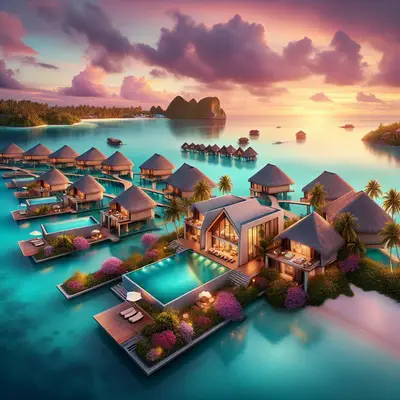
At the highest level, villas and residences are often sited for maximum natural seclusion rather than simple convenience. Clifftop pavilions are oriented away from flight paths and public beaches; overwater villas are staggered to prevent direct lines of sight; island compounds use natural topography and dense planting to create a perimeter of quiet. For discerning travelers, the tell is in the transitions: whether one can move from bedroom to pool to dining pavilion to spa treatment room without ever encountering another guest—or a camera lens.
Architectural privacy now extends into the digital realm. The most elevated properties are investing in secure, high-bandwidth networks that segregate guest traffic from operational systems, deploy advanced encryption, and provide dedicated, private Wi‑Fi networks for high-profile visitors. For executives and public figures, this blend of physical and cyber discretion has become non-negotiable, and the finest resorts are quietly competing on this invisible infrastructure as fiercely as they do on views or design.
Culinary on Your Terms: The Rise of the Micro-Brigade
In exclusive resorts, food is neither a buffet nor a performance staged at set hours—it is a continuous, deeply personal dialogue. Instead of a chef, there is an intimate brigade assigned to a villa or residence: an executive chef, a sous, a pastry specialist, sometimes even a dedicated forager or tea sommelier on call. Menu tastings happen over days, not minutes, and preferences are absorbed into a living culinary profile that travels with the guest from stay to stay.
The most refined properties build entire gastronomic ecosystems around this level of service. On-property organic farms, artisanal bakeries, and aging rooms for meats and cheeses allow chefs to work with products that never leave the estate until they reach the table. In coastal enclaves, bespoke dawn fishing expeditions transform into late-morning sashimi, while inland retreats may pair truffle hunts or vineyard walks with private cellar dinners.
What distinguishes the genuinely exceptional is not theatrical excess, but precision: the resort that remembers a guest’s preferred tea temperature, the exact level of spice that balances rather than dominates, or the time of day when a light, nutrient-focused menu is quietly introduced after a long-haul arrival. Nutritionists and wellness chefs increasingly collaborate in the background to align indulgence with longevity, ensuring that a week of pleasure does not feel like a week of recovery afterward.
The Invisible Itinerary: When “Nothing Planned” Is Perfectly Orchestrated
For the sophisticated traveler, the most luxurious schedule often appears to be no schedule at all. Yet at the top tier of exclusive resorts, a tremendous amount of orchestration occurs behind the scenes to protect that sense of unstructured ease. These properties employ senior-level “experience designers” whose role is less concierge and more curator—subtly editing options so that each day possesses an arc without ever feeling scripted.
Instead of pre-packaged activities, guests are quietly offered “moments.” A vintage Riva happens to be available just as the sea is at its calmest; the sommelier proposes a sunset tasting on a cliff ledge that, conveniently, is otherwise unused; a visiting artist is “in residence” during the exact week a guest arrives, leading to a private studio visit that feels serendipitous rather than scheduled.
The true hallmark of mastery is restraint. High-end experience teams know when not to intervene, allowing unhurried mornings or extended poolside afternoons to breathe. The most exclusive enclaves have shifted from activity-heavy itineraries to mood-based frameworks—reading a guest’s energy levels, sleep quality, even biometric data (with consent) to gently recommend a sailing day instead of a demanding hike, or a sound bath rather than a high-intensity workout. The result is an itinerary that feels discovered, not delivered.
Wellness Without the Slogan: Deep, Clinical, and Beautifully Human
Wellness at the pinnacle of private resorts has moved far beyond scented candles and generic massages. The new benchmark is integrative, clinically informed, and tailored with the same nuance as fine couture. Guests may begin with a comprehensive diagnostic: advanced blood panels, sleep analysis, movement screenings, even epigenetic testing, all conducted privately and interpreted by medical specialists in partnership with the resort’s wellness team.
Yet the most successful programs resist the temptation to become sterile clinics. Instead, data is used as a silent framework, while the guest’s experience remains tactile and sensorial. A personalized protocol might include infrared saunas and cryotherapy, but it will be framed within rituals that feel deeply human—outdoor yoga platforms overlooking the sea, forest bathing guided by a naturalist rather than a technician, or meditative sound journeys held in architecturally resonant spaces.
Nutrition, sleep, and stress management are woven into the fabric of the stay rather than presented as a separate “program.” Turn-down service includes calibrated lighting schemes and aromatherapy to optimize circadian rhythms; villa pantries are pre-stocked in alignment with metabolic goals; spa treatments are sequenced to support recovery after long flights or demanding work schedules. For those who travel incessantly, these resorts have become essential recalibration labs—places where time away enhances performance rather than interrupts it.
The New Currency: Access, Continuity, and Discreet Influence
At the rarefied end of the market, the true value of an exclusive resort is increasingly measured in continuity and access rather than in-room finishes—though those remain impeccable. Many ultra-luxury travelers now think in terms of portfolios: membership-based villa clubs, fractional residence schemes, and multi-property alliances that allow them to move between destinations while remaining within a single, trusted ecosystem.
Within these networks, the relationship is personal and longitudinal. A dedicated relationship manager might oversee a family’s travel preferences across years, aligning school holidays, business commitments, and multigenerational needs into a coherent travel calendar. Preferences—from pillow densities to wine allocations to privacy thresholds—are treated as enduring data points, allowing each new stay to feel like a seamless extension of the last, regardless of geography.
Access extends beyond the property line. The most sophisticated resorts maintain quiet relationships with galleries, private aviation providers, yacht brokers, medical specialists, and even education consultants. A conversation at breakfast about contemporary art may translate into a private viewing at a closed gallery the following week; a passing remark about a sailing interest may lead to a charter opportunity that is not publicly listed. This subtle brokerage of opportunity—always discreet, never transactional on the surface—is a defining feature of modern ultra-luxury hospitality.
For the elite traveler, these five dimensions—architected privacy, personalized gastronomy, invisible itineraries, clinically grounded wellness, and continuity of access—constitute a new baseline. They are not about spectacle, but about a quiet sense that every detail has been considered, every friction anticipated, and every experience calibrated to feel both rare and profoundly comfortable.
Conclusion
True exclusivity in travel is no longer a matter of postcode or price tag alone. It is a choreography of privacy, personalization, and thoughtful restraint that allows guests to exhale fully—professionally, digitally, and emotionally. The most coveted private resorts are those that recede just enough into the background, letting nature, connection, and genuine rest take center stage while an intricate, invisible system ensures that everything simply works.
For those who move constantly through bright, hyper-visible worlds, these properties offer something far more valuable than opulence: a beautifully engineered return to self, in places designed to be remembered only by those who have actually been there.
Sources
- [United States Travel and Tourism Overview – U.S. Travel Association](https://www.ustravel.org/research/travel-facts-and-figures) – Data and insights on high-spend segments and trends in luxury and experiential travel
- [Luxury Travel Market Report – Deloitte](https://www2.deloitte.com/global/en/pages/consumer-business/articles/hospitality-travel-trends.html) – Analysis of emerging expectations among affluent travelers, including personalization and wellness
- [Global Wellness Economy Report – Global Wellness Institute](https://globalwellnessinstitute.org/industry-research/global-wellness-economy/) – Research on the growth of wellness tourism and integrative health offerings in hospitality
- [Data Privacy and Cybersecurity in Hospitality – World Economic Forum](https://www.weforum.org/agenda/2022/08/hospitality-sector-cybersecurity/) – Discussion of rising expectations around digital privacy and secure infrastructure in high-end hotels and resorts
- [Private Membership Clubs and the New Luxury Consumer – McKinsey & Company](https://www.mckinsey.com/industries/travel-logistics-and-infrastructure/our-insights/the-trends-transforming-the-postpandemic-travel-landscape) – Insights into membership-based models, continuity of experience, and evolving notions of exclusivity
Key Takeaway
The most important thing to remember from this article is that this information can change how you think about Exclusive Resorts.