For the traveler who measures value in quiet details rather than loud displays, the right resort is less a destination and more a calibrated environment. These are the places where service anticipates, design recedes, and the most remarkable moments often pass without ever appearing on a social feed. Within this tier of hospitality, the usual language of “luxury” is inadequate; what matters are the subtle mechanics behind the scenes that allow your stay to feel effortlessness itself.
Below are five exclusive insights into how the most rarefied resorts truly operate—details that seasoned luxury travelers will recognize, and that discerning newcomers will quickly learn to demand.
The Pre‑Arrival Dossier: When Your Stay Begins Weeks Before Check‑In
At the highest level, your experience does not begin at reception; it starts the moment your name appears in the reservation system. Leading resorts quietly assemble a pre‑arrival dossier that can be surprisingly extensive, often combining guest history, preference notes, and open‑source intelligence curated by guest relations teams.
For repeat guests, this may include preferred pillow density, favored floral scents, typical waking hours, and even whether you tend to dine with your devices on the table or out of sight. For first‑time visitors, teams may review booking channels, special requests, and, occasionally, publicly available information about your professional background or previous travels. The goal is not surveillance—it is precision. A villa might be stocked with a particular non‑alcoholic spirit you once requested in another property within the same group, or your car from the airport may already be set to your usual cabin temperature.
The refinement lies in restraint. The most sophisticated resorts will never announce what they know. Instead, they let the knowledge surface subtly: the right reading material appearing next to the chaise, a turn-down amenity that speaks to your hobby, or a room location that balances your need for privacy with your enjoyment of a view. By the time you arrive, the space feels improbably aligned with your habits, as if designed specifically for you—because, in a quiet way, it was.
Architecture for Privacy: The Spatial Engineering You Rarely Notice
Exclusive resorts are rarely arranged around a central spectacle; they are engineered to choreograph privacy. Pathways curve not simply for aesthetics, but to break sightlines. Elevation changes, vegetation density, and building orientation are all used to ensure that guests occupy parallel worlds, rarely intersecting unless they choose to.
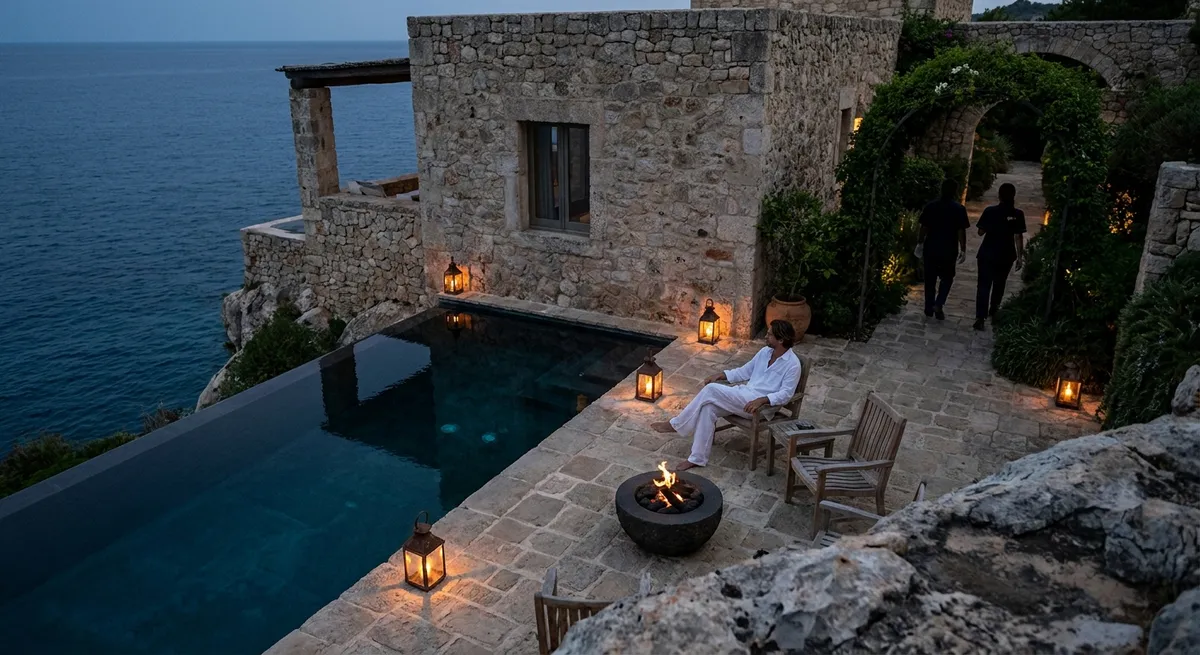
High-end Caribbean and Mediterranean properties, for example, are increasingly designed with “layered thresholds”—a subtle progression from public to semi-private to deeply private zones. The arrival area may be open and dramatic, but guest villas will often be tucked behind sight-shielding walls, planted berms, or carefully angled facades. Infinity pools are oriented to face open water, not neighboring terraces. Even restaurant seating plans may be iterated repeatedly to ensure that key tables maintain conversational privacy, regardless of occupancy.
This kind of spatial discretion has implications beyond comfort. It reduces the need for visible security, helps maintain a low profile even when high-profile guests are present, and preserves a sense of calm even at high occupancy. The most successful designs are those you barely register: you simply notice that you never feel watched, never have to negotiate for a quiet corner, and never experience the low-level fatigue of constant proximity to strangers.
The Invisible Service Grid: How Seamless Stays Are Actually Orchestrated
What appears as effortless spontaneity in a top-tier resort is, in reality, the result of an invisible and highly disciplined service grid. Back-of-house corridors, service elevators, and timing protocols are all engineered so that the work of hospitality happens almost entirely out of the guest’s line of sight.
Housekeeping teams often operate on micro-schedules that account not just for room type and length of stay, but also for observed patterns—when you typically leave for breakfast, how long you spend at the spa, when you book excursions. Mini-bar replenishment, poolside set-up, and in-villa dining collection are threaded through your day so they occur when you are naturally elsewhere. The objective is to avoid interruptions without forcing you into a rigid timetable.
At the very top level, guest experience managers or butlers act as conductors of this grid. Their real art is knowing when not to appear. They skim daily briefing notes, monitor preferences, and quietly resolve minor frictions before you notice them: a schedule shift due to weather, a restocking of a particular tea you favored at breakfast, a subtle recalibration of your transport timings based on airside traffic predictions. Technology plays a role, but the finest properties use it as a backstage tool, not a front-of-house spectacle. The most premium signal of all is an absence of visible coordination, even as everything clicks into place around you.
The Curated Periphery: Experiences Outside the Resort That Feel Entirely Your Own
For discerning travelers, a resort is not an island—even when it physically is. What increasingly distinguishes ultra-luxury properties is the way they curate the surrounding environment into a private extension of the guest experience.
Rather than offering generic excursions, the best resorts maintain deep, long-term relationships with local guides, artisans, captains, and conservationists. These are not arranged as mass-market tours, but as one-to-one introductions. A sunrise sail might be led by a skipper whose family has fished those waters for generations, with no other vessels in sight. A market visit may end not in a tourist cooking class, but in a quiet kitchen where a respected local chef cooks side by side with you, off-menu and off-script.
The distinction lies in how these experiences are framed and paced. There is often no brochure, no public sign-up sheet, no sense of being part of a rotating schedule. Instead, experiences are suggested only when they genuinely align with your interests as observed and expressed during your stay. This restraint preserves both authenticity and rarity. You leave with a sense that you have not just visited a destination, but been briefly admitted into its private vocabulary—without spectacle, without performance, and without the fatigue of over-curated “culture.”
Time as the Ultimate Amenity: How the Best Resorts Quietly Protect Your Hours
In the rarefied world of exclusive resorts, time is the most important currency. The most successful properties are meticulous in how they defend your hours from friction, waiting, and decision fatigue.
This begins with travel logistics. Transfers are often synchronized not just with flight times, but with real-time runway and immigration data when available, minimizing idle moments in transit. Check-in may be conducted in-suite or effectively dissolved altogether, with registration handled in advance. Menus, spa offerings, and activity options are presented in a way that narrows decisions rather than expanding them: instead of handing you a dense compendium, a good concierge will simply propose two to three precise options that already account for your schedule, preferences, and mood.
Internally, time protection extends to staffing ratios and service standards. Bars are staffed to ensure that cocktails arrive in minutes, not quarters of an hour. Spa treatment transitions are designed to feel unhurried while still running to an exacting timetable. Housekeeping calibrates turn-down service to your natural rhythms, so you never return to a room mid-service after dinner. At the pinnacle of this approach are properties that make you feel as though you have lived more fully in a brief stay than in a longer, more conventional vacation—not because you did more, but because there were fewer seams, fewer frictions, fewer compromises.
Conclusion
True exclusivity in resorts is no longer defined by chandeliers or amenity lists; it is measured in discretion, in the sophistication of what remains unseen, and in how closely the experience aligns with the contours of your life. From pre-arrival dossiers to invisible service grids, from architecture that choreographs privacy to a near-obsessive defense of your time, the finest properties operate with a level of nuance that is almost impossible to imitate.
For the luxury traveler, understanding these quiet mechanics is empowering. It allows you to read between the lines of marketing language, to recognize when a resort is truly operating at this rarefied level, and to choose environments where every moment feels both meticulously considered and entirely your own.
Sources
- Forbes Travel Guide: What Makes a Five-Star Hotel? - Outlines standards and criteria used to evaluate top-tier hotels and resorts worldwide
- American Hotel & Lodging Educational Institute - Provides insight into professional hotel and resort operations, including service and back-of-house standards
- Cornell Center for Hospitality Research - Research reports on hospitality management, guest experience, and service design at luxury properties
- Virtuoso: The Future of Luxury Travel - Industry perspective on evolving expectations and behaviors among high-end travelers
- Luxury Institute: Wealth and Luxury Consumer Research - Data and insights on affluent consumer preferences, including privacy, personalization, and experiential luxury
Key Takeaway
The most important thing to remember from this article is that this information can change how you think about Exclusive Resorts.