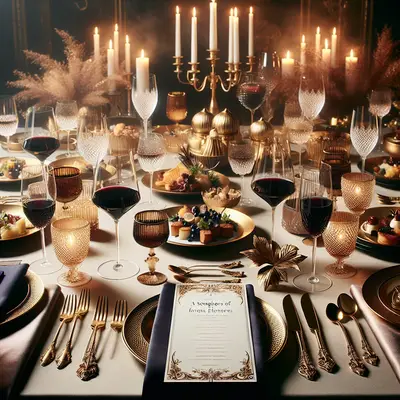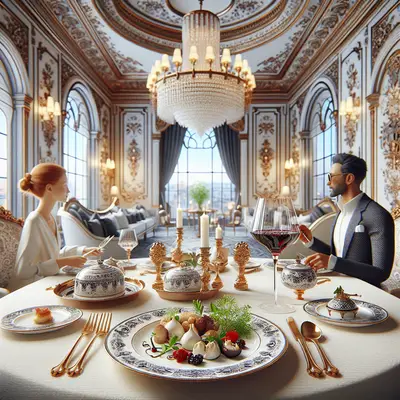
Fine dining for the serious traveler is no longer about collecting Michelin stars like passport stamps. For Jet Ready’s audience, the most memorable tables are those where the choreography is invisible, the decisions are anticipatory, and the experience lingers long after the last glass is cleared. This is dining as a quiet power move: understated, precise, deeply personal. Not a spectacle—an instrument.
What follows are five exclusive insights shaping how discerning travelers now approach the world’s most compelling dining rooms.
The True Luxury: When the Restaurant Edits You
At the highest level, exceptional restaurants no longer simply present a menu; they curate you into their narrative.
In leading rooms—from Paris to Tokyo to São Paulo—the most coveted experience often begins before you sit down. Your preferences, allergies, pacing, and even conversational style are quietly mapped from prior visits or through a discreet pre-arrival exchange with a guest relations liaison or concierge. The point is not to impress you with what they know, but to remove friction so thoroughly that you never notice it existed.
The most sophisticated travelers now treat fine dining as a long-term relationship rather than a single reservation. They return to the same restaurant in different seasons; they allow the chef to track their evolving tastes over time. In response, elite dining rooms are building nuanced guest profiles: how you prefer your water, whether you favor precision plating or more rustic servings, your comfort level with raw textures, your tolerance for experimental courses.
At this level, “chef’s choice” is no longer a set menu but a tailored progression that respects your appetite, your schedule, and even your evening plans afterward. Luxury isn’t abundance; it’s editing—every course that doesn’t appear because the restaurant already knows it’s not for you.
The New Table: Micro-Worlds Within the Dining Room
For luxury travelers, the most prized seat is often not the one with the best view of the room, but the one that feels like its own micro-world—secure, acoustically controlled, and subtly detached.
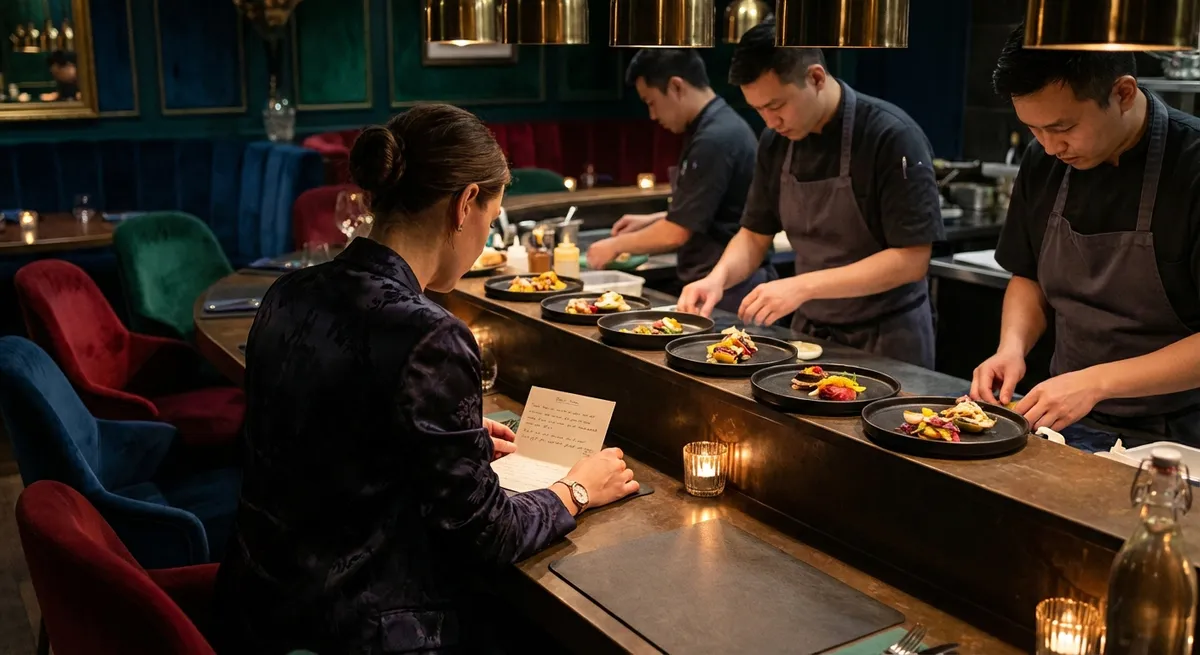
Modern fine dining has evolved beyond the ostentatious corner banquette. High-end properties are investing in architectural pockets: semi-enclosed alcoves, chef’s counters with hidden sightlines, private nooks that allow genuine conversation without the theatrics of a “private dining room.” The ideal spot grants visibility without exposure—where you can read the room without being in the room.
Acoustic engineering has become a silent marker of sophistication. The most elevated restaurants now treat sound the way they treat light: highly controlled, never harsh, and always in service of intimacy. For travelers arriving from long-haul flights and boardrooms, the ability to speak at a natural volume and still feel insulated from adjacent tables is not a “nice to have”—it’s non-negotiable.
Insiders leverage this shift by working with elite concierges or the restaurant’s guest relations team to quietly request specific zones: the two-top by the service station that never feels rushed; the chef’s counter seat with a discreet exit; the table that allows both privacy and quick egress to a waiting car. In a world saturated with visibility, the real luxury is the option to disappear—beautifully.
Timing as Strategy: Owning the Rhythm of the Meal
For the global traveler, when you dine can matter more than where. The most astute guests use timing as a tactical tool to transform a good restaurant into an unforgettable one.
Early services—often dismissed by conventional diners—can yield the most focused experiences. At 6:30 p.m. in a top-tier dining room, the sommelier has more time to explore off-menu bottles, the kitchen has maximal bandwidth for bespoke adjustments, and the pacing can be tuned sharply to your onward commitments: a flight, a deal closing, a performance.
Conversely, late seatings may offer a different kind of privilege: the ability to stretch the evening, to add an unlisted cheese course, to accept a final pour from an opened prestige bottle that will not survive another night. Depth of interaction, not duration alone, defines the luxury of time here.
For frequent travelers, jet lag becomes an advantage rather than an inconvenience. Booking a later seating in Europe, aligned with your home time zone, can result in uncommon clarity and presence at the table. Some of the most refined restaurants will now subtly adjust pacing to match your circadian reality—shortening intervals if they sense fatigue or building in longer pauses when you arrive with energy and curiosity.
Mastery of fine dining in this context is not surrendering to the restaurant’s timeline, but engaging in a quiet dialogue with it—signaling, through micro-choices, the rhythm you want your evening to follow.
The Off-List Conversation: Reading a Cellar Without Seeing It
For sophisticated travelers, the wine list is not a catalog; it’s a language. The real conversation, however, often begins with what you don’t see.
In the world’s most serious dining rooms, the printed list is only a partial story—a curated surface. Behind it lies the off-list cellar: small allocations, mature vintages, idiosyncratic producers kept in reserve for guests who understand and respect nuance. Access isn’t granted by bravado or by ordering the most expensive label, but by engaging the sommelier as an equal mind rather than a service provider.
The new high-level approach is not asking for “your best bottle,” but articulating intent: how you want to feel during and after the meal, the level of structure or lift you enjoy, your openness to lesser-known regions. Instead of specifying countries or grape varieties, seasoned travelers describe mood and texture—silken vs. angular, meditative vs. energetic, contemplative vs. social.
In response, sommeliers increasingly propose flights that tell a story—pairing a benchmark producer with an emerging name, or placing classical regions alongside high-altitude or coastal counterparts. This is less about status, more about narrative: your glass as a quiet journey across climates, philosophies, and decades.
True luxury here lies in trust: allowing the sommelier to guide you into their private mental map of the cellar, confident that the choices will align more closely with your palate than anything you could have selected by label alone.
Culinary Diplomacy: Fine Dining as a Soft-Landing in New Cities
For the modern jet traveler, certain restaurants now function as soft-landing zones—places where you can enter an unfamiliar city and, within three courses, feel entirely oriented.
High-caliber dining rooms are increasingly doubling as cultural interpreters. Their menus crystallize a place’s agricultural landscape, its seasonal rhythms, its anxieties and ambitions. Instead of generic “global” luxury, the most relevant fine dining experiences feel anchored: herbs foraged from nearby hillsides, ceramics made by local artisans, seafood landed hours before service by named boats.
For the well-traveled, this groundedness is not about rustic charm but about signal clarity. In one dinner, you can decode the city’s priorities: sustainability, heritage, innovation, restraint. You sense how a destination negotiates its past and future on the plate.
Elite travelers are now leveraging this deliberately. A first-night reservation at a thoughtful restaurant can function like a briefing: a controlled environment where you adjust to local time, taste the region’s vocabulary, and quietly gather context for meetings, site visits, or investments that follow. Sommeliers and chefs—often globally networked—become discreet conduits of information, offering perspective on everything from local producers to emergent neighborhoods.
In this way, fine dining evolves from indulgence into infrastructure. It’s not just a pleasure; it’s an elegant way of calibrating yourself to somewhere new with precision and grace.
Conclusion
For Jet Ready’s audience, fine dining has moved far beyond spectacle and excess. The most compelling experiences are calibrated more than curated—subtle, strategic, and deeply attuned to the individual seated at the table. The real luxury is not in what is seen, but in what is managed invisibly on your behalf: the edited menu, the acoustically perfected table, the unprinted wine, the rhythm of courses that respects both your body clock and your ambitions.
In a world saturated with options, the discerning traveler treats each serious restaurant not as a trophy, but as a finely tuned instrument—one more tool in a life designed around precision, privacy, and enduring pleasure.
Sources
- [Michelin Guide Official Website](https://guide.michelin.com) - Global reference for fine dining restaurants, chefs, and evolving culinary standards
- [The World’s 50 Best Restaurants](https://www.theworlds50best.com) - Annual ranking and profiles of leading restaurants worldwide, useful for understanding international trends
- [Harvard T.H. Chan School of Public Health – The Nutrition Source](https://www.hsph.harvard.edu/nutritionsource/healthy-eating-plate/) - Insight into balanced eating and how high-end kitchens increasingly integrate health-conscious choices
- [United States Department of Agriculture (USDA) – Seasonal Produce Guide](https://www.usda.gov/media/blog/2016/07/18/seasonal-produce-guide) - Authoritative overview of seasonality, relevant to how top restaurants structure menus
- [UNESCO Intangible Cultural Heritage – Gastronomic Meals](https://ich.unesco.org/en/intangible-heritage/gastronomy-and-foodways-00054) - Context on food as cultural expression, reflecting how fine dining interprets local identity
Key Takeaway
The most important thing to remember from this article is that this information can change how you think about Fine Dining.