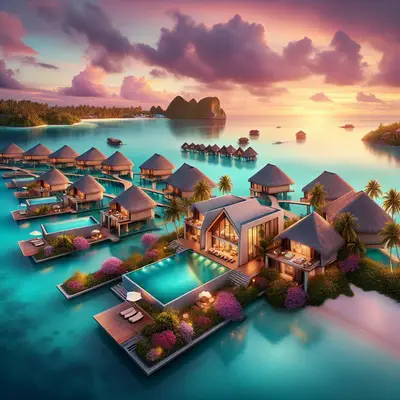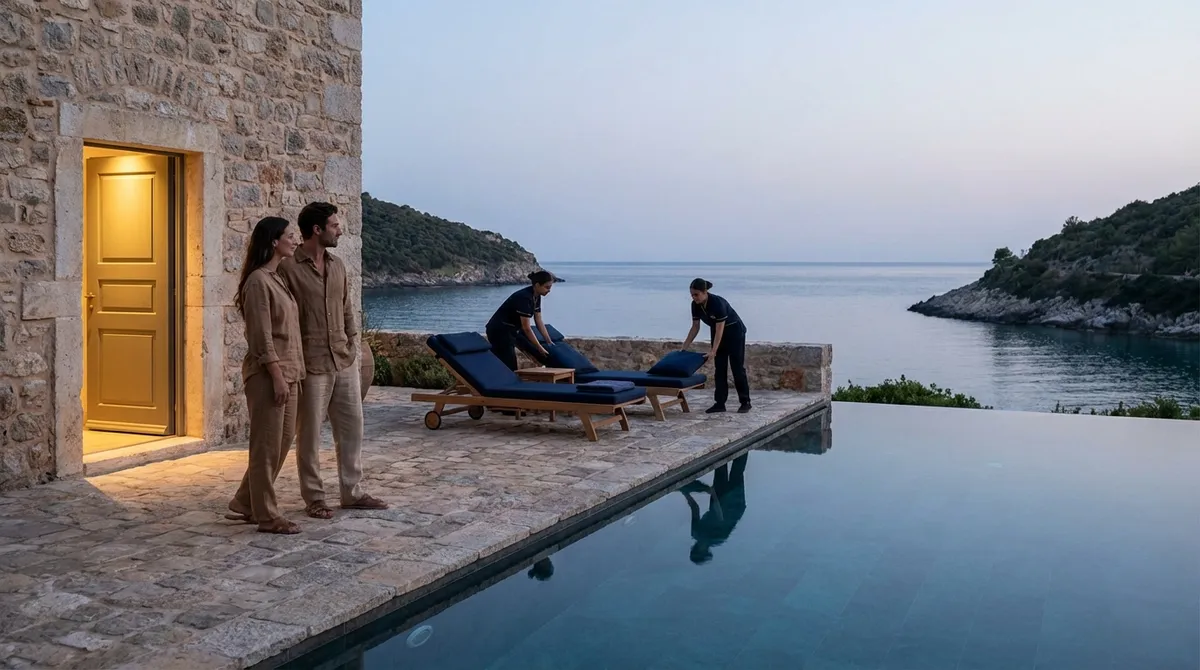
In the upper echelons of travel, exclusivity is no longer defined by marble lobbies and a recognisable logo. It is expressed in nuance: the way a resort anticipates your preferences before you arrive, the quiet precision of a team that knows when not to knock, the sense that the property itself has been curated for a very specific kind of guest—one who values privacy, time, and texture above display. At this level, “exclusive resort” stops being a marketing phrase and becomes a private lexicon, intelligible only to those who move within it.
The New Geography of Privacy
For the contemporary luxury traveler, location is no longer simply about vistas; it is about control over exposure. Choosing an exclusive resort today often begins with an assessment of how deftly it balances access with invisibility.
The most coveted properties are rarely the most photographed. They sit at the edges of established destinations: close enough to arrive by direct flight or private transfer, yet removed from the obvious circulation of tourism. Their entrances are often deliberately understated—no crowded porte-cochère, no check-in queue—just a quiet threshold where the public world falls away.
Privacy at this level is three-dimensional. It includes acoustic privacy (soundproofed suites, discreet service corridors), visual privacy (landscaping that shields pools and terraces from any outside gaze), and digital privacy (strict data protocols, minimal public posting by staff, and an unspoken understanding that not every moment is meant for social media). For discerning guests, the true luxury lies in being present without being observed.
Hospitality as Quiet Intelligence
What distinguishes an exclusive resort from a well-run five-star property is not the number of staff, but the calibration of their presence. The service ideal is no longer omnipresence; it is intelligent restraint.
The most refined teams operate from a meticulously tuned profile of each guest—culled not only from pre-arrival questionnaires but from an ability to read patterns. Preferred pillows, morning coffee rituals, the exact level of natural light you tend to keep in your suite: these are noted and remembered, but never announced. The art lies in making a guest feel effortlessly understood, not studied.
At the best properties, “no” is rarely spoken. Constraints are managed through alternatives that appear as opportunities, never limitations. A fully booked restaurant becomes a private tasting on a lantern-lit jetty; a closed spa becomes an in-suite treatment executed with the same choreography and product range. This is hospitality that moves like a well-composed score—each interaction carefully timed, each silence intentional.
Time as the Ultimate Amenity
In the rarefied world of exclusive resorts, the most valuable luxury is neither square footage nor thread count; it is time that has been dignified and delicately expanded. Guests at this level are typically time-poor and decision-fatigued. The resort’s role is to reduce friction to the point where hours feel longer and choices feel lighter.
It begins before arrival, with a pre-structured yet flexible framework: transfers sequenced to avoid waiting, unpacking and pressing completed silently, key dietary or wellness requirements already in motion. On property, the choreography continues—reservations that do not require reminding, a spa able to absorb last-minute changes without visible disruption, and a team that shields the guest from the administrative noise of travel.
The most sophisticated properties also understand the psychology of time. Mornings are kept quiet and low-touch; mid-day activity is designed to feel optional rather than scheduled; evenings are crafted as a series of invitations rather than obligations. The result is a stay in which the guest feels not simply rested, but regrounded—as if their internal clock has been recalibrated to a more humane rhythm.
Sourcing Rarity, Not Opulence
The era of ostentation is waning; the new marker of exclusivity is informed subtlety. Guests at the top tier increasingly look past visible extravagance towards the provenance, craftsmanship, and intentionality of what surrounds them.
This shift expresses itself in the smallest details. The minibar features a vintner whose bottles never reach retail shelves, or a chocolate maker whose production is measured in kilos, not tons. The resort’s linens may carry no visible logo, but are woven by a heritage atelier that typically serves only couturiers or historic hotels. Even the spa’s scent profile may be a quietly commissioned blend, unavailable for purchase and recognizable only to those who have stayed.
Curation replaces brand saturation. Rather than a roll call of globally recognised names, the property tells a story through artisans, growers, and makers who are discovered, supported, and thoughtfully integrated. For the guest, the pleasure lies not in being impressed, but in being introduced—to a rarer coffee varietal, an obscure ceramicist, a local perfumer whose work might otherwise remain undiscovered. Exclusivity becomes less about cost and more about access to things that are, by nature, produced in very small quantities.
Designing Experiences That Do Not Need an Audience
In a world calibrated for visibility, the most exclusive resorts are quietly reorienting themselves around experiences that feel complete even if they are never shared. This does not mean ignoring social media; it means designing stays that prioritize interior memory over the external image.
Instead of the standard sunset cocktail on a crowded deck, a guest might find a single table set at the furthest edge of the property, where the experience is built for two rather than for a lens. A cooking class becomes a conversation with the chef over open coals, followed by a recipe packet and a private pantry tour rather than a photo wall. A guided hike might conclude not with a staged viewpoint, but with a silent tea ceremony overlooking an unmarked valley.
For the luxury traveler, this approach offers a different form of status: the knowledge of having lived something that cannot be fully translated to an audience. The story becomes more precious because it resists documentation. In this space, exclusivity is defined not by velvet ropes, but by the depth of an experience that feels quietly, almost selfishly, one’s own.
Conclusion
The landscape of exclusive resorts is evolving away from spectacle and towards discernment. For those attuned to it, the new signals of true exclusivity are understated: the sense of being protected without feeling handled, the subtle luxury of regained time, the pleasure of rarities discovered rather than displayed, and experiences that remain luminous even in the privacy of one’s own memory.
For the sophisticated traveler, choosing an exclusive resort is no longer about simply reserving a suite; it is about selecting a philosophy of how one’s time, privacy, and attention will be treated. In that choice lies the difference between a beautiful stay and an experience that quietly redefines what travel can be.
Sources
- [Skift: The New Definition of Luxury Travel](https://skift.com/2019/08/19/the-new-definition-of-luxury-travel/) - Industry analysis on how luxury travel expectations are shifting toward personalization and privacy
- [Forbes: Why Privacy Is the New Luxury in Travel](https://www.forbes.com/sites/duncanmadden/2022/10/30/privacy-is-the-new-luxury-in-travel/) - Explores the growing importance of discretion and seclusion in high-end hospitality
- [Virtuoso: 2024 Luxe Report](https://www.virtuoso.com/travel/articles/virtuoso-2024-luxe-report) - Insights from a leading luxury travel network on emerging elite traveler preferences
- [Condé Nast Traveler: How High-End Hotels Are Redefining Luxury](https://www.cntraveler.com/story/how-high-end-hotels-are-redefining-luxury) - Overview of how premium properties are evolving beyond traditional markers of opulence
- [Harvard Business Review: The Psychology Behind Experience Design](https://hbr.org/2017/09/the-psychology-behind-experience-design) - Examines how thoughtful design can shape perception, time, and memory in service environments
Key Takeaway
The most important thing to remember from this article is that this information can change how you think about Exclusive Resorts.