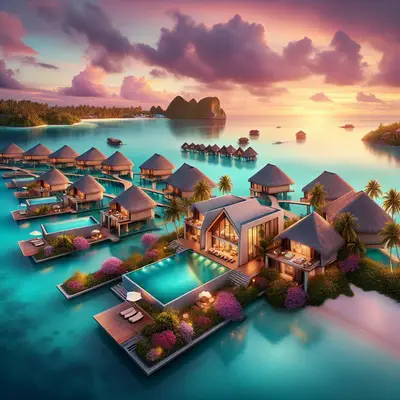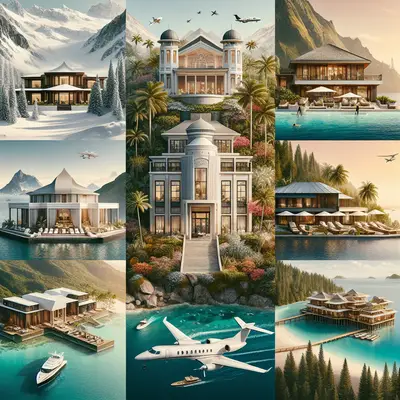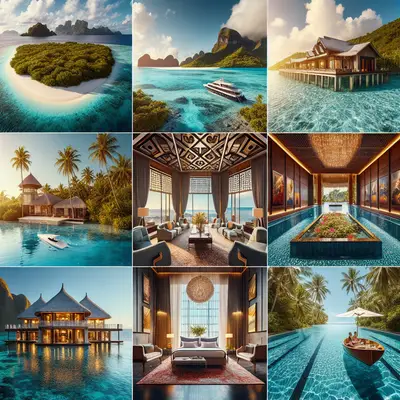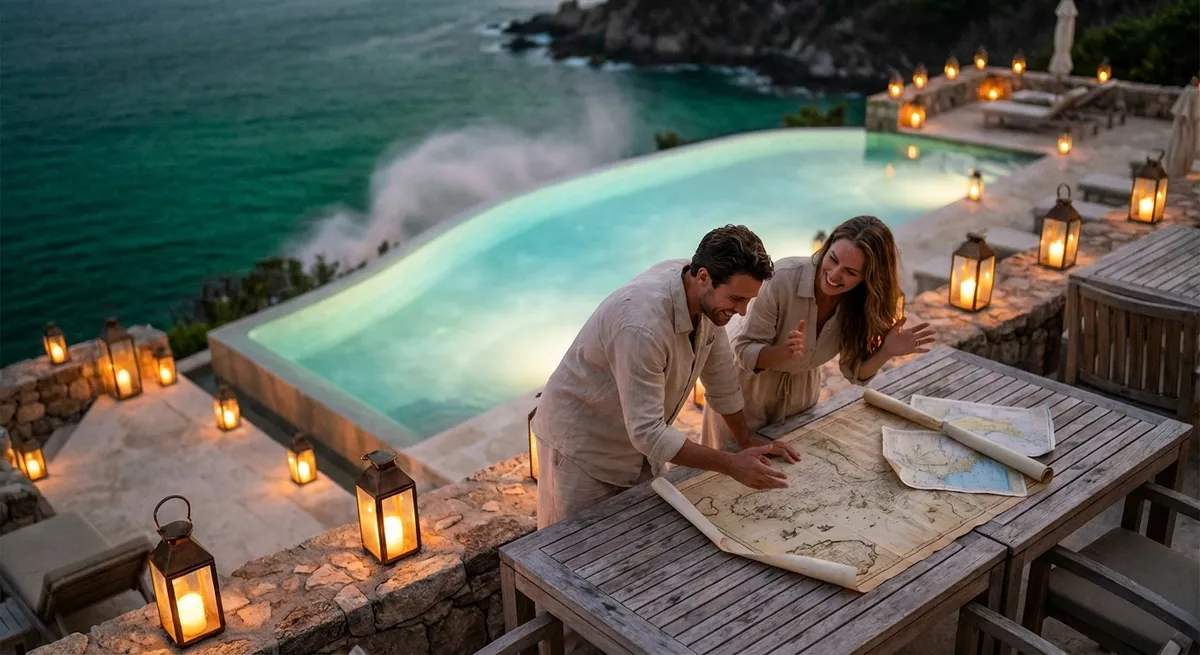
There is a tier of travel that never appears on flash-sale newsletters or airport billboards. It exists in the quiet corners of the world’s most coveted coastlines, in unlisted penthouses above familiar skylines, and in islands that appear only as small unnamed shapes on aviation maps. This is the realm of truly exclusive resorts—properties designed not for spectacle, but for precision: of service, of privacy, of experience. For the traveler who measures value not in square footage or brand logos, but in orchestration, subtle access, and the feeling of inhabiting a world slightly removed from the ordinary, these retreats offer an entirely different grammar of luxury.
The Architecture of Privacy: Design That Disappears in Plain Sight
At the highest level of hospitality, privacy is not a feature; it is the foundation. The most discreet resorts are conceived from the ground up to control visibility—of guests, of staff, of the property itself. Villas are arranged on topography that naturally interrupts sightlines, so that neighbors become a theoretical concept rather than a visual presence. Landscaping is choreographed as carefully as interiors, using native flora not simply for beauty but for acoustic dampening and visual screening.
Inside, the spatial cues are deliberate. Arrival routes often bypass public lobbies entirely, guiding guests through private courtyards or hidden entrances. Corridors are minimized; instead, spaces flow as if they were part of a private residence. Service access is fully decoupled from guest circulation, allowing an almost uncanny sense of solitude even at full occupancy.
For the seasoned traveler, the true luxury is this sense of being “off the grid” without sacrificing precision. You never see the mechanisms, only the result: an infinity pool that seems to merge with the horizon, a terrace that feels like a natural extension of the cliff, a bedroom where the strongest sound at night is the rustle of trees or a distant tide. The resort does not impose its presence; it recedes, so that the destination itself becomes the protagonist.
Invisible Service: The Fine Art of Anticipated Needs
In exclusive resorts, service evolves from responsive to predictive. The staff’s goal is not to fulfill requests, but to pre-empt them so effectively that many never need to be voiced. This requires a level of training and guest intelligence that goes far beyond standard five-star protocols.
Subtle observation begins from the moment of reservation, not check-in. Preferences gleaned from previous stays—pillow firmness, preferred pacing of meals, whether you like lights dimmed upon returning at night—are quietly layered onto your profile. During your stay, micro-details are noted: at what time you naturally drift to breakfast, how you take your coffee when not asked, which side of the bed you sleep on, how often you change pool loungers. These are not logged as curiosities, but as data points to refine the choreography of each day.
The result is an almost cinematic flow to your time on property. Fresh towels appear at the precise moment your poolside novel reaches its final chapter. A pair of reading glasses—similar in style to the ones you left in your suite—materialize at dinner when you squint at a wine list. Golf carts or boats arrive a minute before you stand up to leave, as if synchronized to an internal clock only the resort can see.
For the luxury traveler, the refinement lies in what does not happen: you are never asked to repeat a preference, never presented with a decision when you clearly prefer to drift, never interrupted at inopportune moments. Service is constant yet rarely visible, like the operating system of a flawlessly designed device.
The New Currency: Access, Not Amenities
At the upper echelon of resorts, the distinction is no longer between “standard” and “suite,” but between what is accessible to anyone with a credit card and what is opened only through relationships, reputation, and discretion. Amenities—oversized pools, lavish spas, marquee restaurants—are now the baseline. What defines true exclusivity is access.
This access can manifest in many forms. A resort may have a private dock reserved not just for arrivals, but for off-menu excursions: early-morning transfers to uninhabited keys before local boat traffic begins, or after-dark departures to bioluminescent bays with a marine biologist in attendance. In urban settings, rooftop pools or gardens may be closed to general guests during certain hours, turning into private lounges for those within a specific circle.
Behind the scenes, concierges operate more like cultural attachés than booking agents. They can unlock museum wings before opening hours, arrange unscheduled vineyard tastings with owners who rarely host the public, or secure last-minute tables at restaurants where the reservations “do not exist” on any digital platform. The value is not in the conspicuousness of these experiences, but in their precision—access curated to your tastes rather than your status.
For the frequent traveler, this becomes the new currency: not what is on the brochure, but what can be summoned beyond it. The most exclusive resorts understand that their role is not only to provide sanctuary, but to rewrite the rules of engagement with the destination itself.
Five Quiet Insights Seasoned Luxury Travelers Recognize
Within this elevated ecosystem, there are certain nuances that experienced travelers quickly notice—and quietly prize.
Occupancy Is a Design Variable, Not a Number
In exclusive resorts, “full” rarely feels full. Occupancy is managed in relation to public space, staffing levels, and seasonality. High-caliber properties intentionally cap bookings below physical capacity during peak months to preserve the sensation of spaciousness and immediacy of service. If restaurants, pools, and beaches never feel crowded, it is not luck; it is controlled scarcity.
Transfer Experiences Reveal the Resort’s True Standards
The manner in which you move to and from the resort often exposes more about its ethos than any suite. Private car fleets, seaplane lounges, marine transfers, even immigration assistance—these transitional touchpoints are meticulously curated by the best properties. Chilled towels scented with local botanicals, silent Wi-Fi for last-minute calls, unobtrusive security checks: the journey is treated as the prologue, not an afterthought.
Cuisine Is a Lens on Local Integrity, Not Just Indulgence
At the highest level, resort dining becomes a study in terroir and traceability. Menus shift with micro-seasons; fishermen and farmers are referenced by name, not to impress, but to underline transparency. Fine dining here is not solely about imported caviar and champagne—it is about how the property interprets its geography on the plate, from fermentation programs to heritage grains to revived regional techniques. The traveler who has dined everywhere begins to look less for theatrics and more for sincerity.
Wellness Moves Beyond the Spa Menu
Massage lists and facials are table stakes. Exclusive resorts are now building integrated wellness ecosystems: resident practitioners instead of rotating consultants, diagnostic-based treatments, sleep-optimized suites with circadian lighting, and nutrition programs that coordinate quietly with the kitchen. For the guest arriving from relentless global movement, this feels less like pampering and more like strategic recovery.
True Exclusivity Is Measured in Frictionlessness, Not Flash
The most valuable luxury is often the absence of friction. Ultra-fast, invisible check-in completed en route. Bills that never require scrutiny because every preference and inclusion has been correctly anticipated. Security that is omnipresent yet never theatrical. Technology that works so seamlessly it disappears. For the well-traveled guest, the memory that lingers is not the logo on the bathrobe, but how effortlessly life unfolded while on property.
Time as the Ultimate Luxury: Stays That Expand the Day
Beneath the aesthetics and the access, the deepest promise of an exclusive resort is temporal: the feeling that time stretches while you are there. This is not an illusion created by empty schedules, but by careful orchestration of pace.
Activities are sequenced to avoid queues and bottlenecks; a late-morning excursion is suggested not just because “the water is nice,” but because that is when the beach will be empty and the sun perfectly angled for soft light. Housekeeping operates as if on telepathy, reading the rhythms of your day so no moment feels disrupted. Even meal pacing is calibrated—faster service for jet-lagged arrivals, slower for sunset dinners when there is nowhere else you wish to be.
The technology layer supports, rather than fragments, attention. Discreet in-suite systems allow preferences to be adjusted in a single gesture, not through a tangle of apps. Communications with staff can happen through quiet, secure channels, avoiding constant calls or interruptions. You are freed from micro-decisions and small frictions, and what remains is a kind of expanded present—hours that feel denser, richer, better used.
For the global traveler accustomed to connecting flights, overlapping calendars, and always-on devices, that expansion of time is perhaps the rarest luxury of all. Not more things, but more being within each moment.
Conclusion
Exclusive resorts at the top of the global hierarchy are no longer fixated on gilded surfaces or ostentatious display. Their true craft lies in engineering privacy that feels organic, designing service that feels telepathic, and creating access that feels both rare and deeply personal. For those who move constantly across borders and time zones, these properties function as carefully calibrated sanctuaries—places where the world does not exactly stop, but rearranges itself into a more elegant order.
In this realm, luxury is not something you are shown; it is something you inhabit. It is the silence between footsteps in a stone courtyard at dawn, the certainty that what you need has already been considered, the knowledge that behind every effortless moment stands an intricate architecture of care. For the traveler who recognizes these subtleties, exclusive resorts become less a destination and more a finely tuned state of being.
Sources
- [World Tourism Organization (UNWTO) – Luxury Tourism: Current Trends, Market Opportunities and Emerging Segments](https://www.e-unwto.org/doi/book/10.18111/9789284416875) - An in-depth look at the evolution of luxury travel and emerging patterns in high-end tourism.
- [McKinsey & Company – The New Dynamics of Luxury: A Global Perspective](https://www.mckinsey.com/industries/retail/our-insights/the-new-dynamics-of-luxury) - Analysis of shifting expectations among affluent travelers and the move toward experiential, discreet luxury.
- [Forbes – How Ultra-Luxury Hotels Are Redefining Privacy And Personalization](https://www.forbes.com/sites/forbestravelguide/2019/11/25/how-ultra-luxury-hotels-are-redefining-privacy-and-personalization/) - Explores the ways high-end properties are innovating around privacy, service, and guest profiling.
- [Cornell University School of Hotel Administration – The Cornell Hospitality Reports](https://sha.cornell.edu/faculty-research/research/centers-institutes/chr/research/hospitality-reports/) - Research-based insights into hospitality operations, service design, and guest experience at the luxury level.
- [Virtuoso – Luxury Travel Consumer Insights](https://www.virtuoso.com/en/travel-advisors/trends-and-insights) - Industry data and traveler behavior trends in the high-net-worth segment, including preferences for exclusivity and bespoke experiences.
Key Takeaway
The most important thing to remember from this article is that this information can change how you think about Exclusive Resorts.