The most compelling luxury today is not a logo, a lobby, or a well-lit arrival moment. It is calibrated access: to time, to space, to people, and to experiences that feel both exceptionally crafted and deliberately unshared. Exclusive resorts operate as discreet ecosystems built around this principle, shaping travel not as spectacle, but as a private choreography. For travelers who have already seen the world’s headlines in person—Amalfi, Maldives, Aspen—the true question is no longer where to go, but how to inhabit a destination in a way that feels genuinely rare.
Below, five refined insights reveal how the world’s most exclusive resorts quietly redesign the very idea of a stay, offering a framework for travelers who demand more than a beautiful room with a view.
1. Access as Design: Why the Best Resorts Are Built Around Your Calendar
At the highest tier of travel, time has become the rarest currency. Exclusive resorts understand this and design around it with near-architectural precision. Flight schedules influence check‑in norms; private transfers are coordinated to minimize what insiders call “transition drag”—the dead time between airport, arrival, and immediate comfort.
The most sophisticated properties now reverse the conventional booking logic: instead of asking guests to adapt to fixed check‑in windows or rigid activity slots, the resort infrastructure bends to the guest’s timetable. Spa programs, dining, and on‑property experiences are stacked and sequenced to eliminate friction. For frequent travelers used to corporate itineraries and tightly packed calendars, the resulting sensation is almost disorienting: the day feels expansive, yet nothing is wasted.
Look for resorts that offer pre-arrival lifestyle profiling—time zone adjustment schedules, nutrition preferences, even preferred pacing of the day. This level of planning, often handled by a dedicated experience director, turns a three-night stay into something with the restorative power of a far longer holiday. The luxury is not only what you do; it is how little time you lose between wanting something and having it, without ever feeling rushed.
2. Invisible Service: The Art of Anticipation Without Interruption
Truly exclusive resorts are moving away from visible opulence toward a more nuanced metric: how invisible the service can be while still feeling omnipresent. The objective is not to impress, but to pre-empt. Towels dry before you notice they are damp. Preferred wines appear without a list being shown. Housekeeping seems never to have entered, yet everything is quietly reset.
This is orchestrated through a combination of intensive staff training and increasingly, subtle technology. Preference tracking systems record micro‑details over repeat visits—whether you prefer your room slightly cool at night, which pillow density you favor, or whether you take coffee before or after a morning swim. The most refined resorts do this without ever making the guest feel “data‑mined”; the interaction remains human, the experience surprisingly warm, if understated.
For luxury travelers, this raises a key question to ask before booking: How does the property learn its guests? The answer will tell you more about your future stay than any photography of suites or pool decks. In the most carefully run properties, service is felt more in the absence of inconvenience than in overt performances of attentiveness.
3. The New Geography of Privacy: Space, Sound, and Sightlines
Privacy has evolved far beyond the concept of a secluded villa with a gate. The contemporary elite traveler is acutely attuned to visual and acoustic privacy—what you can hear, what you can see, and who can see you. Exclusive resorts answer this by treating land and architecture as instruments, not stage sets.
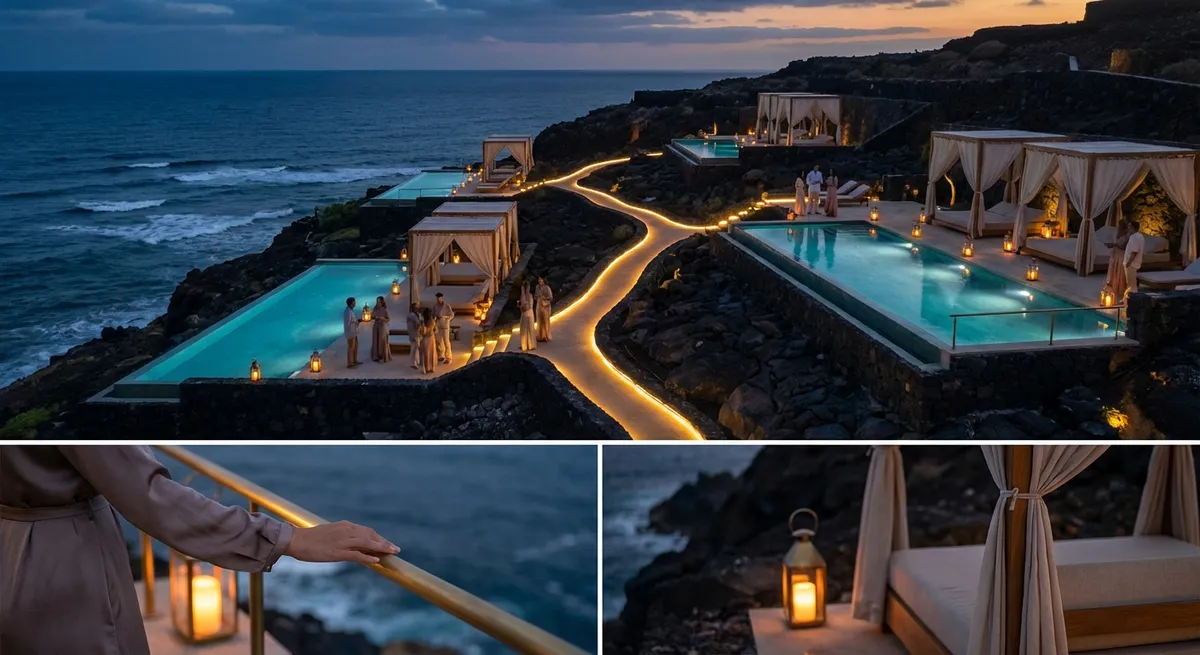
Landscaping is deployed as a visual filter as much as an aesthetic one: tree lines, elevation changes, and water features are used to separate experiences without obvious barriers. Suite layouts are designed to obscure neighboring terraces from view. Pathways curve subtly to reduce chance encounters. Sound is managed as carefully as sightlines; dining areas and lounges are configured to absorb conversation rather than broadcast it.
For those planning a stay, it is worth requesting more than a “quiet room.” Ask how far your villa or suite is from the main social hubs, whether there are private approaches to certain spaces, or if there are alternative timings for popular amenities, from pools to fitness studios. At this level, true luxury is the assurance that your experience can be either connected or entirely discreet—on your terms.
4. Curated Locality: Destinations as Private Frameworks, Not Tourist Scripts
The traditional model of resort excursions—pre‑packaged tours, shared boats, scripted cultural experiences—is increasingly incompatible with the expectations of well-traveled guests. Today’s most exclusive resorts curate the local environment not as a checklist of attractions, but as a series of carefully edited encounters reserved for a very small audience.
Rather than offering “the best restaurant in town,” a resort might arrange a private service in a historic chapel rarely open to visitors, or secure after‑hours access to a gallery curated personally by its director. Beach days become anchored by secluded coves reachable only at a specific tide, escorted by guides who are more akin to cultural translators than activity staff.
This approach requires long‑term relationships with the local community and a deep sensitivity to impact—ethical, environmental, and cultural. Discerning travelers increasingly assess properties on these criteria: not simply whether an experience is exclusive, but whether it is respectfully so. The most sophisticated itineraries now combine profound privacy with visible contribution to the places that make that privacy possible.
5. Wellness as Precision, Not Performance
Wellness at an exclusive resort is no longer a spa appointment appended to an otherwise indulgent trip. It has become a central organizing principle, deeply personal and increasingly data‑driven. Travelers arrive not only to rest, but to recalibrate—sleep, metabolism, focus, even emotional bandwidth.
At the top end, properties collaborate with clinical partners and medical professionals to offer advanced assessments: sleep tracking, metabolic panels, guided breathwork, and structured recovery programs for frequent flyers or high-performers. Yet the experience remains enveloped in calm sophistication rather than clinical austerity. Linen, light, scent, and silence are curated as rigorously as the diagnostic tools.
For luxury travelers, the key is to look for integration rather than spectacle. A true wellness-forward resort does not isolate its programs in a separate wing; instead, it embeds them throughout the stay—thoughtful mini-bars, lighting that follows circadian rhythms, menus designed to support specific goals, and staff who understand the difference between a guest seeking transformation and one seeking deep rest. The most valuable outcome is subtle: you return not only relaxed, but operating with a sharper, quieter clarity.
Conclusion
Exclusive resorts today are less about grandeur and more about intelligent discretion—the ability to orchestrate time, service, privacy, locality, and wellness into a seamless, deeply personal stay. For the sophisticated traveler, the decision is no longer between one postcard-perfect destination and another. It is a question of alignment: which property’s quiet logic best matches the way you prefer to live, think, and move through the world.
Choose well, and the resort does more than host you. It becomes a private operating system for your best days away—graceful, finely tuned, and almost entirely unseen.
Sources
- [Virtuoso – Luxury Travel Trends](https://www.virtuoso.com/travel/articles/luxury-travel-trends) – Industry insights on evolving expectations among high‑net‑worth travelers
- [Forbes – How Luxury Hotels Are Redefining Service](https://www.forbes.com/sites/forbesbusinesscouncil/2022/06/28/how-luxury-hotels-are-redefining-service-post-pandemic/) – Discussion of personalization, invisible service, and guest expectations
- [American Hotel & Lodging Association – Consumer Trends Report](https://www.ahla.com/research-insights) – Data on traveler preferences, including wellness and experiential travel priorities
- [Global Wellness Institute – Wellness Tourism Research](https://globalwellnessinstitute.org/industry-research/wellness-tourism/) – Research on the rise of integrated wellness offerings in high‑end hospitality
- [Condé Nast Traveler – Privacy and Seclusion in Luxury Travel](https://www.cntraveler.com/story/the-rise-of-seclusion-luxurys-new-frontier) – Exploration of privacy, seclusion, and exclusive experiences in modern luxury travel
Key Takeaway
The most important thing to remember from this article is that this information can change how you think about Exclusive Resorts.