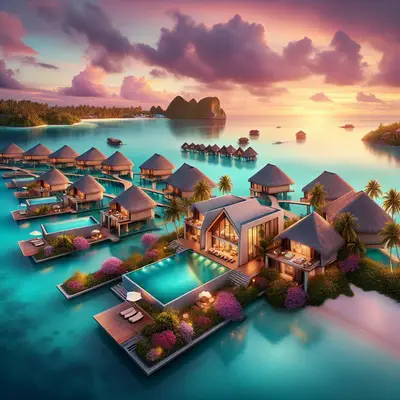
For the traveler who has already seen the world, the question is no longer where to go, but how to inhabit a place. Exclusive resorts—those quiet, meticulously curated enclaves that rarely advertise and almost never discount—answer that question with nuance rather than noise. They are less about spectacle and more about orchestration: of privacy, of time, of service, of atmosphere.
This is the realm where the most discerning guests trade overt opulence for rarefied ease, where every detail is designed not to impress, but to disappear into the seamlessness of your stay. Within this less visible tier of hospitality, five particular insights define how true exclusivity is being understood and experienced today.
The Art of Invisible Service
At the most discreet resorts, service has shifted from performative luxury to a finely tuned, almost invisible choreography. The staff-to-guest ratio may be high, but the presence of staff rarely feels intrusive. Instead, service appears precisely when needed, then recedes before you have to ask it to.
In these properties, the best butlers and concierges are trained not simply in efficiency, but in perception: recognizing a guest’s preferred morning routine after a single day, adjusting room lighting to mirror your natural sleep cycle, or ensuring your favored vintage is decanted at the exact moment you tend to return from dinner. Requests are remembered across stays and sometimes even across sister properties, building a subtle continuity that feels less like a booking and more like a private membership.
True exclusivity lies not in being constantly attended to, but in the feeling that everything has been taken care of before it even crosses your mind. Luggage disappears and reappears without fanfare. Airport formalities are dissolved into quiet, expedited passages. The most premium resorts understand that luxury now is measured less in visible indulgence and more in the absence of friction.
Architecture as Privacy, Not Spectacle
Earlier eras of luxury hospitality often equated prestige with scale—soaring lobbies, grand atriums, expansive boulevards of marble. The contemporary exclusive resort has inverted that equation, favoring architecture that prioritizes privacy, intimacy, and quiet spatial intelligence over sheer drama.
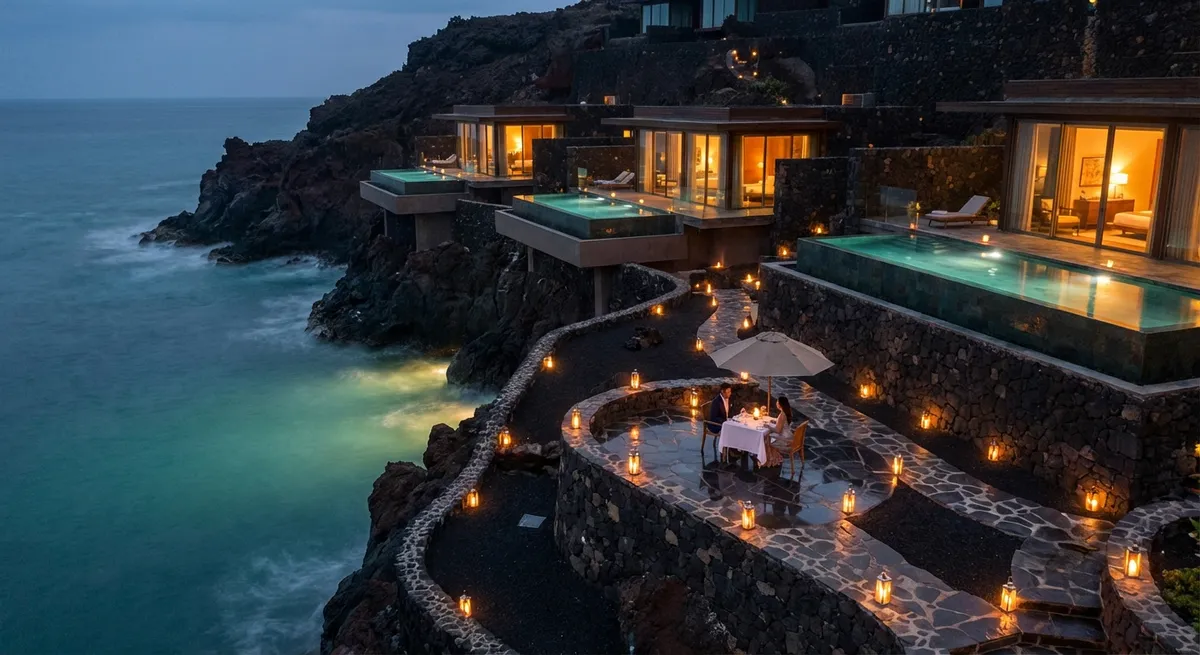
Villas are often oriented with forensic care: sightlines angled away from neighboring terraces, pools half-hidden by native landscaping, and paths that subtly avoid crossing guests’ fields of view. The best properties work with local topography rather than against it—tucking suites into cliff faces, floating pavilions above rice paddies, or threading them through old-growth forests in ways that feel organic rather than imposed.
Interior spaces are increasingly designed with “silent comfort” in mind: acoustically treated walls, whisper-quiet climate systems, natural materials that soften footsteps and conversation. Public areas are segmented into smaller, more intimate pockets—reading salons, shaded verandas, secluded fire pits—creating an environment where you are never forced into the crowd unless you choose it.
The architecture of the truly exclusive resort is a study in restraint. It knows you could have chosen spectacle anywhere. What you wanted instead was seclusion with civility.
Curated Stillness: Programming for the Unhurried
Luxury travelers today are less interested in stacking itineraries with activities and more invested in reclaiming a sense of temporal spaciousness. The most refined resorts have started to design their programming accordingly, favoring depth over density.
Rather than offering dozens of generic excursions, they may focus on a handful of quietly exceptional experiences: a sunrise sail with a marine biologist instead of a standard boat tour; a private atelier visit with a local artisan in place of a commercial “craft village”; a guided stargazing evening with an astronomer rather than a mass-market night cruise. The emphasis is not on how much you can do, but on how fully you can inhabit what you choose.
Even wellness programming has evolved beyond predictable spa menus. You might find circadian-aligned treatment schedules, sommelier-curated herbal infusions to accompany your sleep ritual, or bespoke movement sessions that account for jet lag, prior injuries, and your preferred energy curve across the day. These experiences are not loud about their benefits, but you feel them in how you sleep, how you focus, how you remember the trip.
Exclusivity, in this sense, is not a matter of access to more, but of access to carefully filtered less—fewer, better, and more thoughtfully orchestrated moments that allow your stay to breathe.
The Discreet Intelligence of Personalization
In an age of abundant data, the most sophisticated resorts are rethinking personalization as an act of discretion rather than accumulation. The goal is not to know everything about you, but to understand what matters without ever crossing the line into performance or intrusion.
At this level, pre-arrival communication is quietly strategic: a few precise questions rather than sprawling preference forms. Your in-room bar might be stocked not with a generic “premium selection,” but with labels that reflect your established tastes—perhaps a non-alcoholic aperitif if your profile suggests a wellness-oriented stay, or a rare single malt from a distillery you once mentioned in passing.
Technology, when deployed well, operates in the background. A resort app that allows you to book a private yoga session or adjust villa settings is useful; more impressive is when those preferences are saved and re-applied to your next visit without your needing to repeat yourself. The real signature of elite personalization is continuity: you arrive and find the same pillow composition that resolved your neck pain last time, the same preferred table on the terrace, the same understated floral notes you favored in your amenities.
For the truly affluent traveler, personalization no longer means being constantly asked what you want. It means moving through your stay with the quiet assurance that what matters has already been understood.
Stewardship as a Marker of Serious Luxury
Perhaps the most defining shift in today’s most exclusive resorts is the full integration of environmental and cultural stewardship into their core identity. It is no longer convincing to simply “offset” a stay with a few symbolic gestures; high-net-worth travelers have become substantially more informed, and they are looking for properties whose commitments are measurable, long-term, and structurally embedded.
The most serious resorts are moving beyond surface-level sustainability towards sophisticated, science-informed practices: regenerative landscaping that restores native habitats, closed-loop water systems, marine conservation partnerships that protect the very reefs their guests come to admire, or carefully limited room counts to reduce ecological pressure. Transparency has become part of the luxury: detailed reporting on energy use, material sourcing, and impact initiatives is increasingly expected.
Cultural stewardship is equally critical. Genuine exclusivity respects its context; it does not extract from it. This can take the form of long-standing relationships with local communities, fair-wage employment practices, apprenticeships that train residents in hospitality management, and design decisions that prioritize local craftsmanship over imported decor. What differentiates the top tier is not how elegantly a resort can insulate you from its surroundings, but how thoughtfully it can connect you to them without commodifying the experience.
For the discerning traveler, knowing that a property is quietly improving the place it occupies is no longer a pleasant add-on—it is a prerequisite for feeling truly at ease.
Conclusion
The world of exclusive resorts has grown more sophisticated, and with it, so have the expectations of those who inhabit it. True luxury has moved away from ostentation and towards orchestration: of invisible service, protective architecture, curated stillness, discreet personalization, and authentic stewardship.
For the traveler who values refinement over display, this evolution offers something particularly compelling—a way to travel that feels less like consumption and more like alignment: with your own rhythms, with the character of a place, and with the quiet assurance that everything has been considered, and almost nothing needs to be said.
Sources
- [World Travel & Tourism Council – Luxury Travel Post-Pandemic](https://wttc.org/news-article/luxury-travel-after-covid-19) - Industry insights into evolving expectations of high-end travelers
- [Virtuoso – 2024 Luxe Report](https://www.virtuoso.com/travel/articles/2024-virtuoso-luxe-report) - Analysis of trends in exclusive, high-net-worth travel preferences
- [Condé Nast Traveler – Future of Sustainable Luxury Travel](https://www.cntraveler.com/story/the-future-of-sustainable-luxury-travel) - Exploration of how top-tier properties integrate sustainability
- [Forbes – The Rise of Ultra-Luxury Villas and Resorts](https://www.forbes.com/sites/forbesbusinesscouncil/2023/09/28/the-rise-of-ultra-luxury-villas-and-travel-experiences/) - Discussion of privacy, personalization, and villa-focused exclusivity
- [Harvard Business Review – The Evolution of Customer Experience in Luxury](https://hbr.org/2020/01/the-future-of-luxury-is-experiential) - Context for how experiential, discreet service defines modern luxury
Key Takeaway
The most important thing to remember from this article is that this information can change how you think about Exclusive Resorts.