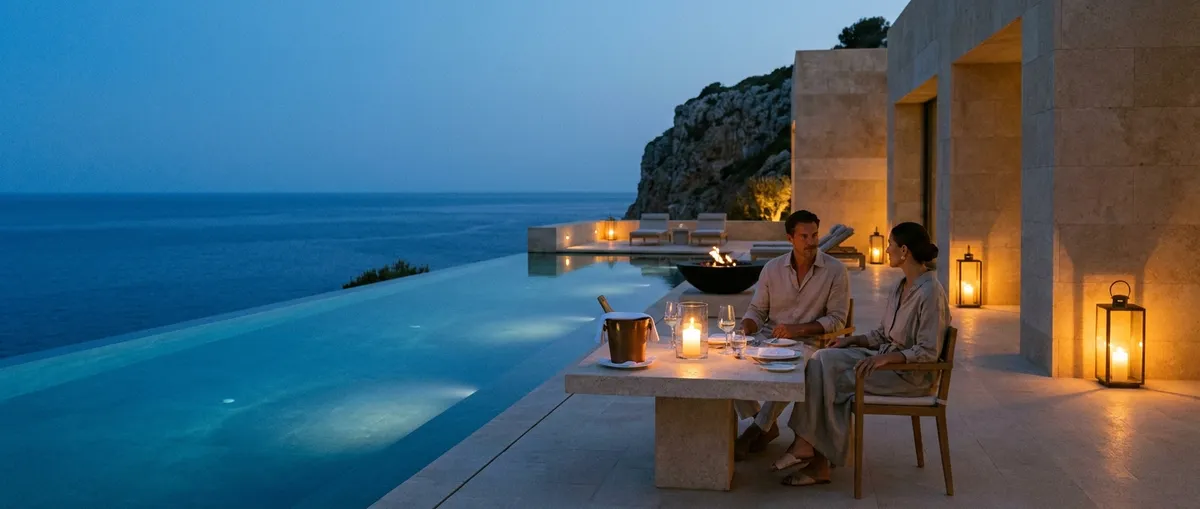
There is a tier of travel that doesn’t announce itself with logos or marble lobbies, but with silence, precision, and the feeling that the world has briefly rearranged itself around your preferences. Exclusive resorts operate in this quiet space—where privacy is architecture, time is elastic, and service is choreographed rather than performed. For the discerning traveler, understanding how these places truly work transforms a stay from simply luxurious to deeply, almost privately, exceptional.
The Architecture of Privacy: How Space Becomes a Silent Shield
In truly exclusive resorts, privacy is not an add-on; it is the primary design brief.
Villas are oriented to sightlines rather than sunsets alone—how far can you see without being seen? Landscaping isn’t merely decorative; it’s a living barrier, absorbing sound and framing views so neighboring suites might as well be miles away. Pathways are curved, not straight, to prevent accidental eye contact between guests who value discretion.
High-end properties increasingly use spatial zoning: private arrival courtyards that bypass traditional check-in desks, staff circulation routes hidden from guest view, and multi-level layouts that separate social, sleep, and wellness areas. The result is a paradox: you feel deeply connected to the setting and yet entirely buffered from the world.
For the luxury traveler, the insight is simple: when evaluating a resort, look beyond aesthetics. Ask how they manage sightlines, sound, and circulation. Privacy done well is not only felt in your suite, but in every transition—from terrace to spa to restaurant—without ever colliding with someone else’s escape.
Time as a Luxury Material: The Invisible Art of Anticipation
At the highest level of hospitality, time is not something you schedule around; it’s something the resort quietly bends in your favor.
The most exclusive properties operate with behind-the-scenes “temporal choreography.” Guest behavior is mapped—not invasively, but intelligently. The aim is to ensure that your pool is unhurried when you arrive, your preferred table is organically available, and your transport is waiting precisely when you discover you’re ready to leave.
This is powered by soft data: your arrival hour, previous travel patterns, dining habits, even how long you lingered over breakfast. Elite resorts translate these cues into service pacing. Housekeeping adjusts to the rhythm of your day rather than enforcing a hotel timetable. Spa teams hold back certain prime slots for top-tier guests and release them just when you decide to book.
To leverage this, communicate your natural rhythms early: when you like to wake, dine, work out, and disconnect. In a well-run resort, this isn’t small talk—it’s the blueprint for making your stay feel suspiciously frictionless, as if the world is always one step ahead of you.
The Hidden Menus: Beyond the Public Offering
What appears on a resort’s website or printed menus is often only the surface of what is truly available.
Exclusive resorts typically maintain “shadow inventories” of experiences: unlisted yacht charters, off-hours access to cultural sites, chef’s-counter dinners in the kitchen, or sunrise-use of wellness spaces usually reserved for staff reset. These are not marketed broadly because their value lies in controlled scarcity and the ability to tailor them to specific guests.
The same applies to culinary and wellness programming. A seemingly straightforward menu may conceal a quiet capacity for off-menu tasting journeys, ingredient-driven dinners curated around your preferred region, or bespoke nutrition-focused meals mirroring your home regimen. In wellness, guest-facing brochures might list standard massages, while the spa director reserves advanced modalities, visiting practitioners, or multi-hour rituals for those who inquire more deeply.
The insight here: elite travelers don’t ask “What do you offer?” but “What is possible?” Phrasing your requests around outcomes—“a private, movement-focused morning in nature” or “a dinner that explores the region through textures rather than courses”—invites the resort to draw from this invisible catalogue.
The Private Supply Chain: Provenance as a Quiet Marker of Quality
At the top end of the market, the difference between “nice” and “exceptional” lives in the supply chain you never see.
Exclusive resorts invest heavily in trusted networks: local fishermen who deliver before sunrise, small-batch vineyards that allocate micro-quantities off the standard list, artisans who produce linens, ceramics, or spa products exclusively for the property. Many operate on quietly negotiated allocations, sometimes years in the making, ensuring that what you experience simply cannot be replicated at scale elsewhere.
This is particularly evident in wellness and gastronomy. The best properties integrate regional biodiversity and scientific rigor—wild herbs gathered under license, mineral-rich local clays, seasonal produce grown on-site or sourced from specific microclimates. The luxury is not merely organic or local; it is curatorial, where every element has an origin story known by name, not just by region.
To discern this, ask precisely where things come from: the olive oil, the honey, the spa ingredients, the ceramics on your table. Elite resorts rarely improvise answers; they know. And when the provenance is both specific and intentional, you can be confident that the rest of the operation is built with the same level of discipline.
Silent Service Codes: How Elite Staff Read and Respond to You
In the most refined resorts, service is not a series of tasks; it is a language.
Staff are trained to read micro-signals—how quickly you scan a wine list, whether you place your phone face down or face up, how you arrange items on a table—to calibrate interaction. A guest lingering over a book with sunglasses on may be approached differently from one scrolling rapidly through messages. The goal is not to serve more, but to serve correctly.
Many properties develop internal “guest profiles” that are dynamic and non-intrusive: preferred pacing of conversation, appetite for suggestions, sensitivity to formality. Over time, these profiles inform everything from how your name is used (or discreetly omitted in public spaces) to whether the sommelier proposes classics or avant-garde pairings.
As a discerning traveler, you can guide this soft coding early. During the first hours of your stay, articulate your preferences explicitly: how much you value quiet, whether you enjoy recommendations, how spontaneous you like your days to be. In ultra-luxury environments, staff are trained to treat such guidance not as demands, but as permissions—to refine their performance until it feels less like service and more like attunement.
Conclusion
Exclusive resorts at their best are not defined by infinity pools or thread counts, but by an intricate ecosystem working in concert: architecture that protects your privacy, time that is orchestrated rather than managed, hidden menus and supply chains that elevate the everyday, and staff who understand you not as a demographic, but as a distinct rhythm.
For luxury travelers attuned to these subtleties, the real privilege is not simply being surrounded by beauty. It is moving through a world that has been meticulously, and almost invisibly, edited in your favor—where every detail feels inevitable, yet nothing feels forced. Once you learn to read these quiet signals, choosing where to stay ceases to be about star ratings and becomes about something far more valuable: alignment.
Sources
- Forbes Travel Guide: What Makes a Hotel Truly Luxurious? – Insight into service standards, personalization, and behind-the-scenes operations at top-tier properties.
- Condé Nast Traveler: How to Spot a Great Hotel – Explores key indicators of quality in design, service, and guest experience.
- Virtuoso: Trends in Luxury Travel – Industry perspective on what high-net-worth travelers now expect from exclusive properties and experiences.
- American Hotel & Lodging Educational Institute – Educational resources on hospitality management and service training that underpin many luxury resort standards.
- Cornell University School of Hotel Administration – Research and publications on hospitality operations, guest satisfaction, and service innovation.
Key Takeaway
The most important thing to remember from this article is that this information can change how you think about Exclusive Resorts.