Fine dining, at its highest level, is no longer about indulgence for its own sake. For the discerning traveler, it is an instrument—a precise, sensory compass that reveals a city’s true character long before the skyline does. The right dining room can tell you more about a destination’s confidence, creativity, and cultural memory than any guidebook. For Jet Ready’s audience, the question is not where to eat, but how to read what a restaurant is really offering when the white tablecloths and wine pairings are only the surface.
Below are five exclusive insights that transform dinner from a reservation into a refined, strategic experience—quietly aligned with the way the world’s most particular travelers move.
1. The Menu as a Map of a City’s Private Confidence
In serious dining rooms, the menu is a discreet form of cartography. It charts what a city believes is worth celebrating about itself—often before that story reaches the mainstream.
Pay attention to how local ingredients appear. When a restaurant moves beyond tourist-friendly clichés and anchors its menu in specific varietals, micro‑seasons, and small producers, it is signaling a certain cultural self‑assurance. A Tokyo counter that names the exact fishing village of its uni, or a Copenhagen dining room that identifies the forest where its mushrooms were foraged, is effectively saying: this place is enough.
For luxury travelers, this matters. Selecting restaurants that are deeply, almost stubbornly, local gives you a compressed briefing on the city’s priorities: what it protects, what it imports, what it edits out. An evening spent following the chef’s tasting menu becomes a quiet, curated orientation to the city itself—distilled into a handful of perfectly constructed courses.
2. Service as an Unspoken Index of Global Literacy
In true fine dining, service is not performance; it is fluency. How a team recognizes, anticipates, and adapts to an international guest’s expectations reveals the restaurant’s understanding of the global elite—more reliably than décor or price point ever could.
Subtle markers tell you everything. The way a sommelier translates a complex list into two or three precise, relevant options—without overselling. The speed at which a team pivots from formal to relaxed when they sense your preference. The quiet competence with which dietary needs are handled not as an inconvenience, but as a design constraint.
For the seasoned traveler, observing this is invaluable. You are not merely being served; you are evaluating the establishment’s global literacy. Those who execute this level of service consistently tend to sit at the crossroads of serious culinary ambition and a truly cosmopolitan clientele—the very axis on which the most compelling travel experiences revolve.
3. The Private Language of the Wine List
Wine programs at serious restaurants are a form of coded communication—especially relevant to travelers who navigate multiple culinary capitals each year. Beyond labels and vintages, they reveal the sommelier’s philosophy, the restaurant’s network, and the depth of its access.
A list dense with only marquee regions and familiar prestige cuvées often suggests a reliance on reputation. By contrast, a program that balances classic producers with carefully chosen emerging regions—think grower Champagne beside restrained English sparkling, or Burgundy flanked by volcanic-soil reds from Etna—signals a quiet, informed curiosity.
As a global traveler, this is an efficient read: does the restaurant simply collect luxury products, or does it curate point of view? Trust sommeliers who can articulate why a particular producer was chosen, and who are willing to guide you into less obvious territory without making the experience feel didactic. These are the teams that can introduce you to new regions and producers you’ll later recognize in other cities—an evolving, personal map of taste that travels with you.
4. Architecture, Acoustics, and the Value of Controlled Silence
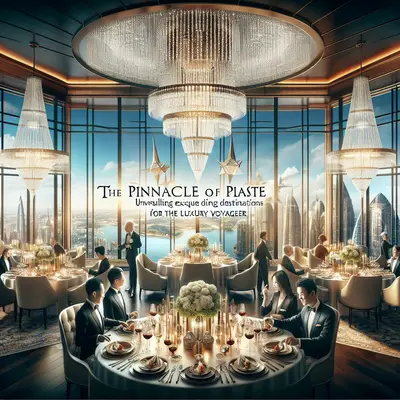
For those for whom travel is constant, a fine-dining room is often less about spectacle and more about calibrated refuge. The true luxury lies in how precisely the space is tuned: light, sound, sightlines, and proximity all converging to create a setting in which attention can narrow to what is on the plate, in the glass, and across the table.
Architecture and acoustics are the most telling. Restaurants designed for serious diners understand that the ability to converse at a natural volume is non-negotiable. Surfaces are chosen as much for their acoustic properties as for aesthetics; lighting is layered, not flat, and adjusted over the course of the evening. Sightlines are curated so that you feel aware of the room yet protected from it.
For high-frequency travelers, this level of intentionality is a differentiator. After days of airports and meetings, the value of a space that has been carefully engineered to restore your sensory equilibrium is difficult to overstate. Choosing such venues turns dinner into a structured decompression ritual—elegantly disguised as a night out.
5. The Post-Dinner Arc: How the Best Restaurants Extend the Evening
The most sophisticated restaurants understand that their role does not end with dessert. For the globally mobile guest, the hours after dinner are often the most strategically important—when decisions are made, relationships deepen, and impressions crystallize.
Notice how the restaurant handles this transition. Is there an intimate bar, semi-detached from the main room, where you can drift for a final glass of something rare? Do they quietly arrange a car, secure a late reservation at a neighboring cocktail institution, or steer you toward an under-the-radar jazz bar that never needs to advertise? These gestures are small, but they reveal a restaurant’s integration into the city’s higher-order social fabric.
For the luxury traveler, this is where dinner becomes infrastructure. Aligning yourself with properties that can extend the evening—softly and seamlessly—means you are never just eating. You are participating in a curated flow of experiences that continue long after the bill is settled, supported by a network that recognizes your time, privacy, and preferences as assets to be protected.
Conclusion
For those who live between time zones, fine dining is more than a recreation; it is an instrument of orientation, calibration, and access. The table becomes a vantage point from which to understand a city’s confidence, an industry’s direction, and a culture’s quiet preoccupations—course by course, glass by glass.
By reading beyond the obvious—the structure of the menu, the fluency of the service, the intent behind the wine list, the discipline of the room, and the arc of the evening—you transform every significant meal into something rarer: a deliberate, highly efficient lens on the world you traverse. In that sense, the true luxury is not simply what arrives on the plate, but the clarity it offers the traveler who knows how to see it.
Sources
- Michelin Guide – What Is a Michelin Star? - Background on how top restaurants are evaluated and what defines high-level dining
- The World’s 50 Best Restaurants – Awards & Criteria - Insight into global fine-dining benchmarks and selection philosophy
- Harvard T.H. Chan School of Public Health – The Nutrition Source: Dining Out - Perspective on restaurant dining and thoughtful menu choices
- Wine & Spirit Education Trust (WSET) – What Is a Sommelier? - Explanation of the sommelier’s role and how they shape the guest experience
- Institute of Acoustics – Sound in Restaurants - Discussion of acoustic design and its impact on the dining environment
Key Takeaway
The most important thing to remember from this article is that this information can change how you think about Fine Dining.