Fine dining for the modern luxury traveler is no longer about starched linens and a parade of plates. It is about intention: where the ingredients began, how the room makes you feel before the first glass is poured, and the unspoken choreography that turns a meal into a memory. At this level, the most meaningful experiences happen well beyond what appears on the menu. They live in the details that almost no one notices—but that you will never forget once you do.
Below are five exclusive, insider dimensions of fine dining that discerning travelers quietly seek out and deliberately curate.
The Geography of the Plate: Provenance as the New Luxury
For the sophisticated traveler, the question is no longer simply “What is this?” but “Where does this come from—and who stands behind it?”
The most compelling restaurants today act as curators of landscapes. A tasting menu might trace a coastline through its shellfish, an alpine region through its herbs, or an orchard through a sequence of textures and aromas. Provenance is no longer a marketing note at the bottom of the menu; it is the architecture of the entire experience.
Elite diners increasingly look for restaurants with deep, long-term relationships with growers, fishermen, and foragers. A chef who visits the same oyster farmer every week or supports a single small dairy for years is quietly signaling more than quality; they are demonstrating a commitment to traceability, ethics, and authenticity.
When planning travel, this means going beyond “best restaurant” lists and seeking places where the chef’s name is mentioned in the same breath as the farmers’. Read the restaurant’s story, its suppliers, and its seasonal philosophy. You are no longer choosing a table—you are choosing an ecosystem.
The Invisible Script: Service as Discreet Intelligence
At the highest levels of fine dining, service is not performance; it is intuition. The finest rooms feel almost telepathic, where you never have to ask—and rarely have to speak.
This is the realm of discreet intelligence: the maître d’ who notices your left-handedness and adjusts your place setting without comment; the sommelier who understands that your “something fresh” means low-intervention but not aggressively funky; the server who subtly spaces courses to align with the rhythm of your conversation, not the quotas of the kitchen.
Luxury travelers in the know pay as much attention to the team’s listening skills as to the chef’s technical prowess. Do they remember your pace from a previous visit? Do they reference allergies and preferences without prompting? Are explanations of each dish measured, not rehearsed?
To access this level of refinement, communicate clearly but quietly at the outset: your timing constraints, your preferences for interaction, your tolerance for explanation. In the right dining room, that is all the script they need. What follows will feel less like “service” and more like being gracefully anticipated.
The Architecture of Atmosphere: Acoustics, Light, and Spatial Privacy
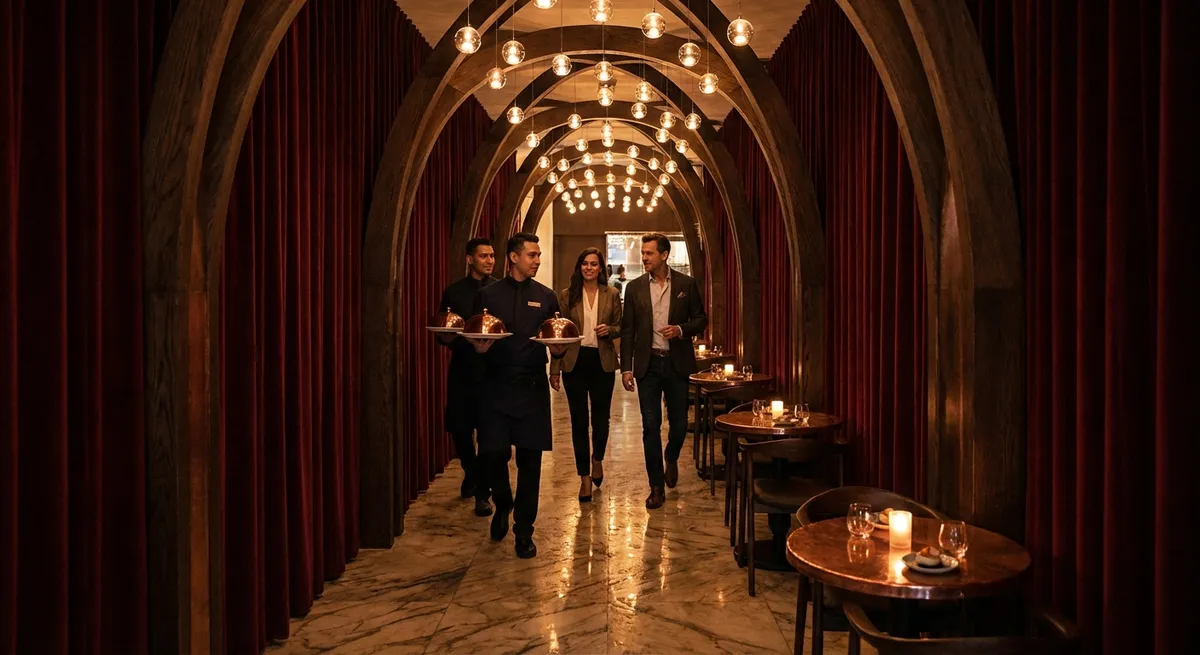
At true fine-dining caliber, a room is not decorative—it is engineered. The most memorable restaurants are composed with as much precision as the dishes themselves, particularly across three dimensions that discerning travelers prize: sound, light, and spatial privacy.
Acoustics are a hallmark of serious design. A powerful indicator of quality is a room that feels vibrantly alive yet allows you to hear a whisper across the table without strain. This balance is achieved not by chance, but through considered materials, ceiling heights, and subtle spatial zoning.
Lighting is equally telling. The best dining rooms employ layers of warm, indirect light that flatter both plate and guest. Nothing glares; nothing feels theatrical. The table becomes its own quiet pool of focus, with the rest of the room gently receding into a soft background.
Then there is privacy, not in the sense of isolation, but of elegant separation. Slightly increased spacing between tables, banquettes that shield sightlines, or the option of semi-private alcoves—these design decisions create a sense of being part of something vibrant while remaining personally cocooned.
When choosing a restaurant in a new city, examine photographs closely: How close are the tables? How is the ceiling treated? Is the lighting harsh or diffuse? For the luxury traveler, the room is not secondary to the cuisine; it is the vessel that allows the cuisine to be truly perceived.
The Cellar as a Narrative: Beyond Labels and Vintage Prestige
In the classic era of fine dining, a cellar’s prestige was measured in famous labels and old vintages. For the contemporary connoisseur, the most intriguing wine programs and beverage pairings read like narratives, not inventories.
A sophisticated cellar today might juxtapose grand cru Burgundy with a tiny-production volcanic white, or an iconic Champagne house with a single-plot grower who farms biodynamically. The through-line is no longer just status, but perspective—how the sommelier interprets place, texture, and progression across the meal.
Luxury travelers increasingly seek programs where the beverage team is empowered to tell a story: perhaps a pairing built entirely from one region, or a sequence that explores different expressions of minerality, or a non-alcoholic journey using infusions, ferments, and distillates that mirror the culinary arc.
To tap into this depth, approach your sommelier as a collaborator rather than a gatekeeper. Share how adventurous you are, the styles you gravitate toward, and the role you’d like the pairing to play (discreet complement, bold counterpoint, or a narrative in its own right). The best cellars do not simply match wine to food; they orchestrate a parallel experience.
The Extended Arc: Before, After, and the Art of Return
For the most refined travelers, a fine-dining experience begins hours before the reservation and continues long after the final course. The “arc” around the meal is curated as thoughtfully as the meal itself.
Before dinner, the most discerning guests consider how they want to arrive: perhaps a quieter bar in the same neighborhood for a single, carefully chosen aperitif; a short walk instead of a car for a subtle mental transition; a pause at the hotel to change into attire that matches the tone of the evening. These are small rituals, but they infuse the experience with intention.
Afterwards, the evening is rarely allowed to dissipate abruptly into bright lights and noise. Instead, guests might retreat to a hotel lounge with soft lighting and measured sound, order a single digestif or tea, and revisit the highlights of the meal while they are still vivid. The memory is thus sealed not in haste, but in calm reflection.
Finally, there is the art of return. At the elite level, relationships with restaurants become long-form rather than episodic. Over time, the team learns your preferences, celebrates your milestones, and occasionally steers you toward something just beyond your comfort zone. For the luxury traveler, this is where fine dining transcends transaction and becomes a quietly sustained dialogue—a conversation that evolves with each visit, each journey, each year.
Conclusion
Fine dining in the modern luxury landscape is less about spectacle and more about precision, subtlety, and coherence. It encompasses the origin of ingredients, the intelligence of service, the deliberate architecture of the room, the narrative in the glass, and the carefully curated arc surrounding the meal.
For travelers who move easily between cities and continents, the most rewarding experiences are those that feel both globally aware and deeply rooted in place—where every detail has been considered, yet nothing feels forced. Seek the rooms where provenance is transparent, service is perceptive, design is quietly protective, the cellar is articulate, and the evening extends gracefully beyond the final course. That is where fine dining, in its most elevated form, becomes not just a meal, but a refined way of inhabiting the world.
Sources
- Michelin Guide – Fine Dining and Restaurant Selection Criteria - Insight into how Michelin evaluates cuisine, service, and ambiance at the top level
- The World’s 50 Best Restaurants – About and Methodology - Overview of how leading global restaurants are assessed and recognized
- Harvard T.H. Chan School of Public Health – Sustainable Food Systems - Background on provenance, sustainability, and ethical sourcing relevant to modern fine dining
- Institute of Acoustics – Sound in Restaurants - Discussion of acoustic design principles in hospitality spaces
- Wine & Spirit Education Trust (WSET) - Explores advanced principles of food and wine pairing and narrative beverage programs
Key Takeaway
The most important thing to remember from this article is that this information can change how you think about Fine Dining.