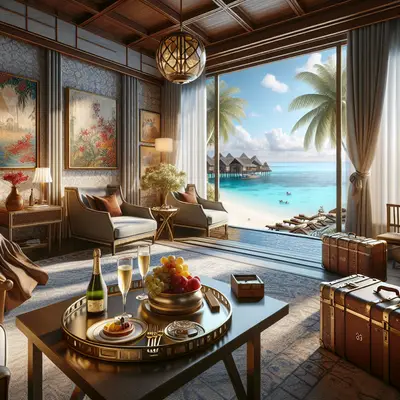
The most discerning travelers know that luxury is no longer a product you book—it is a standard you inhabit. Premium living today is defined less by display and more by deliberate design: of time, of surroundings, of relationships, and of the quiet infrastructure that allows a life to move seamlessly between continents. For those who treat every departure lounge as a continuation of their living room, and every arrival as a curated re-entry into their own rhythm, the true privilege lies in orchestration, not excess.
This is a portrait of premium lifestyle as a practiced discipline rather than a collection of purchases—anchored in five exclusive insights that resonate with modern luxury travelers.
The Private Calendar: Curating Time as a Signature Asset
Among those who live in constant motion, the rarest luxury is no longer access—it is unclaimed time that still feels expansive, not hurried. The most sophisticated travelers treat their calendar like a private members’ club: rigorously edited, fiercely protected, and unapologetically aligned with personal values.
This starts with designing travel around energy, not availability. Red-eye flights are traded for rest-optimized itineraries; meetings happen when the body is most alert, not when it is simply convenient for everyone else. Elite travelers increasingly use flexible booking classes and loyalty status not just for upgrades, but for the ability to reshape trips dynamically as priorities shift—treating rebooking rights as a productivity tool, not a perk.
The calendar itself becomes an ecosystem: travel days are never fully booked; recovery windows are treated as non-negotiable; key decisions are reserved for specific time blocks when the mind is clear and distraction-free. Weekends aren’t just “off”—they’re architected with the same intention as a major board presentation or a critical negotiation.
In this world, the most sophisticated signal of status is not how busy one appears, but how masterfully one has edited out the non-essential. The premium lifestyle is less about doing more everywhere, and more about creating the conditions to be fully present anywhere.
The Invisible Infrastructure: Designing a Life That Travels Well
To the untrained eye, a frequent traveler appears to move effortlessly from city to city. What’s invisible is the infrastructure quietly engineered behind the scenes: a personal operating system refined over years, in which everything from wardrobe to health to digital life is configured to travel as smoothly as its owner.
The premium lifestyle favors a modular approach. Wardrobes are built on a consistent palette across home bases—dark, tailored essentials that can be recombined globally, with minimal luggage and maximum coherence. Tailors in multiple cities maintain updated measurements; preferred dry-cleaners and shoe care services are pre-vetted and on file. A jacket repaired in London will match the standard set in Singapore.
Wellness follows the same logic. A global network of trusted practitioners—concierge physicians, physiotherapists, dermatologists, nutritionists—ensures continuity of care across time zones. Medical records are securely digitized and instantly accessible; prescriptions are managed to anticipate travel, not react to it. Recovery rituals—infrared saunas, contrast therapy, carefully sequenced sleep routines—are as portable as a passport.
Digital life is equally intentional. Document templates, travel checklists, and contingency plans (from lost luggage to delayed passports) are pre-designed and stored in secure cloud systems. Devices are synchronized but compartmentalized, separating work, personal, and high-security profiles. This frees cognitive bandwidth: crises become inconveniences, not derailments.
The result is not perfection, but resilience. The premium lifestyle is built on systems that remove friction before it appears, allowing spontaneity to feel safe rather than reckless.
The Quiet Network: Relationships as a Global Safety Net
For the truly seasoned traveler, the most powerful loyalty program is not a card in a wallet but a network of humans who recognize a name, remember a preference, and are empowered to act. Premium living isn’t about knowing “someone everywhere,” but about cultivating a small constellation of trusted contacts who make the world feel subtly smaller.
This network spans more than concierges and travel advisors. It includes private bankers who understand cross-border needs, art advisors who can navigate both acquisitions and transport, legal counsel attuned to multi-jurisdictional realities, and security specialists who can quietly assess risk before a reservation is ever made.
Equally important are the “soft” nodes in this network: a sommelier who understands your cellar, a gallery manager who knows which exhibitions merit a detour, a private chef who can stock a residence before you arrive, a wellness director who calibrates treatments after a long-haul flight. These relationships develop over years, with consistent patronage and sincere respect—never transactional urgency.
The discreet power of this network becomes most visible in moments of disruption: a last-minute medical appointment abroad, a quiet room secured during a city-wide event, a complex itinerary re-routed around an emerging situation. In these instances, reciprocity and reputation move faster than formal channels.
For luxury travelers, the premium lifestyle is defined not only by where they can go, but by who can quietly smooth the path when they choose to go there.
The Refined Threshold: Carrying a Sense of Home Across Borders
Premium life is no longer anchored to a single address; it is defined by the ability to feel at home across multiple geographies. The most discerning travelers cultivate a portable sense of place—an aesthetic and sensory continuity that follows them from penthouse to pied-à-terre, from villa to villa.
This begins with a personal vocabulary of comfort. A favored scent—translated into candles, room sprays, or travel-sized diffusers—anchors unfamiliar suites to a familiar emotional landscape. Preferred bedding textures, from the density of a duvet to the weight of a throw, are specified in advance or replicated through partnerships with hotel brands that stock known linens. The effect is subtle but profound: jet-lagged arrivals feel less like intrusion, more like return.
Art and objects also travel. Small pieces—a particular ceramic cup for morning tea, a compact framed photograph, a travel-sized sculpture—act as talismans that convert generic luxury into personalized refuge. For those with multiple residences, interior designers coordinate across properties so that visual language, lighting temperatures, and material choices form a coherent narrative rather than a series of disconnected statements.
Even routines cross borders. Morning rituals—stretching, journaling, coffee exactly as preferred—are preserved wherever possible, supported by pre-arranged amenities or in-room setups. Evening wind-downs—specific playlists, herbal infusions, digital curfews—signal to the body that rest is imminent, regardless of time zone.
In this framework, luxury is not just having a beautiful room; it is stepping into a space, anywhere in the world, and experiencing the unmistakable sensation: “This is mine, even if only for a night.”
The Elevated Filter: Choosing Experiences with a Curator’s Eye
In an age where every destination is relentlessly documented and every “must-see” is aggressively promoted, the true connoisseur of premium living relies on a different compass. Experiences are not collected for social proof; they are chosen through a curator’s lens, seeking depth, texture, and a resonance that endures well beyond the return flight.
This means favoring encounters over itineraries. A three-hour conversation with a local craftsperson may be more meaningful than ticking off five landmarks in an afternoon. Private access is valued not for exclusivity alone, but for the ability to engage—lingering in a museum gallery after hours with a curator, or tasting wines with the producer rather than just the sommelier.
Data increasingly informs these choices. Sophisticated travelers leverage airline and accommodation data, wellness wearables, and even environmental metrics—like air quality indexes and seasonal crowd patterns—to decide not only where to go, but when and how. They seek destinations when they are slightly off-peak, restaurants before they are overexposed, and properties that invest in sustainability standards that align with their own ethics.
The premium filter also extends to digital consumption. Instead of chasing viral lists and over-shared locations, these travelers rely on a blend of trusted advisors, long-form journalism, academic insights, and niche local sources to refine their view. They are comfortable forgoing the obvious in favor of the quietly exceptional.
Ultimately, the defining question is not “Was this impressive?” but “Will this matter to me in five years?” The answer to that question shapes a life where each journey feels less like an escape and more like a precise extension of who one has chosen to become.
Conclusion
The modern premium lifestyle is not a glossy highlight reel of destinations and purchases; it is a nuanced choreography of time, systems, relationships, spaces, and choices. The most sophisticated luxury travelers understand that what appears effortless from the outside is, in reality, the product of meticulous intention.
To live well between journeys is to accept that every detail—how the calendar is structured, how the suitcase is packed, how the room lights dim at night—is a quiet expression of personal standards. In that discipline lies the truest luxury: a life so carefully designed that wherever you land, you arrive as yourself, not as a guest in someone else’s idea of what premium should be.
Sources
- [McKinsey & Company – The Rise of the Global Affluent Traveler](https://www.mckinsey.com/industries/travel-logistics-and-infrastructure/our-insights/winning-the-changing-travelers) – Analysis of changing expectations and behaviors among high-end travelers.
- [Bain & Company – Luxury Goods Worldwide Market Study](https://www.bain.com/insights/category/luxury-goods-worldwide-market-study/) – Provides insight into evolving definitions of luxury and the shift toward experiential value.
- [Harvard Business Review – The Future of Premium Services](https://hbr.org/2015/05/the-future-of-luxury-is-personal) – Explores personalization, service design, and shifting luxury consumer priorities.
- [World Travel & Tourism Council (WTTC)](https://wttc.org/research/insights) – Offers research on global travel trends, high-spend segments, and the impact of premium travel behaviors.
- [Cornell University School of Hotel Administration – Hospitality Research](https://sha.cornell.edu/faculty-research/centers-institutes/chr/research/) – Academic insights into hospitality, guest experience, and service innovation at the high end of the market.
Key Takeaway
The most important thing to remember from this article is that this information can change how you think about Premium Lifestyle.