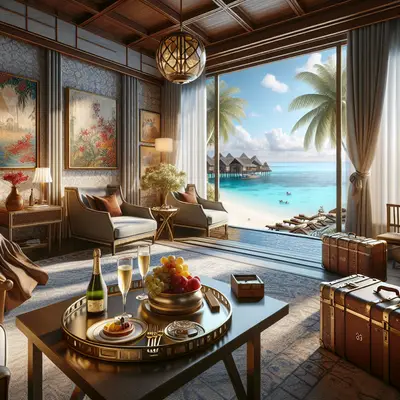
There is a quiet moment, often just before takeoff, when the world begins to recede and your journey actually starts. For some, it’s signaled by the click of a seatbelt; for others, by the first sip of something chilled in cut glass. For the genuinely discerning traveler, it begins much earlier—with a series of deliberate decisions that turn movement into a refined, deeply personal experience. Premium travel is no longer about ostentation or mere access; it is about curation, restraint, and an almost obsessive attention to how every hour feels.
Below are five exclusive, under-discussed insights that today’s luxury travelers are quietly using to shape journeys that feel less like logistics—and more like a beautifully scored private ritual.
1. Designing Your “Transit Ritual” as Carefully as Your Destination
Most travelers plan where they will stay; very few plan how they will transition.
A truly premium lifestyle recognizes that the liminal hours—airports, transfers, arrivals—shape your entire perception of a trip. Instead of treating these as tolerable inconveniences, the most refined travelers architect them with the precision of a well-composed evening.
This begins with a personal transit ritual. Think beyond lounge access and priority security. Consider your sensory script: the texture of the clothing you fly in, the scent that accompanies you from car to cabin, the playlist that begins exactly as the aircraft doors close. A well-chosen cashmere layer, noise-canceling headphones that feel like bespoke tailoring for the ears, a portable fragrance that becomes your signature in the air—these details form a private world inside public spaces.
Luxury fliers also build in protected silence windows: no email, no calls, no digital demands for the first and last 30 minutes of every flight. It becomes a boundary that signals to your nervous system that these hours are yours, not your calendar’s. A monogrammed notebook, a physical book instead of another glowing screen, or a curated offline reading folder can turn a flight into a retreat at 37,000 feet.
When transit is elevated to ritual, delays feel less like theft and more like extra time in a cocoon you designed for yourself.
2. Treating Time Zones as a Medium, Not an Obstacle
The ultra-mobile are increasingly treating time zones as a material they can sculpt, rather than an inconvenience to endure. Instead of “powering through” jet lag, sophisticated travelers reframe the shift as a strategic realignment of attention.
The approach starts days before departure. Three elements matter most: light, meal timing, and movement. You can gently nudge your circadian rhythm toward your destination with subtle shifts—moving your main meals and exposure to bright light closer to the target time zone, and using low-intensity movement rather than intense workouts before long-haul flights.
Onboard, the most discerning travelers often forgo the temptation of constant dining and entertainment in favor of a controlled, almost minimalist routine: one considered meal aligned with destination mealtime, carefully managed hydration, minimal alcohol, and short, deliberate walks rather than sporadic pacing. The intention is to arrive with a nervous system that feels calibrated rather than battered.
Upon landing, they rarely commit to intense social or business obligations in the first 6–8 hours. Instead, they reserve that window for light, grounding activities that introduce them to the destination: a slow walk outdoors, an unhurried coffee in natural light, perhaps a short, targeted spa treatment focused on circulation rather than indulgence.
The luxury isn’t in having no time constraints; it’s in knowing precisely how to choreograph your body through them.
3. Building a Global Network of “Trusted Micro-Hosts”
The future of premium travel is less about memorizing loyalty tiers and more about cultivating a quiet network of “micro-hosts”: individuals and small teams who act as your proxies in cities across the world.
These are not simply concierges in the traditional sense. They might be a private guide in Tokyo who understands your tolerance for crowds and your preference for hidden counter seating over large dining rooms. An art advisor in London who knows you prefer emerging artists shown in converted industrial spaces, not just the marquee galleries. A wellness consultant in Zürich who designs bespoke half-day resets between meetings.
Savvy travelers invest in deepening these relationships over time, sharing nuanced preferences and feedback rather than starting from zero on every trip. This creates a form of continuity that transcends geography: you begin to feel “locally known” in cities where you don’t actually live.
The key is discretion and long-term reciprocity. You treat these relationships as ongoing collaborations, not one-off transactions. Over the years, a trusted micro-host can quietly steer you away from overbooked, overexposed venues and toward rarefied experiences that never make it to social feeds: an off-hours museum visit, an early-morning market walk before the city fully wakes, a chef’s menu served at a time that suits your internal clock rather than the restaurant’s.
What emerges is a private global ecosystem tailored to your tastes—not defined by algorithms, but by people who actually know how you move through the world.
4. Curating an “Anchor Object” for Each Journey
In an era where every destination risks blending into a similar palette of marble, linen, and artisan ceramics, the most mindful travelers have begun to reclaim a tactile sense of place through what might be called an anchor object.
This is not a souvenir in the conventional sense. It is a deliberately chosen, functional item that will live with you after the journey ends—subtle, useful, and imbued with the memory of where it was acquired. A hand-thrown bowl from a local ceramicist whose studio you visited personally; a leather-bound notebook from a historic stationer; a compact textile that folds easily into your luggage yet becomes a signature at home—a throw, a table runner, a pillow cover.
The act of choosing an anchor object forces a different kind of presence. You slow down enough to understand the provenance of the piece and the person behind it. You ask questions, you listen, you engage. The object then travels forward with you, integrated into your daily rituals: you pour morning tea into the bowl, jot notes in the notebook, rest beneath the textile on a quiet evening.
Over time, your living space becomes a curated topography of your travels—less “global décor,” more a private cartography of memories encoded in things you actually use. It is a refined antidote to disposable, trend-driven consumption and a way to let place live on in form, not just in photos.
5. Elevating Recovery to the Same Status as Indulgence
There is a growing realization among high-frequency travelers that the true mark of a premium lifestyle is not how much one can fit into an itinerary—but how intelligently one recovers from it.
Recovery is no longer an afterthought reserved for spa days; it is being integrated into the architecture of the trip. This might mean choosing accommodations not solely for views and square footage, but for air quality, soundproofing, bedding, and access to movement and light. Some travelers now routinely request details about mattress type, blackout capability, and room orientation (morning vs. evening light) alongside more obvious preferences.
On a more advanced level, personalized wellness tools—portable sleep kits, compact percussive devices, travel-sized red-light panels, or even data from wearables—are used to fine-tune when to eat, when to sleep, and when to move after a long haul. Not to chase perfection, but to protect the one non-renewable currency: cognitive clarity.
The paradox is that prioritizing recovery quietly amplifies every other luxury experience. A tasting menu is more nuanced when your senses are rested. A morning swim feels more like ritual than obligation when your sleep has been considered, not compromised. The most elegant form of indulgence might simply be the ability to arrive somewhere extraordinary—and actually feel fully there.
Conclusion
In a world saturated with status symbols and algorithms that insist on showing us the same “must-visit” places, premium travel has shifted into something far more nuanced. It is not about louder cabins, larger suites, or more visible forms of privilege. It is about intention: how you manage transit, sculpt time zones, cultivate hidden networks, choose the few objects that follow you home, and honor the quiet, unglamorous work of recovery.
For those willing to think this way, every journey—no matter how familiar the route or how frequently trodden the city—becomes an opportunity to refine the texture of your life. Not by adding more, but by choosing more precisely.
Sources
- National Sleep Foundation – Jet Lag and Sleep – Evidence-based guidance on circadian rhythms, light exposure, and strategies to reduce jet lag, informing the time-zone and recovery insights.
- Harvard Medical School – Travel and Your Health – Practical, research-backed recommendations on healthy travel habits, movement, and hydration during flights.
- U.S. Department of Transportation – Traveler Information – Official resources on air travel, passenger rights, and considerations for planning premium, low-friction transit experiences.
- Mayo Clinic – Sleep Tips for Travelers – Medical insight into managing jet lag, sleep timing, and light management that supports the concept of treating time zones as a medium.
- The Metropolitan Museum of Art – Provenance and Collecting – Context on provenance and the cultural significance of objects, relevant to the idea of thoughtfully choosing “anchor objects” with meaningful origins.
Key Takeaway
The most important thing to remember from this article is that this information can change how you think about Premium Lifestyle.