Luxury travelers no longer chase mere scenery; they seek orchestration. The most coveted resorts are not defined by marble lobbies or logoed amenities, but by a carefully constructed ecosystem of privacy, precision, and anticipation. At this level, the true luxury is not what you see, but what you don’t have to ask for—and often, what no one else will ever know existed.
Below, we explore five exclusive insights that quietly distinguish the world’s most exceptional resorts from the merely impressive.
The Art of Managed Invisibility
In elite resorts, service is designed to feel almost fictional—present, but never conspicuous. The objective is not constant attention, but calibrated distance.
The most sophisticated properties engineer staff movement like backstage choreography. Housekeeping routes are plotted to avoid guest sightlines; maintenance is scheduled when villas are likely empty; gardens are tended at sunrise so that, by the time you step outside, the landscape appears as if it simply exists in a permanent state of perfection.
Guest profiles are built not to sell upgrades, but to refine invisibility. If you prefer a morning swim, your terrace will be cleared while you’re at the pool. If your routine is late dinners and late mornings, the turn-down schedule discreetly adapts. Discretion isn’t just about confidentiality; it’s about making sure that your experience never feels interrupted by the operations required to sustain it.
This is where truly premium properties diverge from aspirational ones: the finest resorts understand that silence and absence—of noise, of requests, of visible effort—are active design choices, not pleasant accidents.
Spatial Intelligence as the New Luxury
At the highest tier, the true differentiator is not how beautiful a space looks, but how intelligently it behaves. Spatial intelligence is the quiet logic that governs sightlines, circulation, sound, and micro-privacy.
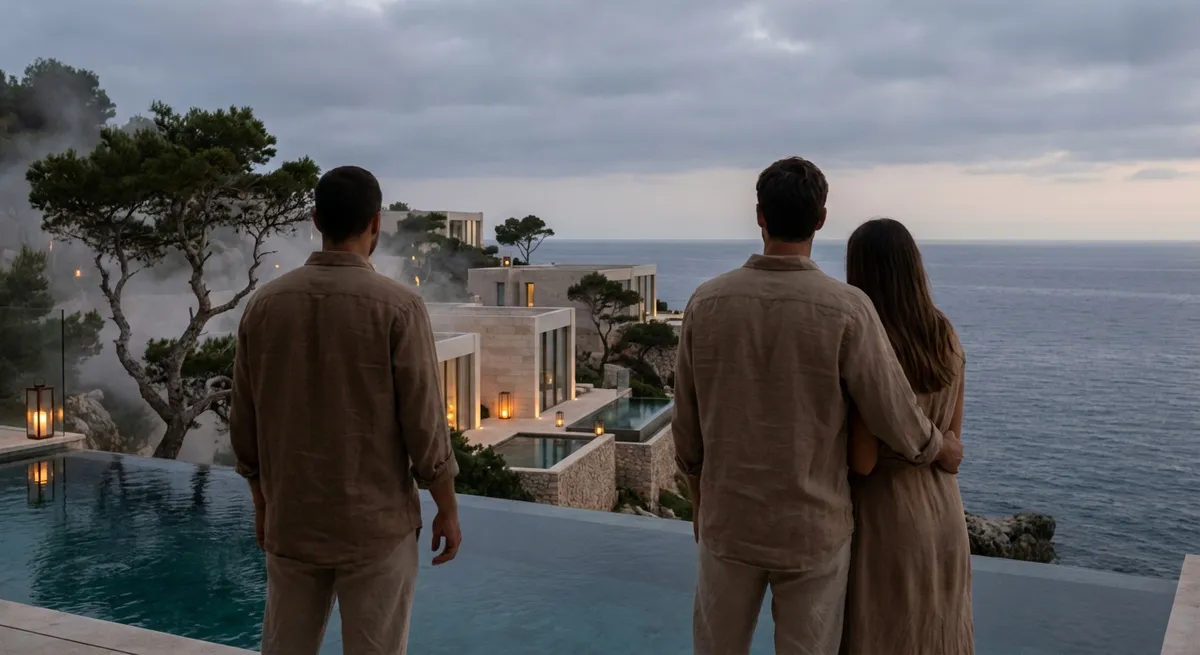
The best villas and suites are configured so that every meaningful moment has a private backdrop. Terraces are angled for unshared views; plunge pools are oriented away from any plausible neighboring gaze; pathways are designed to minimize guest-to-guest contact unless you deliberately seek it out. Sound-dampening materials, strategic landscaping, and topography are leveraged to create a sense of isolation even within a larger resort.
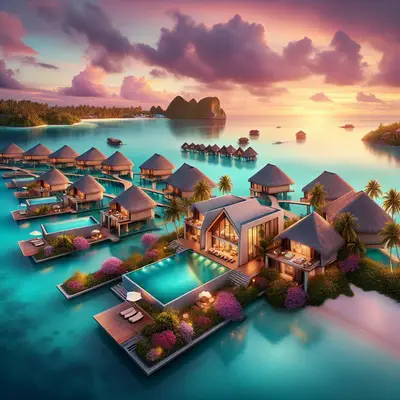
In coastal and island destinations, spatial intelligence becomes a kind of subtle cartography. Jetty placements are chosen to segment arrival points, so that yacht guests and helicopter arrivals experience separate, equally composed narratives. Overwater bungalows are staggered not only for ocean views, but to choreograph how the horizon reveals itself as you move from bedroom to deck to sea.
For the refined traveler, this translates into a continuous feeling of being exactly where you should be, without ever needing to maneuver around others to achieve it. The space has done the work for you.
Anticipatory Service Rooted in Precision Data
The best exclusive resorts do not guess your preferences—they anticipate them with precision. Yet the sophistication lies in how that intelligence is gathered and expressed.
Data at this level feels handwritten, not harvested. Preferences may originate from your booking history, prior stays, or your travel advisor’s insights, but they are then filtered through a deeply human lens. A favorite tea from a previous visit appears, unannounced, in your villa. The resort’s yacht is provisioned with the one champagne you rarely find, but casually mentioned two years ago at a different property within the same collection.
Technology quietly underpins this experience: secure guest profiles shared across sister properties, integrated CRM systems, and real-time internal messaging that keeps your evolving preferences current throughout the stay. Yet you never see the interface—only the outcome. The sophistication lies in protecting the illusion that the resort “simply knows,” while, in reality, a network of invisible systems and expert staff are synchronizing around you.
For the luxury traveler, this anticipatory precision offers a rare state of ease: you are fully recognized, yet never exposed.
Private Access as a Curated Privilege, Not a Transaction
Exclusive access is no longer about how much you can buy, but what cannot be bought at all. The most discerning resorts treat access as a curated dimension of your stay—deeply personal, often unpublicized, and intentionally unscalable.
This might manifest as after-hours access to a historic site, through a relationship the resort has cultivated over decades. It may be a chef’s off-menu tasting that draws on local ingredients not available for commercial sale, or a private visit to an artisan whose work is otherwise only seen in museum collections. In wilderness settings, it could mean carefully controlled access to fragile ecosystems under the guidance of a conservationist, not a “tour guide.”
Crucially, these experiences are not marketed as packages. They’re rarely found on the resort website, and often not even on a printed activities list. They exist in the realm of “if you know, you know”—activated only when the resort understands that you are the kind of traveler who values depth over spectacle.
The privilege here is less about exclusivity for its own sake and more about intimacy with place, history, and culture—curated through the resort’s relationships, not merely its resources.
The Quiet Economy of Time, Transitions, and Recovery
Ultra-premium resorts understand that their true currency is not thread count or amenity kits, but your nervous system. The entire experience is designed around how you arrive, decompress, recalibrate, and re-enter the world.
Travel at this level often begins before you step on a plane. The resort coordinates with your aviation team or commercial carrier to optimize arrival windows, arranges fast-track immigration where allowed, and calibrates your first 24 hours to combat jet lag: light exposure, meal timing, in-villa wellness rituals, and sleep environments tailored to your circadian profile.
Transitions within the stay are equally curated. A day spent diving or heli-skiing flows into recovery with customized spa protocols, nutritional adjustments, and even subtle environmental changes—lighting, scent, temperature—that signal your body to downshift. For families, the resort orchestrates parallel experiences so that children are fully engaged while adults access genuinely restorative solitude.
Departure is treated not as an afterthought, but as a final movement. The finest properties will pace your last day to avoid the abruptness that typically accompanies check-out: late departures when feasible, pre-packed luggage that still leaves your immediate environment intact, and discreet coordination with your next destination to ensure the sense of continuity extends beyond their own gates.
For those accustomed to relentless tempo, this invisible architecture of time is often the most profound luxury of all.
Conclusion
The rarest resorts are not merely places to stay; they are meticulously composed environments where architecture, service, privacy, and time converge into a singular, unrepeatable experience. What distinguishes them is not ostentatious design or visible extravagance, but a disciplined commitment to what the guest never has to see: the operations, negotiations, data, and decisions that make effortless living possible, if only for a few days.
For the refined traveler, understanding these subtleties shifts the question from “Where is the most luxurious resort?” to “Which properties have mastered this quiet, intricate architecture of care?” That is where true exclusivity lives—and where the journey becomes as considered as the destination.
Sources
- [Forbes Travel Guide – What Makes a Five-Star Hotel](https://www.forbestravelguide.com/about/forbes-travel-guide) – Outlines the rigorous service and design standards behind top-rated luxury properties
- [Virtuoso – The Future of Luxury Travel](https://www.virtuoso.com/travel/articles/the-future-of-luxury-travel) – Explores evolving expectations of affluent travelers and the shift toward personalization and access
- [Condé Nast Traveler – How Hotels Use Data to Personalize Your Stay](https://www.cntraveler.com/story/how-hotels-are-using-data-to-personalize-your-stay) – Examines how high-end hotels leverage guest data to deliver anticipatory service
- [Aman Resorts – Brand Philosophy](https://www.aman.com/about-aman) – Illustrates how an ultra-luxury brand structures privacy, space, and experience at the highest level
- [OECD – Tourism Trends and Policies](https://www.oecd.org/cfe/tourism/oecd-tourism-trends-and-policies-20767773.htm) – Provides broader context on global tourism trends, including high-end and experience-driven segments
Key Takeaway
The most important thing to remember from this article is that this information can change how you think about Exclusive Resorts.