In the upper tier of travel, resorts are no longer destinations; they are operating systems for how the affluent live, disconnect, transact, and recover. The most exclusive properties function with an invisible choreography—where privacy is a given, anticipation replaces request, and the rarest commodity is not opulence, but precision. For the Jet Ready traveler, these spaces are less about being seen and more about inhabiting a meticulously curated micro‑world, calibrated to personal preference and protected from unnecessary friction.
Below, five exclusive insights reveal how the most discerning guests quietly evaluate a resort’s true caliber—long before the welcome drink arrives.
The Architecture of Privacy: Designing Space Around Discretion
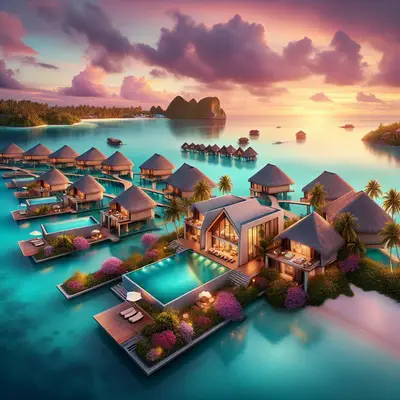
In the strata of ultra-high-end retreats, privacy is no longer a feature; it is the foundational design principle. The most elite resorts are composed not just of suites, but of sightlines, distances, and layers of controlled access. A villa might be technically oceanfront, but what matters is whether the infinity pool is shielded from neighboring decks, if approach paths allow staff to move invisibly, and if sound from adjacent properties disappears into the landscape.
Architects working at this level think in terms of thresholds—what you see, hear, and encounter from the moment you step off a tender or disembark a seaplane. Discreet arrivals via private docks, subterranean garages, or side entrances bypassing the main lobby are not indulgences; they’re signals that the property understands the tempo of a guest used to moving through the world unannounced. Landscaping becomes a security instrument and a privacy veil, using topography and vegetation to create natural buffers instead of obvious barriers.
Savvy travelers will often ask for site maps, aerial views, or even topographic layouts before booking, quietly studying how the resort choreographs separation between public and private domains. At this level, exclusivity is less about how few rooms the property has, and more about how thoughtfully those rooms are positioned in relation to one another—and to the world beyond the gate.
Service as Silent Intelligence: Anticipation Over Attendance
True luxury service has evolved far beyond formal politeness and constant presence. In the most rarefied resorts, staff operate more like discreet analysts than attendants, absorbing micro-signals—from how you take your coffee to how you stack your books by the bedside—and translating them into a personalized, living profile.
This isn’t about showmanship or scripted familiarity; it’s about calibrated invisibility. Your preferred sparkling water appears on ice without a word. The lighting scene in your villa shifts subtly at the same hour you dimmed it the evening before. If you work across time zones, housekeeping understands not to appear within your “quiet hours,” even if those hours start at noon and end at dusk.
The most advanced properties are now marrying human intuition with restrained data use, capturing preferences across sister resorts so that your arrival feels more like a continuation than a restart. The key distinction is that the technology here is backstage. What you experience is a sense of being understood without being observed.
Seasoned luxury travelers pay close attention to the “negative space” of service: how quickly a tray is cleared without interrupting conversation, whether staff instinctively adjust their distance when you begin a sensitive call, and if personal boundaries are honored when notable guests or families with security details are present. In these nuances, the quiet hierarchy of service excellence is revealed.
Time as the Ultimate Amenity: Controlling Tempo, Not Just Itineraries
For guests operating in high-stakes, high-frequency environments, the most valuable resort amenity is not a spa, a Michelin-credentialed chef, or a rare wine cellar—it is the controlled manipulation of time. Exclusive resorts worthy of a Jet Ready itinerary understand that their role is to reformat time from something managed into something curated.
This begins long before check-in. Elite properties coordinate with private aviation providers, yacht captains, and protection teams to compress transition windows, smoothing customs clearances where possible, pre-arranging ground movements, and ensuring that arrival feels like a continuation of cabin calm rather than a logistical reset. On property, they avoid “fixed hour” thinking; breakfast adapts to your body clock, wellness experiences are layered rather than stacked, and departures are planned backward from your desired state of mind, not the last possible moment before wheels up.
The most sophisticated resorts also recognize that their guests’ definition of “free time” is complex. Quiet workspaces with unbranded, high-spec technology, private boardroom-style villas, and secured digital infrastructure allow a CEO to clear an acquisition document between a dive and dinner without ever leaving privacy.
Those accustomed to this level of travel often evaluate a resort by how it handles three anchors: early arrival after an overnight flight, last-minute schedule changes, and unexpected extensions. Properties that can flex around these without visible strain move from “luxurious” to “indispensable.”
Curated Isolation: When Remoteness Is Engineered, Not Accidental
Remoteness has become a familiar luxury trope, but there is a profound difference between being far away and being strategically removed. The most coveted exclusive resorts practice curated isolation—a deliberate balance of access and seclusion, where the property feels a world apart while remaining structurally tethered to global connectivity and advanced medical, security, and logistical networks.
For island and wilderness properties, this might mean multiple redundancy plans for arrival and departure, including helipads, seaplane docks, and backup marine routes. It often includes private agreements with nearby hospitals or international medical evacuation providers, enhanced on-site clinics, and discreet relationships with local authorities. In some urban enclaves, curated isolation takes the form of “resort within a city”—hyper-secure compounds with private entrances, internal courtyards, and layered access that allow guests to exist parallel to, but not within, the surrounding metropolis.
Discerning travelers look beyond the aspirational photos of remoteness and quietly evaluate the infrastructure behind them: How many hours and legs to reach the property? How stable and scalable is communications coverage? What is the contingency plan if weather disrupts movements? The most elite resorts are those that make their remoteness feel intentional and reversible, never precarious.
When executed well, curated isolation creates an unusual mental clarity. The outside world is not absent; it is selectively dimmed, allowing guests to choose how porous they want that boundary to be on any given day.
The New Currency of Authenticity: Local World, Global Standard
In the ultra-luxury segment, authenticity is no longer shorthand for rustic or improvised. The truly elite resorts manage a marriage of place-specific depth with globally consistent standards—where a hyper-local experience never comes at the cost of comfort, safety, or discretion.
At this level, “local” is not just décor and a signature dish. It’s a sommelier who can navigate both your preferred Bordeaux vintage and the most compelling micro-producer in the neighboring valley. It’s wellness programming that respects indigenous traditions while being vetted by contemporary medical insight. It’s architecture that references regional forms without slipping into pastiche, supported by quietly hidden climate control, air quality systems, and acoustic engineering that meet the expectations of guests who cross continents weekly.
Guests with seasoned passports will often test this balance by requesting experiences just beyond the standard guest menu—a private viewing of a gallery before opening hours, a chartered visit to a remote vineyard rarely open to the public, or a conversation with a local architect, historian, or conservationist. The response reveals whether the resort simply interfaces with its surroundings or is genuinely braided into the fabric of its locale.
For the Jet Ready traveler, the ideal resort exists in a dual register: locally fluent yet globally literate. It is a place where one can step into the nuance of a destination while never relinquishing the expectation that every detail—from pillow density to data encryption—meets a familiar, uncompromising standard.
Conclusion
In the rarefied world of exclusive resorts, luxury is no longer defined by visible symbols. It resides in the intangible: how your presence is shielded, how your time is curated, how seamlessly your world travels with you, and how intelligently a property inhabits its own location. The most exceptional retreats are those that anticipate these needs without narration, allowing you to experience distance without disconnection, immersion without exposure, and service without performance.
For travelers who measure journeys not in miles but in moments of unbroken ease, the question is no longer “Where is the most luxurious resort?” but “Which property understands the way I choose to live when I am away from home?” The difference, as always at this level, is everything.
Sources
- [Forbes Travel Guide – What Makes a Hotel or Resort ‘Five-Star’?](https://www.forbestravelguide.com/about) – Overview of service, privacy, and design standards at the highest tier of hospitality
- [American Express – 2024 Global Travel Trends Report](https://www.americanexpress.com/en-us/travel/discover/get-inspired/global-travel-trends/) – Insights into luxury traveler preferences, including privacy, personalization, and time optimization
- [Condé Nast Traveler – The Future of Luxury Travel](https://www.cntraveler.com/story/the-future-of-luxury-travel) – Exploration of evolving expectations in high-end hospitality, including authenticity and curated experiences
- [World Travel & Tourism Council – High Net Worth Travel Trends](https://wttc.org/research/insights) – Research on behavior, spending patterns, and priorities of affluent travelers
- [International Luxury Hotel Association – Luxury Hospitality Insights](https://theilha.com/luxury-hotels-magazine/) – Industry perspectives on service innovation, design, and guest experience in luxury resorts
Key Takeaway
The most important thing to remember from this article is that this information can change how you think about Exclusive Resorts.