The most memorable meals in a traveler’s life are rarely about opulence alone. They live instead in the orchestration of quiet details: the way a glass is placed, the pause before a dish is unveiled, the sense that the room and the plate are moving in concert with you. For the luxury traveler, fine dining is less about “where” and more about “how”—how a chef frames a place, how a team anticipates your rhythm, how a table becomes a private stage.
This is fine dining as a private art form: precise, unhurried, and deeply personal. Below are five exclusive insights that shape that experience for those who have learned to look beyond the obvious.
The True Luxury is Tempo, Not Tasting Menus
In the upper tier of dining, the real privilege is not the length of the menu, but control over time. The finest restaurants quietly calibrate tempo around your evening—turning what could be a rigid procession of courses into a fluid, made‑to‑measure experience.
Watch for how the room moves with you. A well‑run dining room will slow the progression when your table enters a deeper conversation, then recover pace seamlessly when you resurface. Courses appear not when the kitchen is ready, but when you are. Champagne refills land just as your glass would have looked empty in a photograph—but never feel intrusive in the moment.
Discreet travelers often request “a slightly elongated service” or “a flexible cadence” in advance. This signals to the restaurant that your priority is a relaxed arc: time for a pre‑dinner martini, perhaps a course served almost family‑style mid‑menu to invite sharing, a generous pause before dessert. The most luxurious dinners feel unstructured while being choreographed down to the footfall.
Off‑Menu Is the Real Menu
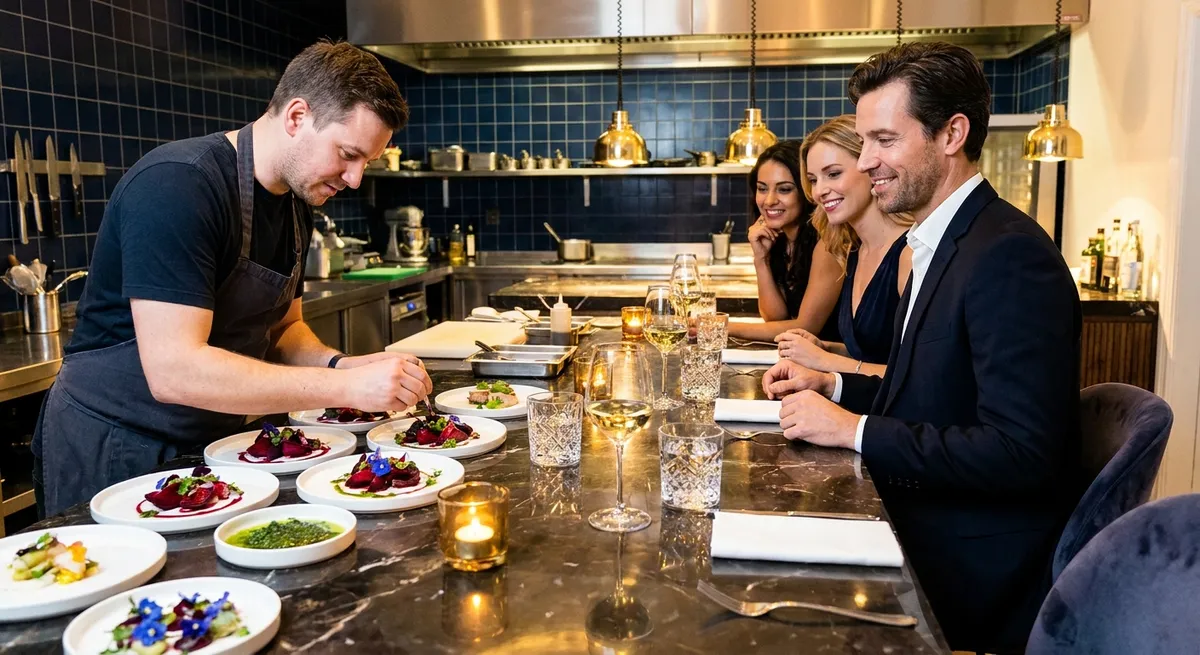
In elite rooms, the most interesting things rarely appear in print. The menu is a script for the public performance; the true dialogue happens off‑menu. Chefs and sommeliers reserve their most personal ideas, rarest bottles, and quietly experimental dishes for those who show curiosity and trust.
The cue is not to demand “something special,” but to invite collaboration. A simple “We’re in your hands—cook and pour as you’d host close friends visiting from abroad” unlocks a different level of hospitality. You are no longer ordering; you are commissioning.
Many top kitchens maintain tiny quantities of hyper‑seasonal ingredients—an aged fish collar, a micro‑allotment vegetable, a single wheel of raw‑milk cheese—that are never formally advertised. Likewise, serious wine programs often hold back cult producers, mature vintages, or late‑release champagnes for guests who respond to nuance rather than labels.
The luxury traveler learns to signal preferences by mood: “tonight we’d like something quietly indulgent,” or “we’re in the mood for a more contemplative, savory progression.” The best teams read that language and build a menu that feels like it couldn’t have been served to anyone else that evening.
Provenance Is the New Status Symbol
For a certain echelon of traveler, status has shifted from “how much” to “from where and by whom.” The finest experiences are increasingly defined by provenance—ingredients and makers with stories that can’t be imitated at scale.
On a plate, this might mean a single vegetable from a farmer who cultivates only for one or two restaurants, or sake sourced directly from a family brewery that produces in micro‑batches. It might be a butter so specific that the producer churns according to the chef’s preferred fat‑to‑protein ratio, or a bread made from grains milled mere hours before service.
For the guest, the signal is not to collect names, but to understand relationships. Ask one or two considered questions: “How long have you worked with this producer?” or “Does this appear on the menu year‑round, or only for a few weeks?” This reveals whether an ingredient is a casual purchase or a long‑standing partnership woven into the restaurant’s identity.
Discerning travelers often choose destinations around these relationships—booking a table specifically to experience one chef’s early‑spring vegetables, a short season of line‑caught fish, or the few weeks when a particular alpine cheese is at its peak. The restaurant becomes a curated portal into a region’s most guarded micro‑terroirs.
Silence as a Signature of Service
In refined dining rooms, true hospitality is audible before it is visible. The space between sounds—cutlery placed rather than dropped, footsteps that never break conversation, doors that sigh instead of slam—is a signature as distinctive as any chef’s plating.
Elite service teams operate in a kind of acoustic minimalism. Chairs are adjusted silently; a napkin is refolded while you reach for a glass; an empty plate disappears as you finish a sentence. The goal is not to impress you with attentiveness, but to remove friction so completely that you notice only the people at your table and the story on your plate.
Luxury travelers recognize this and often align their own behavior with the room’s intent. Phones remain out of sight; photos, if taken, are swift and unobtrusive; voices soften in respect for the shared sanctuary. In turn, the staff reciprocates: hushed explanations when you are mid‑conversation, more detailed storytelling when they sense your curiosity deepen.
At the highest level, even the design echoes this principle. Upholstery is chosen as much for its acoustic dampening as its aesthetic. Carpets, wall treatments, and even glassware are selected to soften clatter and keep the dining room tuned to murmur rather than roar. Silence, curated and intentional, becomes part of the flavor profile.
Dining as a Cartography of Memory
For those who travel frequently, meals become the most enduring way to anchor a city in memory. The finest restaurants understand this and design experiences that map themselves onto your personal narrative: a sequence of tastes and gestures that will reappear in your mind when you are thousands of miles away.
This can be as subtle as weaving a local ingredient into a familiar format, so that a dish feels both foreign and oddly intimate—a saffron‑scented broth echoing a childhood soup, or a dessert that reinterprets a flavor you associate with home. It might be the way a sommelier pairs a wine from your last trip with a dish from your current one, stitching destinations together in a single course.
Some of the world’s most considered dining rooms now keep discreet notes on returning guests beyond preferences and allergies. They remember that you celebrated a quiet promotion at the corner table, or that last time you favored savory over sweet. Your next visit subtly references the last—a glass of the same producer poured as an apéritif, or a small bite that nods to a dish you once particularly loved.
For the traveler, the most powerful gesture is to let the restaurant into your story. Share why you are there: not “a business dinner,” but “the first evening we’ve had entirely offline in weeks,” or “marking the end of a long project abroad.” When a team understands the emotional context of your evening, they can shape a progression that will live in your memory as more than “excellent food”—it becomes a chapter in your private atlas of places that mattered.
Conclusion
Fine dining, at its most elevated, is no longer defined by chandeliers and showmanship. It is defined by control of tempo, the intimacy of off‑menu dialogue, the quiet prestige of provenance, the choreography of silence, and the ability to inscribe a city onto your memory through taste.
For the luxury traveler, the real privilege is not simply gaining access to the restaurant everyone mentions—it is learning to read the invisible language of these rooms, and to participate in the experience as a collaborator rather than a spectator. In that space, dinner ceases to be an intermission between flights and meetings, and becomes something rarer: a private work of art, performed just once, for you.
Sources
- World’s 50 Best Restaurants – Official List & Insights - Global reference for leading restaurants, chef philosophies, and evolving fine dining trends
- Michelin Guide – Official Site - Authoritative resource on starred restaurants, service standards, and contemporary interpretations of luxury dining
- Harvard T.H. Chan School of Public Health – The Nutrition Source - Evidence‑based information on ingredients, food quality, and dietary considerations often reflected in modern high‑end cuisine
- UNESCO – Intangible Cultural Heritage: Gastronomic Meals - Context on how culinary traditions and dining rituals shape cultural and high‑end gastronomic experiences
- The New York Times – Food & Dining Section - In‑depth reporting on restaurant culture, chef‑driven movements, and the evolution of fine dining worldwide
Key Takeaway
The most important thing to remember from this article is that this information can change how you think about Fine Dining.