There is a moment, somewhere between boarding call and black car arrival, when time loosens its grip and the world narrows to a single tasting glass, a single plate, a single decision: stay, or move on. For the modern luxury traveler, fine dining is no longer a scheduled indulgence at the end of the journey; it is the invisible thread that stitches flights, cities, and seasons into a coherent narrative. At Jet Ready, we see gastronomy not as background pleasure, but as an organizing principle for a life lived elegantly in motion.
Below, five exclusive, insider perspectives that quietly shape how discerning travelers now experience the world—one table, one course, one rare bottle at a time.
The Chef’s Atlas: Reading Menus as Maps, Not Lists
To the untrained eye, a menu is an index of dishes. To the well-traveled gourmand, it is an atlas—encoded with latitude, harvest cycles, and supply-chain politics. Luxury travelers increasingly read menus the way art collectors read provenance: for origin, rarity, intention, and context.
When you sit down in Paris and see a single line—line-caught turbot, Île d’Yeu, beurre blanc—you are not just choosing fish; you are opting into the quiet logistics of a chef who refuses compromise on sourcing, who maintains relationships with specific boats and micro-producers. A dish built on DOP (Protected Designation of Origin) or seasonal-only ingredients is also a statement about tempo: this is not a plate that can be replicated everywhere, at any time.
For travelers who cross time zones as casually as avenues, this matters. It becomes a discipline: seek restaurants whose menus change not quarterly, but nightly; where “off-menu” suggestions are based on what arrived at the back door that morning. Elite frequent flyers now design itineraries to intersect with fleeting culinary windows—white asparagus in Baden-Baden, sea urchin in Hokkaido, green almond season in Andalusia—treating each meal as a geo-stamped chapter in a private atlas of taste.
Precision Without Theater: The New Discretion in Service
The traditional markers of luxury service—elaborate ceremony, hyper-visible staff, ornate table-side flourishes—are being quietly refined. What the global traveler wants, especially after a long-haul flight or a day of meetings, is precision without theater: service that anticipates but does not announce itself.
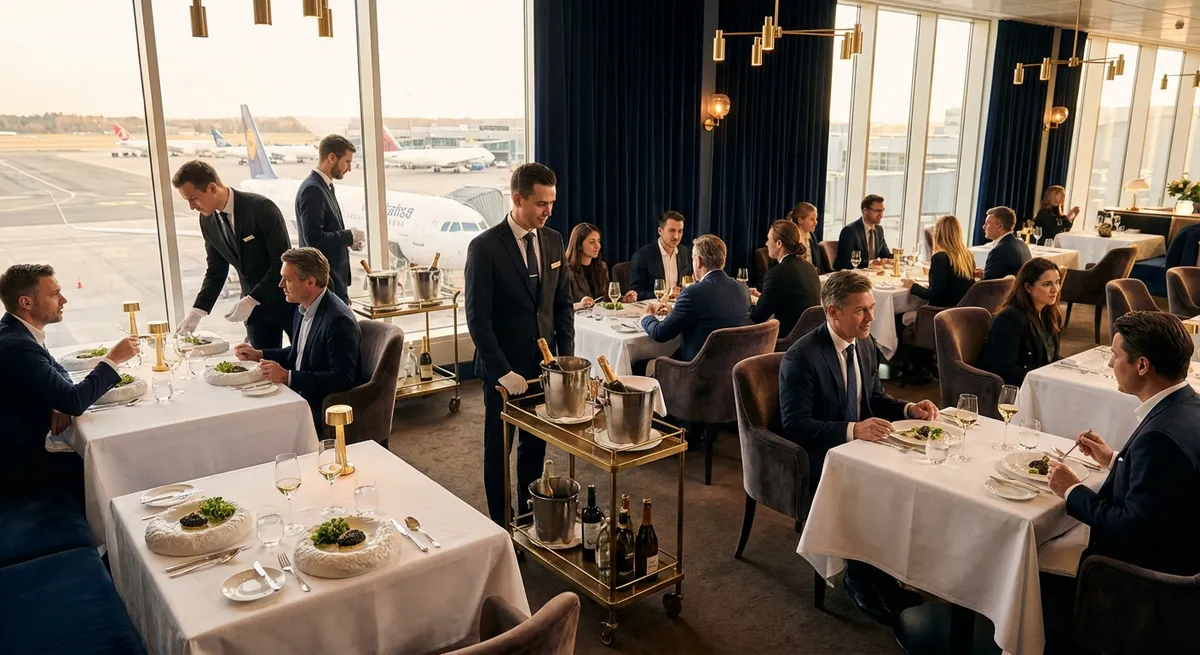
In this new grammar of hospitality, the finest dining rooms behave more like top-tier airport lounges than grand salons: minimal friction, maximal foresight. The sommelier who already knows your aversion to heavy oak because your hotel concierge shared your profile; the maître d’ who subtly paces the meal to your departure time without a single mention of the clock; the team that tunes sound levels and lighting to fend off jet lag rather than to impress Instagram.
What distinguishes the best restaurants for the luxury traveler is how seamlessly they integrate with a life in transit. Reservations that flex for delayed flights. A chef willing to adapt tasting menus for a short layover without cheapening the experience. Service scripts rewritten for frequent global guests who prefer continuity—a particular mineral water, a specific pattern of courses, a known coffee ritual—over spectacle. The real luxury now is having a dining room that functions almost as an extension of your personal cabin, wherever you land.
Beyond the Plate: Dining Rooms as Global ‘Third Spaces’
For those who live between terminals and tarmacs, the finest restaurants are no longer just places to eat; they are “third spaces” that serve as informal boardrooms, salons, and private clubs. Unlike traditional members-only venues, these spaces are technically open to all, but effectively curated by price point, access, and the length of reservation lists.
In Tokyo, Copenhagen, or New York, certain counters and corner tables have become unofficial nodes of a global network: investors, designers, founders, art advisors, and collectors who time their reservations to coincide with major art fairs, conferences, or seasonal openings. Deals are not always struck here, but trajectories are set. For the well-informed traveler, these restaurants form an invisible map of influence.
Choosing where to dine in a new city becomes strategic. Do you seek the temple of gastronomy where conversation gives way to reverent silence? Or the tasting counter where the chef is as plugged into cultural shifts as your favorite curator? Increasingly, the luxury traveler builds a portfolio of “third spaces” around the world—rooms where they are not merely served, but recognized, remembered, and subtly plugged into local currents without overt networking.
The key is discretion. The truly premium dining rooms manage the rare balance: tables spaced to safeguard conversation, acoustics that allow confidentiality without hushed stiffness, and staff who understand when to withdraw entirely from the narrative unfolding at the table.
Curation of Indulgence: Intelligent Restraint as a Mark of Luxury
In an era where any experience can be maximized, layered, and upgraded, the most sophisticated travelers are rediscovering the elegance of calibrated indulgence. Fine dining, for them, is no longer a sequence of unchecked excess, but a curated exercise in alignment: with one’s health, circadian rhythm, schedule, and personal aesthetic.
This manifests not in “diet” menus, but in dialogue. Leading chefs now approach the tasting menu as a collaborative commission instead of a rigid manifesto. They fine-tune portion sizes for guests arriving straight from a long-haul flight, rebalance courses toward lighter textures for those heading into an evening event, or quietly adjust sodium and richness for travelers battling dehydration at altitude.
For repeat guests, some restaurants maintain private profiles that go far beyond allergies—tracking preferences in acidity, spice, sweetness, and even how early or late in the meal a guest enjoys substantial savory courses. The result is a new breed of bespoke menu that feels less like a performance and more like a tailored garment: almost invisible in its rightness.
For the global traveler, this intelligent restraint has a strategic dimension. Thoughtfully designed meals can shorten jet lag, stabilize energy, and maintain cognitive clarity—turning dinner from an indulgence that must be “earned off” to an asset that supports a demanding travel cadence.
Time as the Rarest Ingredient: Designing Journeys Around a Single Table
Among those who can go almost anywhere, the most coveted luxury is not destination but alignment: a specific chef, at a specific moment, in a specific place. Increasingly, itineraries are being built backwards—from the table outward.
Instead of asking, “Where should I go this summer?” many high-frequency travelers start with a single, time-sensitive opportunity: a residency by a revered chef in a remote location; a restaurant whose creative peak is widely whispered about; a kitchen team intact before an anticipated change in leadership; or a one-season collaboration between a winemaker and a dining room. Travel then spirals out around this fixed point—flights, villas, side trips serving the gravitational pull of that one meal.
This approach reframes fine dining from a pleasant endpoint to a central architecture of the journey. A week in the Italian Alps or on a Pacific island might be structured so that the crescendo is a singular dinner calibrated to golden hour, optimal seasonality, and a specific wine pairing that will not be repeated.
It also introduces a new rhythm to travel planning: early intelligence, pre-release bookings, and relationships with concierges who can access embargoed reservation windows. The result is not a frantic race to secure tables, but a composed choreography in which everything else—galleries, sailing days, even meetings—quietly orbits the table that made the trip inevitable.
Conclusion
For the truly global traveler, fine dining is no longer a series of isolated highlights; it is a unifying language in an otherwise fragmented, high-speed life. Menus double as maps, dining rooms as off-the-record salons, and service as a soft technology for managing energy, privacy, and time.
The next evolution of luxury travel will not be defined solely by aircraft type or suite category, but by how seamlessly your gastronomic life follows you at 35,000 feet and beyond—quietly precise, intelligently restrained, and always one thoughtful course ahead of your journey.
Sources
- Michelin Guide Official Website – Global reference for top-rated restaurants and evolving fine dining trends.
- World’s 50 Best Restaurants – Annual ranking and editorial insights on influential chefs, restaurants, and gastronomic movements worldwide.
- Harvard T.H. Chan School of Public Health – Nutrition Source – Evidence-based guidance on nutrition, helpful for understanding health-conscious approaches to fine dining.
- U.S. Department of Agriculture – Seasonal Produce Guide – Authoritative resource on seasonality and sourcing, relevant to menu design and ingredient provenance.
- BBC Travel – Gastronomy Features – In-depth stories on global food cultures, culinary destinations, and how travel and dining intersect.
Key Takeaway
The most important thing to remember from this article is that this information can change how you think about Fine Dining.