There is a particular kind of traveler for whom the journey is measured less in miles and more in courses. For them, fine dining is not an event squeezed between meetings and check-out times; it is the quiet axis around which an entire itinerary turns. At this level, a restaurant is more than a reservation—it is a stage for memory, a barometer of a city’s confidence, and often, the most honest expression of its culture. For the luxury traveler, understanding how to move through this world with discernment transforms a simple meal into an experience that lingers long after the jet engines fall silent.
Fine Dining as Cultural Intelligence
For the sophisticated traveler, a destination’s most compelling dining rooms are not merely about opulence but about narrative. A Michelin-starred chef in Tokyo may express a century of culinary discipline in a single piece of toro, just as a tasting menu in Copenhagen might distill a radical new interpretation of sustainability into a course of seaweed and wild herbs. In both cases, the plate becomes a form of cultural intelligence—an accelerated way to understand where a place has been and where it is going.
What separates world-class dining from mere spectacle is this depth of context. Luxury travelers increasingly seek restaurants that reveal something essential about a locale’s history, migration patterns, or terroir, whether that’s a Parisian chef reimagining regional French classics or a Lima kitchen weaving indigenous ingredients into contemporary form. Attentive diners read a menu the way a collector studies provenance; ingredients and techniques become clues, tracing connections across continents and centuries.
For those traveling privately or on meticulously curated itineraries, this cultural dimension becomes particularly powerful. A carefully chosen restaurant can provide insights faster than any museum tour: the way local diners dress, how they order, when they arrive, what they celebrate, and which dishes command reverence. Sitting at the right table in the right dining room at the right hour is a masterclass in the city’s unwritten codes, delivered one course at a time.
The New Discretion: Securing the Unlisted Table
At the highest tiers of travel, the true luxury is not simply gaining a reservation—it is securing the exact experience you prefer, without your name ever appearing on a public waitlist. While many travelers fret over online booking platforms, seasoned luxury guests move along quieter channels: private aviation concierges, discreet hotel guest relations teams, or membership-based services that cultivate personal relationships with restaurant directors and chefs.
The distinction lies in nuance. It is not about ostentation or demanding special treatment; it is about precision and subtlety. A well-placed note to the restaurant regarding a guest’s preferred pacing, a known aversion to truffle oil, or a preference for a corner banquette can result in an experience that feels uncannily tailored. This is less about status and more about a carefully established dialogue, often conducted through intermediaries who understand both sides of the equation.
In the most coveted rooms—those where bookings evaporate within minutes of opening—the unlisted table exists as a quiet safety valve for very loyal guests, trusted partners, and travelers who value discretion. The art lies in continuity: returning to a restaurant over the years, remembering faces, sending concise feedback, and allowing familiarity to develop organically. For luxury travelers, the reservation is rarely a single transaction; it is the visible tip of a long-cultivated relationship.
The Architecture of Timing: When to Dine, and Why It Matters
In fine dining, timing is its own form of luxury. The same menu at 7:30 p.m. on a Saturday and at 9:00 p.m. on a quiet weekday can feel like two different restaurants. For travelers who cross time zones with ease, understanding the temporal architecture of a dining room is an exclusive advantage.
Early seatings often bring precision: the kitchen is at full strength, energy is controlled, and service can feel almost ceremonial. Later services, particularly in cities like Madrid, New York, or Hong Kong, can turn a meal into a social theatre, with industry regulars, off-duty chefs, and hotel insiders quietly filling preferred tables. Some luxury travelers deliberately choose late reservations to watch a city’s characters converge in one room, while others request the first table of the evening, valuing focus and privacy above atmosphere.
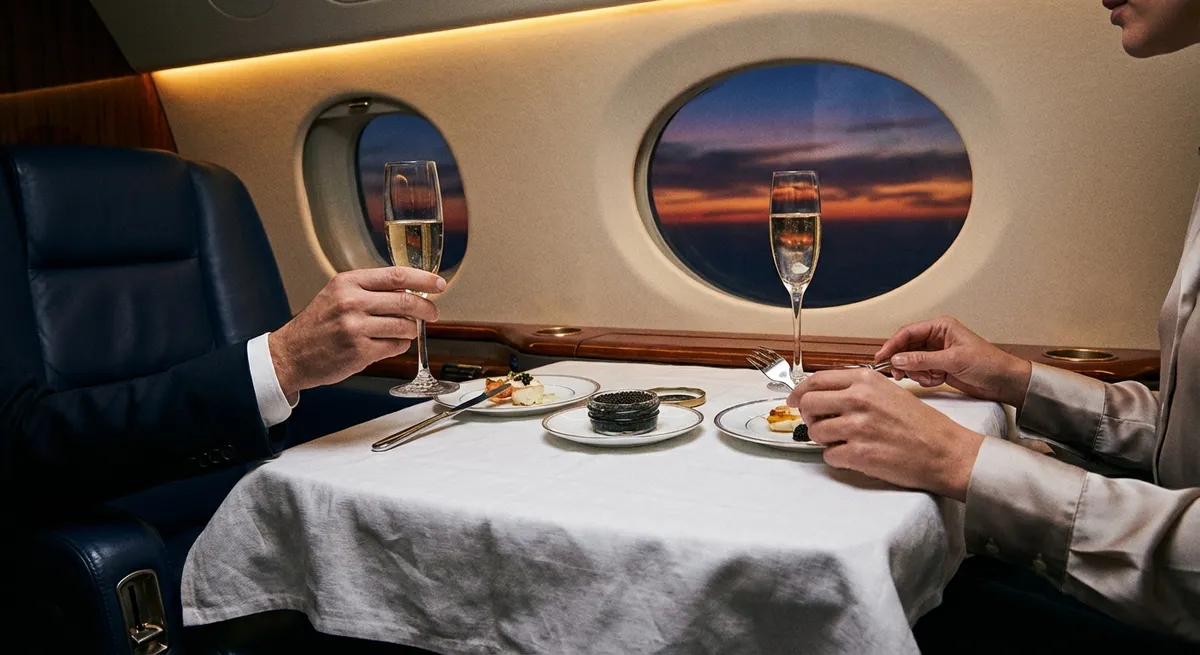
There is also the question of how long a meal should take. For those traveling by private jet or with tight yet flexible agendas, the ability to choreograph a tasting menu to a precise timeline—two hours instead of three, a compressed pairing, a decision to move desserts to the lounge—can make the difference between an indulgence and an inconvenience. The most accomplished restaurants understand this and can pace service accordingly, but only when the guest’s preferences are conveyed in advance with clarity and grace. Here, timing becomes a shared craft rather than an accident.
Beyond the Menu: Invisible Luxury in Service Design
To the untrained eye, fine dining is about what appears on the plate. To the frequent luxury traveler, its real refinement lives in what remains invisible. This might be the way a sommelier subtly adjusts their language when they sense a guest’s deep knowledge, or conversely, their desire for guidance without jargon. It could be the decision to split a course across two plates unprompted, knowing the table is sharing, or the quiet arrival of an alternative dish when a guest has barely glanced at an ingredient they once mentioned disliking.
These gestures emerging from service design are increasingly the new currency of luxury. Many of the world’s leading restaurants now track guest preferences with the rigor of a hotel’s guest profile system: favored wine regions, historical allergies, celebration dates, even seating preferences based on light levels or proximity to the kitchen pass. Returning guests may find that a beloved dish, long off the menu, appears “from the kitchen” as a small course, or that a specific glassware style they once complimented has been laid in advance.
For travelers who are accustomed to a certain standard on board their aircraft or in their suites, the alignment of service philosophies between their hotel, their jet, and their chosen restaurants creates a sense of seamlessness. The real luxury is water-like: it adapts to the vessel. In practice, this means fewer questions, fewer interruptions, an intuitive reading of body language—and the sensation that the evening is unfolding exactly as you would have designed it, without ever having to articulate it in the moment.
The Curated Pairing: Aligning Wine, Travel, and Memory
At the rarefied intersection of fine dining and luxury travel, wine becomes more than a pairing; it becomes a method of archiving experiences. A 1998 Barolo opened in Piedmont at harvest, a grower Champagne shared in a Paris townhouse, a Napa Cabernet revisited in the very valley where it was made—these are not simply bottles, but sophisticated timestamps attached to journeys.
Discerning travelers increasingly use their itineraries to deepen their relationship with specific regions and producers. A multi-city trip might be structured to include one meaningful wine experience in each destination: a vertical tasting in Bordeaux, a sake pairing dinner in Kyoto, or a natural wine bistro in Copenhagen recommended by a sommelier in London. Over time, these experiences create an invisible map, where each glass recalls not only its origin but the specific hotel suite, car ride, or conversation that framed it.
The most forward-thinking restaurants understand this and are modernizing the concept of pairing to match the traveler’s reality. Instead of rigid pre-set flights, they may suggest a sequence that reflects where a guest has just come from or where they are going next—perhaps beginning with a wine from the previous destination as a quiet farewell, then transitioning into the region’s own expression as an introduction. Some create “jet lag–sensitive” pairings, emphasizing lower-alcohol selections or focusing on freshness and minerality for guests stepping off long-haul flights. In these hands, wine becomes a subtle instrument for recalibrating the body and anchoring memory simultaneously.
Conclusion
For the luxury traveler, fine dining is not a trophy to be collected but a refined undercurrent to every journey—a private dialogue between place, palate, and time. The most memorable meals are rarely the loudest or the most photographed; they are the ones in which logistics, timing, service, and narrative align with such coherence that the evening feels inevitable, almost preordained.
To move through the world with this level of culinary discernment is to accept that restaurants can function as both mirrors and maps: reflecting one’s own tastes while pointing, quietly, to new terrain. In the end, the true privilege is not simply having access to the world’s most coveted tables, but having the sensitivity to recognize when a room, a course, a glass, and a moment have aligned into something irreproducible. That is the quiet, enduring luxury that travels with you long after the final course has been cleared.
Sources
- [The Michelin Guide – Official Site](https://guide.michelin.com/) - Global reference for fine dining standards, star ratings, and restaurant recognition
- [World’s 50 Best Restaurants](https://www.theworlds50best.com/) - Influential ranking and editorial insights into leading restaurants worldwide
- [Academy of Nutrition and Dietetics – Dining Out Smart](https://www.eatright.org/food/planning-and-prep/eating-out/how-to-dine-out-healthy) - Context on menu design, portions, and dining considerations
- [Harvard T.H. Chan School of Public Health – The Nutrition Source: Wine](https://www.hsph.harvard.edu/nutritionsource/alcohol/wine/) - Evidence-based overview of wine, health, and moderation
- [UNESCO – Intangible Cultural Heritage: Gastronomy](https://ich.unesco.org/en/intangible-heritage/domains/knowledge-and-practices-concerning-nature-and-the-universe) - Explores food and gastronomy as expressions of cultural heritage and identity
Key Takeaway
The most important thing to remember from this article is that this information can change how you think about Fine Dining.