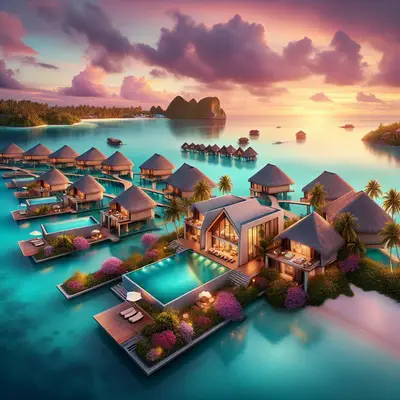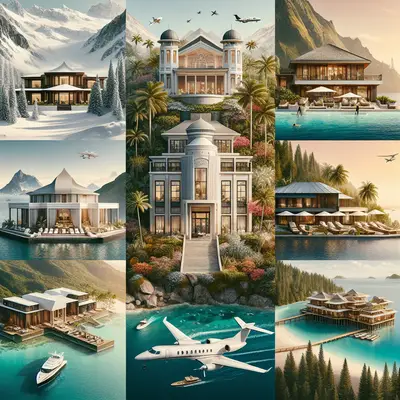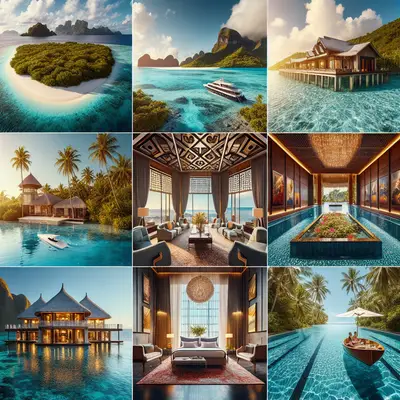
The most discerning travelers do not simply choose where to stay; they curate the context in which their time unfolds. Exclusive resorts—whether perched on a private peninsula, woven discreetly into a heritage city, or hidden in a desert valley—serve less as “accommodations” and more as finely tuned ecosystems for presence, privacy, and precision. Understanding how these places are designed, and how to move through them, transforms a stay from impressive to deeply personal.
Below, five exclusive insights reveal how sophisticated travelers quietly extract the most from these sanctuaries—without ever breaking the surface calm.
The Geometry of Privacy: How Space Is Silently Engineered
In truly exclusive resorts, privacy is not declared; it is architected.
Thoughtful spatial planning ensures that sightlines, soundscapes, and circulation all conspire to create a feeling of effortless seclusion. Villas are oriented to frame views without framing neighbors. Pathways curve rather than cut, encouraging gentle discovery instead of direct exposure. Public areas are layered in “soft zones” of intimacy—quiet corners, semi‑screened lounges, and terraces that feel somehow yours, even when occupied.
Sophisticated travelers learn to read these spatial cues. A subtly recessed seating area may indicate a spot favored for late‑night nightcaps; an apparently secondary boardwalk might provide the most serene morning walk. Asking your butler or guest experience manager not just where things are, but how different spaces “feel” at various times of day, unlocks a deeper understanding of the property’s spatial rhythm.
The insight: privacy is often most successful where it is least visible. Seek the transitions—thresholds, alcoves, passages. That is where the resort’s true intention is revealed.
Time as a Concierge: Orchestrating Your Stay by Rhythm, Not Schedule
Exclusive resorts operate on a quieter calendar than the one printed in your room compendium.
The best experiences rarely appear as “11:00 AM – activity” in an itinerary. Instead, they are choreographed around natural cycles—sunrise, tides, seasonal produce, local customs—and the resort’s own internal tempo. A coastal property, for instance, may be at its most tranquil in the late afternoon when yacht parties have departed, while a desert retreat will often reveal its finest textures just after dusk, when heat dissipates and stars begin to dominate the horizon.
Luxury travelers learn to treat time as their primary concierge. They ask about “the hour when the resort feels most itself,” or the chef’s preferred time for a market visit, or when the spa’s thermal areas are typically quietest. They notice when the staff slows their pace, when music softens, when the horizon changes character.
The insight: rather than filling days with back‑to‑back activities, align your movements with the resort’s natural rhythm. This transforms the property from a backdrop into a living, breathing collaborator in your journey.
The Invisible Network: Cultivating Discreet, High‑Trust Relationships
In the world of exclusive resorts, relationships are the real upgrade.
Behind polished service is an intricate network of concierges, guest relations directors, preferred partners, and global hospitality groups who quietly move mountains for those they know well. Loyalty is less about accumulating points and more about cultivating a recognizable profile of preferences, values, and travel style across properties and brands.
Sophisticated travelers understand that a single thoughtful conversation can have more impact than an entire loyalty tier. Sharing how you like to spend your mornings, what you consider restorative, or which details you habitually notice (lighting, acoustics, textiles, local sourcing) gives the team raw material to design around you. Over time, this creates a frictionless experience: the correct pillow appears without asking; your preferred pool lounger is “somehow” always available; arrival and departure feel more like seamless transitions than transactions.
The insight: treat each stay as an ongoing dialogue rather than a one‑off event. You are not just checking in—you’re adding another chapter to a long, quiet file on how to look after you exquisitely well.
Curated Locality: When Place Becomes Part of the Suite
At the highest level, a resort is not merely situated somewhere; it converses with its surroundings.
Instead of generic “international luxury,” you’ll find architecture that borrows proportions from local temples or townhouses, landscaping that restores native flora rather than overwriting it, and culinary programs that move beyond token dishes toward genuine co‑creation with local producers, foragers, and artisans.
Discerning guests look for signs of this deeper integration: handcrafted ceramics from a nearby studio instead of anonymous tableware; a library curated with regional literature; spa rituals that reflect indigenous botanicals and time‑honored techniques, not just imported trends. They often request private introductions—to a winemaker whose bottles appear on the degustation list, or to the designer behind the custom textiles in their suite.
The insight: locality, when fully curated, turns the resort into a portal rather than an escape. You leave not only rested, but imprinted—carrying a refined, distilled version of the destination with you.
The Art of Understatement: Selecting Resorts That Edit, Not Add
True exclusivity is increasingly measured in what is omitted.
In a world saturated with options, some of the most compelling resorts are those that exercise rigorous restraint. Fewer rooms, fewer restaurants, fewer events—yet each element is executed with extraordinary clarity. Instead of a sprawling list of amenities, you might find a single, impeccably equipped wellness studio; rather than multiple “concept” bars, one impeccably lit lounge where every pour is intentional.
Experienced luxury travelers now seek this form of editing as a relief from excess. They pay attention to noise—both literal and visual. Is the design language coherent, or a collage of trends? Do staff announcements intrude upon the natural soundscape? Are digital interfaces quietly intuitive, or constantly vying for your attention?
The insight: the most elevated resorts are not those that give you everything, but those that remove everything that does not serve your sense of ease, focus, and pleasure. When choosing where to stay, look less at the length of the amenity list and more at the quality of the resort’s restraint.
Conclusion
Exclusive resorts, at their best, are not stages for spectacle but instruments of calibration. They tune light, texture, sound, and time with the same care a luthier brings to a violin—so that, when you arrive, your own pace can soften into something quieter, more precise, more intentional.
Understanding the geometry of privacy, the rhythm of time, the power of discreet relationships, the depth of true locality, and the luxury of understatement allows you to read these properties with a more informed eye. You begin to see not just what is presented, but what is designed for you to discover in your own time.
In that space—between what is visible and what is quietly orchestrated—resorts stop being destinations and become instruments for a more refined way of moving through the world.
Sources
- [Forbes Travel Guide – What Makes a Five-Star Hotel](https://www.forbestravelguide.com/about/forbes-travel-guide-five-star-award) – Insight into the service and design standards that define top-tier luxury properties
- [Virtuoso – The Future of Luxury Travel](https://www.virtuoso.com/travel/articles/future-of-luxury-travel) – Industry perspective on emerging preferences among high-end travelers
- [Condé Nast Traveler – Why Sense of Place Matters in Hotels](https://www.cntraveler.com/story/why-sense-of-place-matters-in-hotels) – Discussion of how deep locality and design shape the guest experience
- [World Travel & Tourism Council – Trends in High-End Tourism](https://wttc.org/research/insights) – Research and reports on evolving expectations in premium travel
- [Cornell University School of Hotel Administration – Hospitality Research](https://scholarship.sha.cornell.edu/hospitalitypubs/) – Academic publications examining service design, guest satisfaction, and luxury hospitality operations
Key Takeaway
The most important thing to remember from this article is that this information can change how you think about Exclusive Resorts.