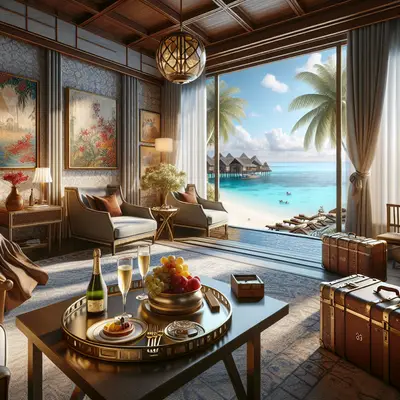
The most refined lifestyles are rarely the loudest. They are defined instead by calibration: intelligent choices, precise edits, and an instinct for what feels both rare and deeply personal. For the luxury traveler, this isn’t about collecting destinations; it’s about orchestrating a life in which every journey, object, and experience is deliberately aligned with a private standard of excellence.
Below, five exclusive insights unfold—not as rules, but as coordinates—for those shaping a premium life with intention and discretion.
1. The Shift from Access to Priority
For discerning travelers, luxury is no longer measured by how much they can access, but by how little friction they experience.
Priority is the new privilege: not just priority boarding, but priority problem-solving, priority decision-making, priority care. This can look like having a dedicated travel advisor with direct lines to general managers rather than generic front desks, or leveraging invitation-only memberships that quietly guarantee late check-outs, unlisted room categories, and last‑minute table reservations that do not appear on standard platforms.
The premium traveler understands that time is the most non-renewable currency. They invest in systems that protect it: airport concierge services that escort them past crowded checkpoints, private drivers who understand when silence is preferred over conversation, and digital tools that reduce administrative noise to a minimum. The measure of success is simple: the world moves around them, not the other way round.
In this recalibrated definition of access, luxury becomes invisible efficiency—where the most extraordinary benefit is that everything simply works without announcement.
2. Crafting an Itinerary Like a Private Collection
A sophisticated life is curated, not crowded. Nowhere is this more evident than in how premium travelers design their itineraries.
Instead of cramming multiple destinations into a single trip, they treat each journey like a capsule collection: tight, intentional, and coherent. A week is devoted to a single coastline, a single city neighborhood, or even a single resort—choosing depth over breadth. Days are structured around one or two anchor experiences, with deliberate whitespace left for unplanned discoveries, private tastings, or an unhurried afternoon by a window with a view and a book.
The most refined itineraries also reflect a personal archive of interests: architecture, contemporary art, artisanal watchmaking, rare wine, or indigenous craft traditions. These passions serve as a quiet thread that stitches together Tokyo, Milan, Oaxaca, and Copenhagen into a narrative that feels distinctly their own.
Rather than asking “What is there to do?”, the premium traveler asks “What belongs in my collection of experiences this year?” The result is a life that feels less like a highlight reel and more like a private museum—intimate, coherent, and deeply considered.
3. The New Discreet Sustainability
For the modern luxury traveler, sustainability is no longer a marketing line; it is a quiet minimum standard.
This is not performative eco-consciousness. It is the decision to stay in properties that respect local ecosystems and labor, even when those properties do not advertise it loudly. It is choosing a hotel that invests in local community projects or marine conservation; chartering with a yacht company that adheres to stringent environmental regulations; supporting restaurants that work directly with regional farmers and fisheries.
Crucially, sustainability at the premium level is about alignment, not sacrifice. Solar-powered island retreats with private plunge pools, all-electric transfers in cities, and expertly designed low-impact villas prove that elevated comfort and environmental intelligence can coexist. The modern elite traveler values this harmony: they want their presence to leave as light a trace as possible while their memories leave the deepest impression.
The benchmark is subtle: a resort that can speak as elegantly about its waste management systems and energy footprint as it can about its wine list is one worth returning to.
4. Investing in Relationships, Not Just Reservations
At a certain level, the true luxury is not “where” but “who.” The most seasoned travelers understand that access, nuance, and personalization are born from relationships.
Instead of relying solely on algorithm-driven platforms, they cultivate long-term connections with a small circle of specialists: a trusted travel advisor, a favorite hotel general manager, a sommelier who remembers their preferences, a private guide whose expertise far surpasses what any standard tour could offer. Over time, these relationships transform routine stays into quietly remarkable experiences—unlisted dishes from the kitchen, after-hours gallery access, or a room that feels intuitively configured before arrival.
This relational approach extends beyond hospitality. Premium lifestyles are often underpinned by a cohort of experts: art consultants, wellness practitioners, tailors, perfumers, and watchmakers who help translate personal taste into tangible form. What emerges is an ecosystem of people who understand the traveler’s sensibilities so completely that fewer instructions are needed with every interaction.
In an age of infinite choice, this curated circle becomes a stabilizing luxury: a human infrastructure that makes the world feel both expansive and deeply familiar.
5. Designing Recovery as Carefully as Adventure
No premium life is built solely on motion. The most refined travelers are increasingly attentive to what happens between departures: recovery, recalibration, and quiet.
This goes far beyond the standard spa treatment. It includes carefully structuring travel days with buffers, not just connections—arriving a day before key events to offset jet lag, selecting cabins with proper sleeping surfaces even on short-haul flights, and integrating nutrition and hydration strategies backed by medical or wellness guidance. It means occasional trips designed explicitly for repair rather than exploration: stays at destination medical spas, wellness clinics, or discreet retreats where recovery programs are as tailored as haute couture.
There is also a digital dimension to recovery. Many premium travelers now negotiate boundaries with their own connectivity: dedicated offline hours while in the air, a second “silent” device used only for navigation and hotel keys, or deliberate weekends without email access. The aim is not escape, but recalibration—a chance to restore clarity so that each new destination is experienced with heightened attention rather than residual fatigue.
In this framework, rest is not an indulgence but an infrastructure. It is the quiet architecture that allows every other luxury to be fully felt.
Conclusion
A truly premium lifestyle is rarely about spectacle; it is about precision. It lives in the way time is protected, how itineraries are composed, which values—like sustainability and discretion—are woven into every choice, and which relationships are cultivated over years rather than visits.
For the luxury traveler, these five insights are less a checklist and more a lens: a way of seeing the world that favors depth over display, intention over impulse, and experiences that feel quietly irreplaceable. In the end, the most compelling luxury is not what others can see—it is how exquisitely your life feels from the inside.
Sources
- U.S. Travel Association – Traveler Trends - Provides data and insights on evolving traveler preferences, including premium segments and changing definitions of value and convenience.
- American Express Travel – 2024 Global Travel Trends Report - Explores behaviors of high-spend travelers, including prioritization of experiences, personalization, and wellness.
- Condé Nast Traveler – The Future of Luxury Travel - Discusses how luxury travel is shifting toward discretion, sustainability, and experiential depth.
- World Travel & Tourism Council – Sustainability in Travel & Tourism - Offers reports and frameworks on sustainable practices within high-end hospitality and tourism.
- Harvard Business Review – The New Luxury Experience - Analyzes how affluent consumers increasingly value personalization, meaning, and emotional connection over traditional status symbols.
Key Takeaway
The most important thing to remember from this article is that this information can change how you think about Premium Lifestyle.