There is a particular kind of resort that doesn’t need to announce itself. It appears in hushed recommendations between peers, buried deep in a personal contact list rather than on social feeds. For the discerning traveler, these retreats are less a destination and more a private operating system for how they move through the world: calibrated, anticipatory, and quietly unforgettable.
The New Geography of Privacy
For a growing circle of luxury travelers, the map of desirable places is no longer defined by famous coastlines or postcard cities. It is defined by the precision of privacy.
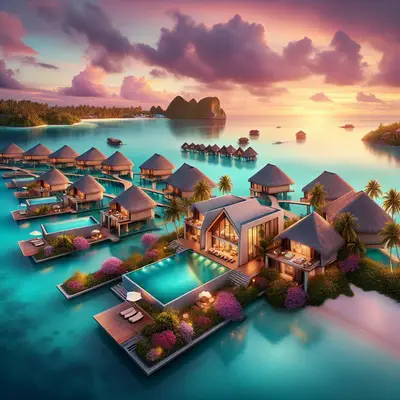
The most sought-after resorts are often not the ones with the longest waiting lists, but the ones that never advertise their availability at all. They are designed around micro-seclusion: a villa oriented a few degrees off the typical ocean view to ensure that neighboring terraces are invisible; pathways planted not just for beauty, but to mute the sound of footsteps and distant conversation; arrival routes that keep guests from ever crossing through a lobby when they would prefer not to be seen.
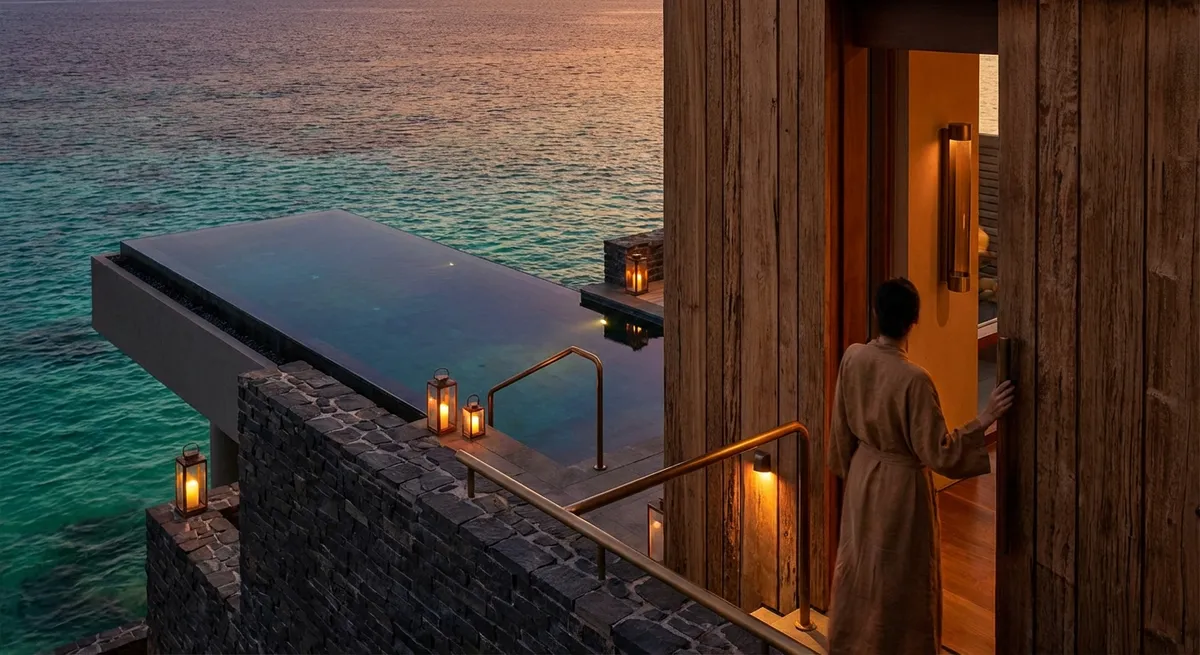
Privacy here is not about isolation, but about control. Guests choose when to be visible and when to disappear. Rooms are laid out so that work calls can be taken with a background of sea and sky, while partners read uninterrupted nearby. The pools are positioned so that from your chaise, it feels as if you have the entire horizon to yourself.
For these travelers, the question is no longer, “Where is it?” but “How quietly can I inhabit it?”
Orchestrated Ease: Service That Edits Itself Out
At the most rarefied retreats, service operates like a well-edited film: you never see the cuts, only the final seamless experience. What distinguishes true exclusivity today is not excess attention, but intelligent absence.
Staff members are trained to read tempo. A couple who lands on-property after an overnight flight is not greeted with a formal tour, but with a chilled towel, a room prepared to sleep immediately, and luggage that appears only once they wake. Drinks arrive refilled, though you never saw anyone approach the table. Housekeeping learns the choreography of your day within 24 hours: when you return from breakfast, the room is already refreshed; when you leave the spa, a pressed evening dress or jacket waits—without being requested.
This is service that anticipates without performing. Guests are remembered, but never displayed. Personal preferences—water temperature, pillow type, whether you prefer background music or silence at turndown—are recorded discreetly and carried forward visit after visit. The feeling is less “served” and more “understood.”
For seasoned travelers, the true luxury is not being asked, “Is everything okay?” but realizing, as you board your departure transfer, that everything has been quietly, continuously, better than okay.
Five Exclusive Insights Only Insiders Tend to Share
Beyond the visible architecture and amenities, there are subtler dimensions of exclusive resorts that regular travelers rarely see or even know to inquire about. The most discerning guests look for—and invest in—the following:
Silent Infrastructure Is the Real Signature
Behind the landscaping and infinity pools lies a different kind of design: air systems that quietly keep humidity at bay, soundproofing that insulates you from neighboring villas even at full occupancy, and water systems that maintain perfect pressure and temperature with no lag. Serious travelers ask about building age, recent upgrades, and who handled the engineering. The true test of a resort’s caliber is not the view from the terrace, but how consistently that comfort holds at 3 a.m., in peak season, during a storm.
Security That Feels Like Safety, Not Surveillance
At the highest level, security is omnipresent and nearly invisible. You may never see a uniform, but cameras are precisely placed, perimeter access is controlled, and staff quietly coordinate with local authorities and private services. Transportation is vetted; guest names are shielded; room locations are never spoken aloud at check-in. Regulars often favor properties with discreet relationships to local embassies, medical facilities, and private aviation terminals—contingency planning is treated as a standard amenity, not an afterthought.
The Power of “Closed-Circle” Experiences
What truly sets certain resorts apart is their ability to transform an entire environment into a closed-circle experience. This might mean shutting a restaurant for a private menu tasting, rerouting other guests to alternative venues without anyone feeling displaced, or arranging after-hours access to a heritage site, vineyard, or offshore sandbar where you simply will not encounter strangers. It’s not only exclusivity; it’s narrative control—your stay unfolds as its own self-contained story.
Chef’s Kitchen, Not Just Fine Dining
In-the-know guests pay close attention to what happens behind the dining room doors. The most elevated resorts invest in direct relationships with local farmers, fishermen, and foragers, as well as carefully curated global purveyors. Menus become living documents, rewritten daily based on what arrives that morning. Guests who return regularly often keep a running “culinary file” with the property: dietary preferences, wines they’ve recently discovered, even regional cuisines they’re curious to explore next visit. Over time, it becomes less like ordering from a menu and more like collaborating with a private chef who knows your palate better than you do.
Continuity Across Borders
Sophisticated travelers increasingly value resort brands and memberships that deliver continuity in multiple countries without falling into sameness. They look for a recognizable service ethic and standard of privacy, paired with sharply distinct local expressions—architecture that is genuinely of the place, staff who are from the region and empowered to shape guest experiences, and programming that could not be transplanted elsewhere. Consistency is found in the way you are known, not in replicating the same room or restaurant in every destination.
These insights are rarely marketed. They are discovered, slowly, through repetition, comparison, and quiet conversation among those who travel often—and well.
Time as the Ultimate Suite Upgrade
For guests accustomed to premium cabins and priority lanes, the only true scarcity left is time. The most exceptional resorts understand this deeply and design every element of their offering around protecting, compressing, and refining it.
Transfers are timed with surgical precision to flight schedules and private arrivals. Jet-lag management is treated as an art form: blackout systems, circadian-aware lighting, spa programs that respond to eastward versus westward travel, even in-room dining menus calibrated to support sleep or focus rather than simply comfort. The result is that a 72-hour stay feels like a week of useful restoration.
Administrative friction is minimized to near-zero. Check-in happens en route or in-residence; passports are scanned once and handled respectfully, not photocopied through multiple desks. Billing is transparent, pre-agreed, and presented with no surprises; concierge teams pre-clear restaurants, health treatments, yacht charters, and cultural experiences so that nothing requires your time in line or on hold.
In the most sophisticated properties, time expands not because the clock slows, but because almost none of it is wasted on anything that does not serve your reason for being there.
The Discreet Art of Belonging Without Broadcasting
What differentiates a truly exclusive retreat from a beautiful hotel is not only who stays there, but the unspoken code under which they do. Guests are often people whose names mean something in their respective worlds, yet there is a shared understanding: here, no one is on display.
Photography policies are subtly enforced; public spaces are designed so that phones feel out of place. The most attuned resorts create quiet, analog rituals—sunset gatherings, late-night libraries, chef’s counter conversations—that foster a sense of belonging without ever veering into forced sociability. You are welcome to remain entirely private, or to engage; both choices are equally valid, and equally protected.
For the traveler who has long passed the desire to prove where they have been, this is the greatest luxury of all: not only to arrive, but to inhabit a place without leaving a digital echo unless they choose to.
Conclusion
Exclusive resorts are no longer defined by marble lobbies and recognizable logos. They are defined by a subtler architecture: of privacy, anticipation, infrastructure, and time. For the discerning traveler, the true markers of excellence are rarely photographed—the unbroken quiet of a morning terrace, a sense of being recognized without being exposed, and an itinerary that seems to gently arrange itself around your needs.
In this realm, luxury isn’t something shown. It is something felt, privately, in the spaces between each carefully considered moment.
Sources
- [U.S. Travel Association – Travel Forecast & Trends](https://www.ustravel.org/research/travel-forecasts) - Provides data and insights on evolving travel behaviors, including demand for premium and leisure segments.
- [Virtuoso – 2024 Luxe Report](https://www.virtuoso.com/travel/articles/virtuoso-2024-luxe-report) - Analyzes preferences of high-net-worth travelers, including privacy, personalization, and exclusive experiences.
- [Forbes – How Luxury Travel Is Changing](https://www.forbes.com/sites/forbesbusinesscouncil/2023/07/13/how-luxury-travel-is-changing/) - Explores shifting definitions of luxury, emphasizing experience, time, and discretion over ostentation.
- [Condé Nast Traveler – Private Villas and Exclusive-Use Resorts](https://www.cntraveler.com/story/the-rise-of-exclusive-use-hotels) - Discusses the rise of exclusive-use properties and heightened interest in seclusion and control.
- [Harvard Business Review – The Value of Customer Experience](https://hbr.org/2014/10/the-value-of-customer-experience-quantified) - Examines how anticipatory, seamless service drives loyalty, relevant to the service ethos of high-end resorts.
Key Takeaway
The most important thing to remember from this article is that this information can change how you think about Exclusive Resorts.