Luxury travelers no longer chase the loudest restaurant in the city—they pursue the quietest table with the sharpest intent. Fine dining has evolved from spectacle to strategy: a place where taste, privacy, timing, and perception are carefully managed. For the Jet Ready traveler, the restaurant is not simply where you eat; it is where influence is measured, relationships are calibrated, and a city reveals its inner circle.
Below are five exclusive, rarely discussed insights that shape the way discerning travelers now experience the world’s most coveted dining rooms.
1. The Real Luxury Is the Request You Never Have to Make
The most sophisticated dining rooms don’t impress with grand gestures; they impress with prescience.
In top-tier restaurants, the true measure of status is not a complimentary glass of champagne—it’s the quiet recognition of your preferences before you articulate them. Guests who travel frequently at a certain level understand the value of being known: the water temperature adjusted to your liking, the pace of service anticipated, the lighting at your table tuned subtly as the evening progresses.
Cultivated relationships with high-caliber concierges and restaurant groups replace the need to “ask” for special treatment. Your profile travels with you—from Paris to New York to Singapore—carrying a record of your preferences, allergies, and even conversational style. For luxury travelers, this is not about entitlement; it is about conserving decision-making energy. When a restaurant silently orchestrates your comfort, it allows the experience to become immersive rather than performative.
This is why serious travelers invest in continuity: staying within the same brand families, nurturing genuine relationships with maître d’s and sommeliers, and treating each visit as part of an ongoing narrative rather than a one-off show. Over time, the result is a dining life in which service feels less transactional and more curatorial.
2. The Most Valuable Table Is Not the One You Think
The mythology around “the best table in the house” is outdated. For those accustomed to moving through premium spaces, the best table is not always by the window, near the terrace, or with a dramatic view of the open kitchen. It is the table that gives you control.
Control over sightlines. Control over noise. Control over how much of your presence the room absorbs and reflects.
In serious dining rooms, certain tables are understood internally as “conversation tables”—placements that minimize foot traffic, reduce the likelihood of photography from adjacent diners, and allow for nuanced discussion without competing with the soundscape of the room. These are the tables that are never offered on a simple online booking. They belong to regulars, to discreet power meetings, to guests whose reasons for being there are not decorative.
Savvy travelers learn to read a room: where the host pauses before choosing a placement, which tables are occupied by solo diners with tasting menus, where sommeliers linger slightly longer. Over time, they develop a quiet preference—corner banquettes that face the room without being in it, slightly offset two-tops that aren’t on the traffic line to the kitchen, or that one table which appears ordinary but reliably receives the best flow of service.
In the modern era of visible dining, true luxury is sometimes having a meal no one else appears to notice.
3. The New Prestige: Pairings That Respect Your Time, Not Just Your Palate
Wine pairings have long been a hallmark of fine dining, but for high-frequency travelers, the traditional model can feel excessive and misaligned with their realities: early departures, back-to-back flights, or multiple engagements in a single evening. The new marker of sophistication is not how much you drink—but how intentionally you do so.
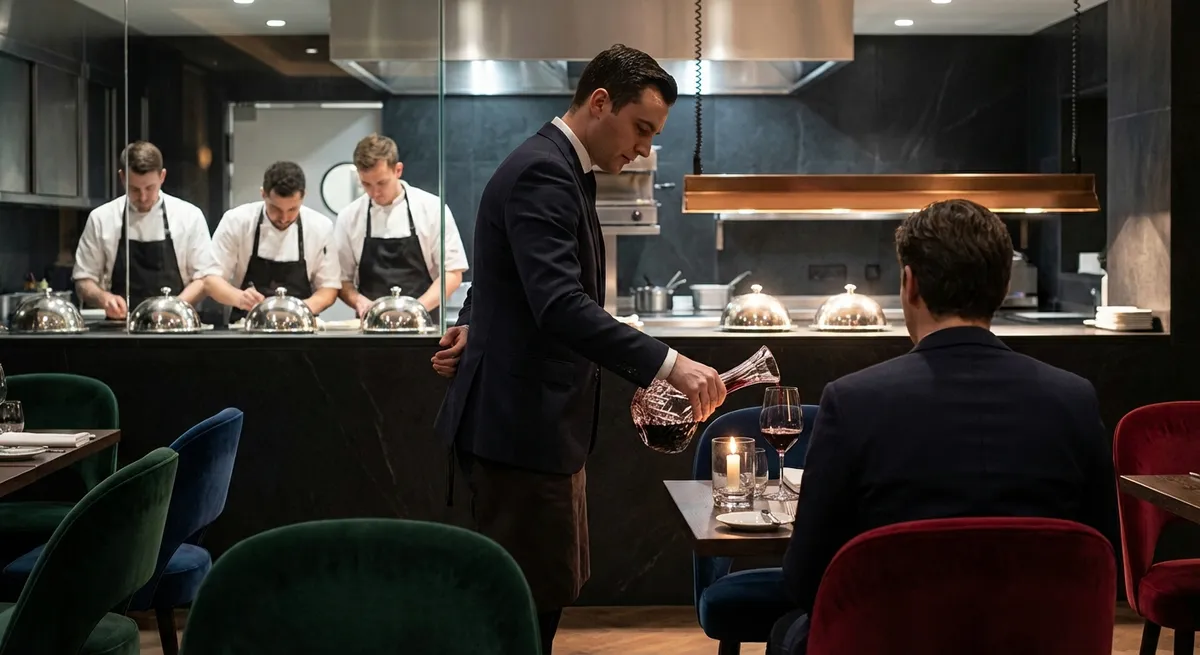
Elite diners now favor calibrated pairing strategies over automatic full pours. They discuss half-pairings, selective pairings (only for specific courses), or a focus on low-intervention, lower-alcohol wines that maintain clarity rather than induce fatigue. A knowledgeable sommelier reads not just your taste, but your evening: your posture, your pace, the way you interact with the menu.
In global capitals, beverage programs are quietly redefining luxury as precision rather than abundance. Aperitifs are lighter, digestifs are more distilled in flavor than in volume, and non-alcoholic pairings have become more than a concession—they are a signal that the restaurant respects cognitive sharpness as much as indulgence.
For the Jet Ready traveler, this is liberation. Fine dining no longer demands sacrificing the next morning’s meeting, the next city, or the next flight. It allows for refinement without residue—an evening that ends exactly where you want it to, not where the bottle dictates.
4. Menu Engineering as a Language Only Insiders Truly Read
The menus in the world’s serious dining rooms are no longer mere lists of dishes; they are coded documents. For the uninitiated, they look elegantly minimal. For the seasoned traveler, they reveal intention, confidence, and the restaurant’s true audience.
Notice how some of the most respected establishments are reducing adjectives rather than adding them. They are stripping away the ornate language, quietly trusting that their clientele does not need every component described. A dish might be presented with three words: a place, a product, a technique. The brevity is not austerity; it is confidence.
Conversely, observe where the chef chooses detail. A precise region for the caviar, a specific producer for the butter, the name of a farm that appears again in another course. It is an invitation to see the menu as a network of relationships, not just a progression of plates.
Luxury travelers read for seasonality and restraint: how many dishes rely on imported luxury products versus hyper-local sourcing; how many elements on the plate are there to impress, and how many are there to clarify flavor. The more deeply you dine at this level, the more you recognize that a shorter, quieter menu is often the sign of a kitchen that knows exactly what it wants to say.
For those in motion, this literacy becomes a powerful filter. You can enter a restaurant in a new city and, by studying the menu for two minutes, know whether they are cooking for the camera, for the guidebook, or for the guest.
5. The Most Memorable Courses Happen Just Outside the Plate
For those who live much of their life in transit, the most valuable fine dining experiences are rarely about a single signature dish. They are about the choreography that surrounds it—the liminal moments that transform a good meal into a lasting reference point.
It might be the way the restaurant handles your arrival from a delayed flight: a shortened tasting menu proposed without a hint of inconvenience, a revised pacing that allows you to exhale rather than rush. It might be a mid-course adjustment when the kitchen realizes you are more interested in conversation than in commentary, and the narration softens accordingly.
The finest dining rooms now operate as emotional barometers. They understand that a business dinner, a reunion, and a solo reset all require different kinds of atmospheric support. The same menu can be framed as celebratory, analytical, or restorative—depending on the energy a guest brings to the room.
This is where enduring loyalty is formed. Not in the garnish, not in the chef’s signature, but in the sensation that a restaurant has met you where you are that day, in that city, at that point in your journey. For the luxury traveler, these are the moments that accumulate into a private atlas of places that always feel precisely, intimately calibrated.
Conclusion
Fine dining, at its highest level, is no longer about towering plates and audible prestige. It is about quiet alignment: between your needs and the restaurant’s instincts, your schedule and the kitchen’s timing, your privacy and the room’s design. The experienced traveler does not simply seek the “best restaurant” in a city; they seek the places where their life in motion can pause without losing momentum.
In this world, luxury is not loud, and it is not random. It is the deliberate, almost invisible set of decisions that allow you to leave a restaurant feeling lighter, clearer, and somehow more precisely yourself—no matter how far from home you are.
Sources
- The World’s 50 Best Restaurants – Official List & Awards - Global benchmark highlighting trends in high-end gastronomy and restaurant philosophy
- Michelin Guide Official Site - Authoritative reference on fine dining standards, service expectations, and culinary excellence worldwide
- Harvard T.H. Chan School of Public Health – The Nutrition Source: Alcohol - Insight into alcohol consumption, moderation, and health considerations relevant to pairing strategies
- Cornell University School of Hotel Administration – Restaurant Revenue Management Resources - Research on restaurant operations, table management, and guest experience optimization
- The New York Times – Dining & Wine Section - Reporting and essays on evolving fine dining culture, trends, and notable restaurants worldwide
Key Takeaway
The most important thing to remember from this article is that this information can change how you think about Fine Dining.