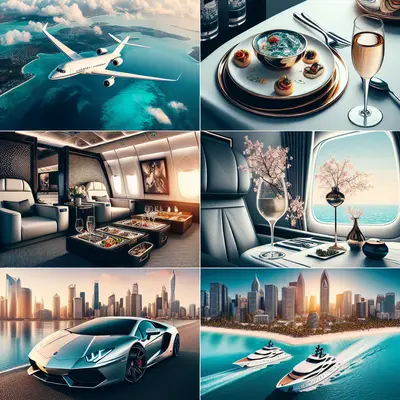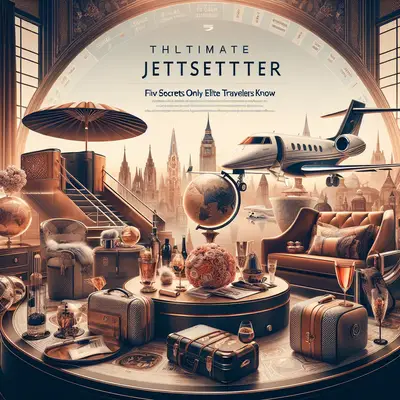
The most interesting luxury journeys today rarely appear on social feeds or in glossy brochures. They are whispered between trusted advisors, arranged through encrypted emails, and experienced with the confidence of those who know that the rarest privilege is not access, but absence—of crowds, of friction, of performance. For the Jet Ready traveler, luxury is no longer a spectacle; it is a finely tuned equation of time, privacy, and precision. This is a world where the smallest adjustments—a door that opens directly onto the tarmac, a chef who remembers your preferred mineral water, a museum unlocked after closing—transform a trip into a quietly remarkable chapter.
Below are five exclusive, under-discussed insights that are shaping this more considered, more intelligent era of luxury travel.
1. The Art of Invisible Orchestration
At the highest tier of travel, the real luxury is not what you see, but what you never have to notice. Invisible orchestration is the difference between a “nice stay” and an itinerary that feels eerily frictionless—bags that vanish from the curb and reappear in your dressing room, paperwork that seems to have completed itself, a room properly lit and tempered before you cross the threshold.
True luxury operations increasingly resemble high-end stage management. Cross-border transfers are rehearsed like performances: ground handlers, pilots, hoteliers, and security teams operate from a shared brief that includes not only your schedule, but your habits—when you prefer to take calls, how long you linger over breakfast, whether you like the car cool or warm upon entry.
You rarely hear about this level of coordination, because its guiding principle is discretion. Private aviation terminals coordinate with flagship suites to avoid lobby delays. Chefs are tipped off about incoming dietary preferences before you land. Housekeeping schedules are designed around your chronotype—no knocks, no interruptions, only the impression that the suite straightens itself. For those accustomed to constant demands on their attention, this engineered ease is not an indulgence. It is a form of cognitive luxury.
2. Time as the True Currency of Premium Travel
Price points and room categories are now secondary markers of luxury. The Jet Ready traveler is acutely aware that the only non-renewable asset on any itinerary is time. The most sophisticated itineraries are therefore designed less around places, and more around the precise way hours are spent, protected, and recovered.
This is why flight times are no longer simply “morning” or “evening,” but aligned with your circadian rhythm and key commitments at destination. It is why the distance between jet, car, and suite is increasingly non-negotiable—measured in steps, not minutes. Elite concierges think in terms of time compression: private pre-clearance at airports, backstage access that collapses waiting, dining experiences curated to be exquisite yet unhurried, and logistics that eliminate redundant movements across a city.
On a deeper level, high-level travelers are asking: what is the opportunity cost of every hour in transit? That question is reshaping choices—shorter, more intense itineraries with deep access rather than sprawling, unfocused weeks; properties with private workspaces that match the caliber of boardrooms; destinations where connectivity and calm co-exist. In this framework, a well-designed 48 hours in one city can be more luxurious than 10 disorganized days across five.
3. Precision Privacy: Beyond “Exclusive” and Into Controlled Visibility
Privacy used to be marketed as seclusion: gated villas, remote islands, hidden chalets. Yet for the contemporary traveler whose life is already partly public—whether as an executive, investor, or public figure—the more nuanced concept is controlled visibility. It is not about disappearing entirely; it is about appearing only where and when you choose.
Precision privacy is now being engineered through architecture, operations, and data discipline. Properties favored by serious travelers often feature layered circulation: service corridors, private elevators, and discrete arrival points that allow you to enter and exit without a single camera phone in sight. Reservations are held under alternate names. Staff are trained not only in etiquette, but in information hygiene—what is never photographed, never posted, never repeated.
At a higher echelon, privacy extends into digital space: secure networks in suites and jets, encrypted communications with concierges, minimal data retention on preference profiles. For some, there is even a preference for “non-Instagrammable” environments—spaces so thoughtfully designed and intentionally understated that they resist easy capture. The true hallmark of this kind of privacy is that, days later, others might know you were away—but not precisely where, with whom, or how extraordinary it really was.
4. The Curated Encounter: Designing Moments, Not Just Amenities
Classic luxury emphasizes inventory—how many restaurants, how large the spa, how extensive the wine list. The more advanced conversation is about encounters: specific, unrepeatable moments that feel as though they could not have been arranged for anyone else, and certainly not in the same way twice.
This might take the form of a private gallery viewing that happens after closing, but is calibrated to your actual interests rather than a generic “VIP tour.” A perfumer who builds a bespoke scent based on the flowers in the garden outside your suite, blended while you dine. A chef who walks you through a market, then cooks a deeply personal menu that acknowledges where you are coming from, not just where you have landed.
The most sophisticated travelers understand that genuine access is rarely advertised. It is created through relationships, trust, and long-term engagement with a destination’s cultural custodians—curators, artisans, winemakers, scholars—rather than quickly assembled experiences designed for a photo. In this world, the value lies not in being “the first” or “the only,” but in feeling that your presence was anticipated, thoughtfully integrated, and quietly remembered.
5. The New Calibration of Comfort: Micro-Details That Matter
Comfort, at its highest level, is intensely personal. The more you travel by private jet, stay in top-tier suites, and dine in exceptional rooms, the more attuned you become to micro-details that most properties never consider—but that define whether a stay truly supports you.
This can mean mattress and pillow programs that go beyond soft/firm and into spinal alignment and sleep temperature, with pre-selected profiles on file. Lighting that is not simply “ambient” but correctly color-calibrated for reading, working, or winding down, controlled intuitively rather than through confusing touch panels. Ventilation that quietly maintains perfect air quality and humidity without the hum of intrusive systems.
Savvy travelers notice the angle of a desk chair, the placement of power outlets, and the ergonomics of a suite’s layout as much as its view. They pay attention to water pressure, sound insulation, and even the tactility of materials—fabrics that are luxurious yet breathable, finishes that age gracefully rather than show fingerprints. The highest compliment is no longer “beautiful room,” but “my body and mind felt better leaving than when I arrived.” Properties and aviation providers that understand this are no longer designing spaces; they are designing states of being.
Conclusion
Luxury travel in its most advanced form is not about spectacle, saturation, or constant motion. It is about intelligent restraint and deliberate design: journeys that conserve your attention, respect your privacy, and turn time—a traveler’s rarest asset—into something that feels expanded rather than depleted. For the Jet Ready traveler, the most precious experiences are not always the ones that can be easily described or displayed. They are the quiet itineraries that leave behind almost no trace, except a sharpened sense that your life, between departures, has become subtly more precise.
Sources
- [Virtuoso: 2024 Luxe Report](https://www.virtuoso.com/travel/articles/virtuoso-2024-luxe-report) - Insights on evolving preferences among luxury travelers and the shift toward time-rich, experience-led itineraries
- [Forbes Travel Guide – What Defines Luxury in Hospitality Today](https://www.forbestravelguide.com/about/forbes-travel-guide) - Overview of modern luxury standards and the importance of service, personalization, and discretion
- [Condé Nast Traveler – The Future of Luxury Travel](https://www.cntraveler.com/story/the-future-of-luxury-travel) - Analysis of emerging luxury travel trends, including privacy, personalization, and experiential design
- [Skift Research – The State of Premium Travel](https://research.skift.com/report/the-state-of-premium-travel/) - Industry data and commentary on high-end travelers’ changing expectations and behaviors
- [World Travel & Tourism Council (WTTC)](https://wttc.org/research/insights) - Research and insights on global travel trends, including premium segment growth and traveler priorities
Key Takeaway
The most important thing to remember from this article is that this information can change how you think about Luxury Travel.