Fine dining has slipped its white gloves off. For the discerning traveler, the most compelling meals are no longer about pomp and theater, but about intimacy, precision, and a kind of unspoken intelligence between guest and kitchen. At this level, dinner is less a performance and more a confidential conversation—one carried out in flavors, textures, and details most people will never notice, but the right traveler will never forget.
Below are five exclusive, insider-level insights that define how the world’s most serious restaurants now serve those who expect something beyond the obvious.
The Reservation Is Now a Relationship
At the upper tier of gastronomy, a booking is no longer a calendar slot—it is a dossier.
Elite restaurants quietly maintain micro-profiles on returning guests: preferred table positioning (banquette vs. corner), light sensitivity, wine tolerance, and even whether you are inclined toward conversation with the sommelier or prefer to be left in peace. The best teams orchestrate an experience that feels improvised, even when it has been calibrated for days.
This relationship often begins before you arrive. Discreet pre-arrival emails may ask about allergies, recent standout meals, or whether you are celebrating anything specific. Your answers are not perfunctory; they are design inputs. A chef might remove a course you’ve recently had at a sister property, or the pastry team may rework a classic dessert to reflect a memory you mentioned.
For luxury travelers, the most powerful move is consistency: returning to the same restaurant in different seasons, cities, or countries. Over time, your profile becomes less transactional and more curatorial. Menus start to bend around you, wine pairings become bolder or subtler based on your reactions, and what the first-time guest experiences is no longer what you are quietly being served.
Menus Are Becoming Maps—For Those Who Can Read Them
On the surface, today’s tasting menus read like minimalist poetry: a list of ingredients, perhaps a place name, sometimes nothing more. But for those fluent in the codes of haute cuisine, they function like maps—telegraphing technique, ambition, and sometimes the chef’s mood that season.
When a chef lists a single product—“Bluefin, charcoal”—it signals confidence: the fish is impeccable, the cooking clean. Longer descriptions with regional qualifiers—“Aged Mieral duck, Cévennes onion, Banyuls jus”—suggest layered techniques and a focus on provenance. A pairing of hyper-local and unexpected global elements (e.g., “Normandy scallop, tamarind, smoked butter”) indicates a culinary dialogue between cultures rather than a simple fusion flourish.
Luxury travelers can quietly decode menus to decide how adventurous they wish to be. A concise, product-driven menu may be the right match when you want purity and restraint; a more narrative format might be ideal when you have the time and curiosity for a longer, more theatrical evening. In both cases, the most valuable move is to share your bias—toward acidity, texture, or umami-heavy dishes—so that the kitchen can adjust in real time.
The most sophisticated restaurants also design “shadow menus” that never appear in print. These are reserved for guests who have earned the kitchen’s trust: extended courses, experimental plates, or an off-menu main built around a seasonal product that is simply too limited to list. The ability to access these is rarely about status and more about how you dine: attention, openness, and genuine engagement with the craft.
The Most Valuable Seat in the Room Is No Longer the Corner Table
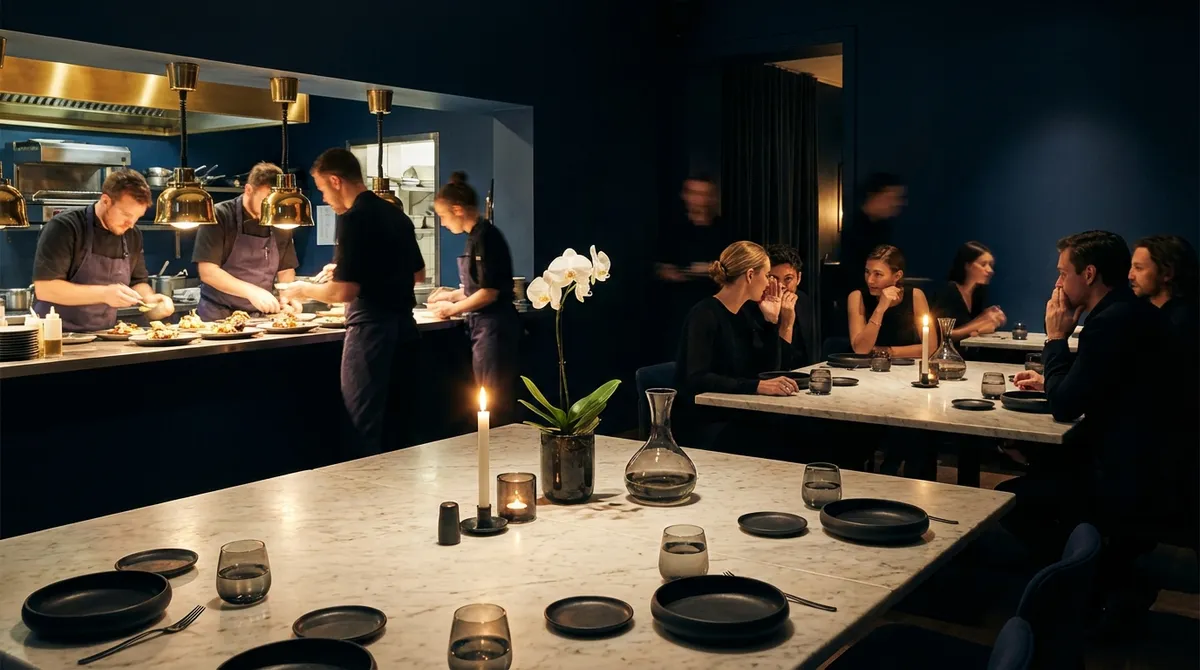
For years, the prime table in a fine dining room was the one that vanished you: a quiet corner, soft light, and enough distance from the service station that you could almost pretend the restaurant belonged to you. That table still has its devotees, particularly for confidential conversations, but a new kind of luxury traveler is seeking something different: proximity to the engine.
Chef’s counters, semi-open kitchens, and strategically placed “theater” seats have become the new premium real estate. The attraction isn't spectacle for its own sake, but a chance to observe the choreography of a serious brigade—the way a saucier finishes plates with microscopic precision, how the pass operates under pressure, the non-verbal language between chef and team.
This shift is subtle but significant. Sitting closer to the kitchen shortens the emotional distance between guest and craft, while the best restaurants maintain a shield of serenity: you see dynamism, not chaos. For some travelers, the ideal solution is a hybrid—beginning with an aperitif or first course at the counter, then transitioning to a quieter table for the remainder of the meal.
Discerning guests now request seating not just for privacy, but for narrative: a view of the cellar door for oenophiles, proximity to a particular art piece, or a line of sight toward windows framing city skylines or ocean horizons. The question is no longer “Where are the best tables?” but “What story do I want the room to tell tonight?”
Pairings Are Quietly Rewriting the Rules of Pleasure
Wine pairings at serious restaurants have evolved far beyond the familiar march from Champagne to white to red to dessert wine. For guests who want to explore without pretense, the most forward-thinking programs feel less like an exam and more like a private tasting salon curated specifically to your curiosity.
Fine dining sommeliers are now as fluent in sake, fortified wines, ciders, and artisanal non-alcoholic pairings as they are in Burgundy and Barolo. It’s increasingly acceptable—even expected—for high-level diners to request a mixed pairing: perhaps a classic white Burgundy with a shellfish course, followed by a refined, brewed tea or low-ABV vermouth with the next plate to reset the palate.
The unspoken luxury lies in calibration. A sommelier noting that you lingered over a particular Chablis may pivot toward similar mineral-driven whites later in the meal. If your pace slows, pours may become more restrained to preserve clarity of perception. The most sophisticated programs also acknowledge travel fatigue: lighter styles, careful consideration of jet lag, and reduced-alcohol options that still feel grown-up and gastronomically serious.
Luxury travelers increasingly recognize that declining a full wine pairing is not a downgrade, but an opportunity. A single, exceptional bottle chosen to evolve across multiple courses can be as intellectually and sensorially satisfying as a parade of glasses—especially when the restaurant’s cellar has the age and depth to match its ambitions.
True Luxury Now Lives in the Silences Between Courses
In an era when every plate can be photographed and every room reviewed in real time, the highest form of luxury is often what never appears on social media: the pauses, the transitions, the invisible edits made to protect your evening from friction.
Consider the pacing. At elite restaurants, the tempo is not fixed; it responds to your table’s unspoken signals. A lingering hand over a glass, a half-finished course, a glance at your watch—these become cues. An experienced team can subtly re-time the progression of dishes, delay the arrival of a rich course, or introduce a cleansing amuse-bouche if the energy at the table begins to dip.
Sound and light are similarly choreographed. Volume is gently modulated as the evening progresses; spots are adjusted so that your plates glow softly without turning the room into a stage set. A table surrounded by international travelers might experience almost imperceptible shifts in service style—more or less verbal explanation, different levels of formality—depending on what the staff senses you need.
For the most discerning guests, the true differentiator is editorial discernment: what the restaurant chooses not to do. Overlong explanations are trimmed if your table signals familiarity with certain ingredients. Seasonal “trophy” items—caviar, truffle, wagyu—are deployed judiciously, in service of the dish rather than as ornamentation. The result is an experience that feels tailored and precise, with no wasted gesture.
In this environment, your own restraint becomes part of the luxury. The most memorable meals are no longer about proving you were there, but about preserving the integrity of a moment that was clearly designed for you, and only you, at that particular point in your traveling life.
Conclusion
For the modern luxury traveler, fine dining is no longer a singular indulgence; it is a refined language through which a destination quietly reveals itself. The most compelling restaurants don't shout about their excellence. They whisper it—through the way a reservation evolves into a relationship, how a menu hints at deeper narratives, the choreography of the room, the intelligence of pairings, and the seamless silences that hold the night together.
To dine well now is to choose spaces where your presence is studied but never surveilled, where craft is visible but never aggressive, and where every course feels like a considered reply to the question you didn’t quite know how to ask: “What does it mean to be here, now, at this table?” For those who travel with intention, these are not just meals; they are the quiet signatures that define a life lived exquisitely in motion.
Sources
- The World’s 50 Best Restaurants – Official List - Global benchmark highlighting trends and philosophies at the top of contemporary fine dining
- Michelin Guide – Official Website - Authoritative reference for starred restaurants, service standards, and evolving definitions of gastronomy
- Harvard T.H. Chan School of Public Health – The Nutrition Source: Healthy Eating Plate - Insight into balanced eating that informs how high-end chefs think about composition and wellness
- The New York Times – Dining & Wine Section - Coverage of global restaurant culture, chef profiles, and emerging fine-dining movements
- Wine & Spirit Education Trust (WSET) - Educational authority on wine, spirits, and pairings that underpins modern beverage programs in fine dining
Key Takeaway
The most important thing to remember from this article is that this information can change how you think about Fine Dining.