The most exclusive resorts do not advertise themselves in neon. They announce their standards quietly, in the first sixty minutes after you arrive—sometimes in the first sixty seconds. For serious travelers, this initial threshold is where aspiration either aligns with reality or quietly unravels. Beyond the views and the thread count, there is an intricate choreography of welcome, privacy, and precision that separates a merely “beautiful” property from a truly world‑class retreat. This is the realm where details speak louder than design, and where travelers who know how to look gain an immediate, almost intuitive reading of a resort’s true caliber.
The Arrival Choreography: When Time Becomes the First Amenity
At a genuinely elite resort, the experience begins before your feet touch the driveway. The strongest properties treat arrival not as a logistical necessity, but as a curated sequence designed to lower your shoulders by several centimeters.
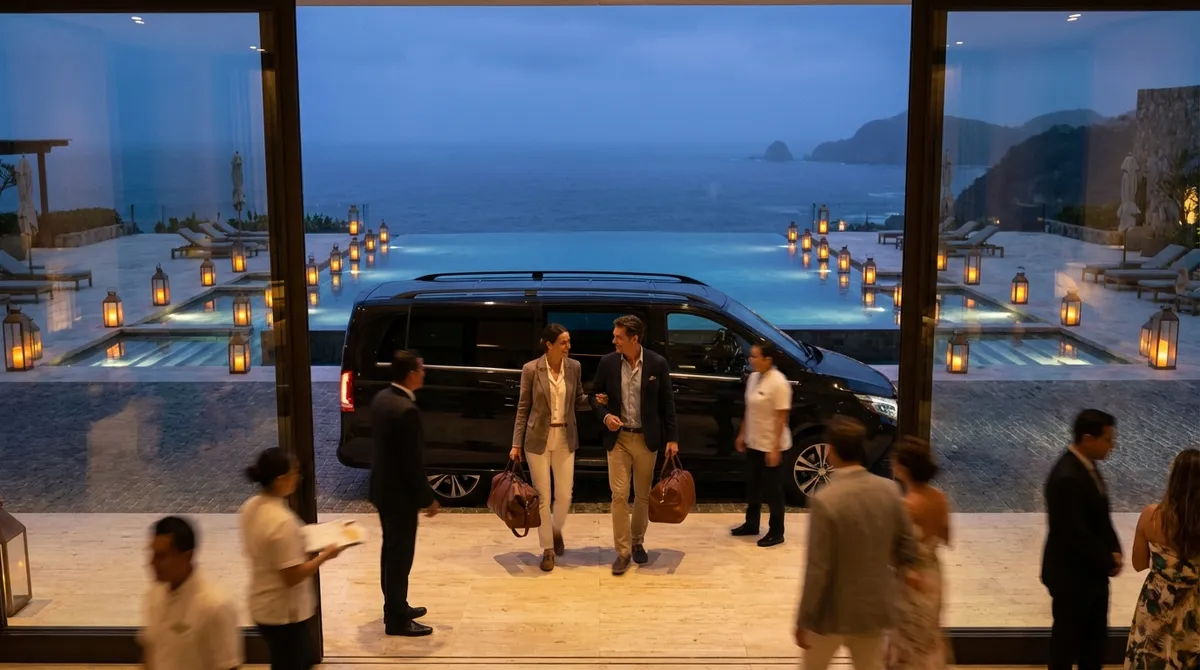
The best resorts orchestrate transfers with the same care as a fine hotel plans a state dinner: drivers who know your preferences without prompting, luggage discreetly tagged and routed, check‑in conducted en route or in‑suite rather than at a counter. The unsaid promise: your time will not be spent waiting, queuing, or explaining.
Watch for how quickly the property collapses administrative friction. Are you asked to repeat your name, your passport details, your arrival time? Or does the process feel pre‑composed around you? In the top tier, even the first glass of water is telling—temperature matched to the climate, presented without flourish, but precisely when you need it.
Elite travelers understand that arrival is not about spectacle but about tempo. A resort that manages to slow the clock in the first ten minutes is signaling something important: they have both the staffing and the systems to keep that feeling consistent throughout your stay.
The Architecture of Privacy: How Space Reveals Intent
Before you assess the view, assess the distance—between suites, between pathways, between you and the nearest stranger’s conversation. True exclusivity is as much about what you do not see and hear as about what you do.
The most considered resorts use architecture to orchestrate privacy without ever making it feel isolating. Sightlines are curved or layered so that you feel connected to the landscape, but not to the activities of other guests. Pathways may be subtly staggered to ensure you are rarely walking in step with others, and public spaces are zoned with an almost residential sensitivity: places to be seen, and places never to be observed at all.
Balcony and terrace design is particularly revealing. At an elite property, you should be able to step outside without immediately appearing in someone else’s frame or photograph. Sound, too, is curated: the best resorts manage ambient noise with landscaping, water features, and building materials that soften echoes rather than amplifying them.
Discerning travelers quickly learn to read these decisions. Privacy that feels natural, rather than enforced by signage or policy, indicates a resort where high‑net‑worth guests and public figures can exist comfortably without constant negotiation over who is watching.
Service Memory: When Hospitality Feels Almost Telepathic
In the upper stratum of resorts, good service is table stakes. What separates the exceptional is service memory—the ability to remember, anticipate, and adapt without ever making the guest feel surveilled.
This is not about staff reciting your name three times in a sentence, but about subtle continuity. Your preferred sparkling water appears on the second day without being requested. The outdoor temperature of your plunge pool is adjusted after the team notices you swim at dawn. A breakfast server you’ve never met somehow knows you take your coffee strong and without sugar because a colleague entered it into the system after dinner.
The line between attentiveness and intrusion is thin. In the finest properties, staff are trained not just in procedure, but in reading social cues: how much conversation you want, whether you prefer to be escorted or simply directed, whether your day is built around business calls or absolute disconnection. The very best service often reveals itself in what does not happen—no repeated questions, no missed transitions, no need to explain the same preference twice.
Luxury travelers quickly sense whether a resort’s service standards are manual or institutional. When every department seems to share the same, quiet knowledge about how you move through your day, you are looking at a property with both investment in training and respect for the privacy of its clientele.
Sensory Calibration: The Silent Language of Comfort
Elite resorts understand that comfort is not one decision, but hundreds of tiny calibrations across all five senses. Most properties can offer a soft bed and a pleasant scent. The best treat sensory experience as a discipline.
Temperature is one of the most telling indicators. In truly refined resorts, public spaces are tempered to feel neutral rather than aggressively cooled or heated, with micro‑climates managed so that a breezy veranda, a shaded cabana, and a spa corridor each feel precisely tuned to their purpose. Lighting is layered: no single, harsh source, but a thoughtful interplay of ambient, task, and accent illumination that lets you read, dine, or unwind without compromise.
Materials matter as much as aesthetics. Fabrics are chosen not only for appearance but for how they respond to local humidity and temperature. Outdoor furniture is comfortable even after hours in the sun. Floor surfaces transition in a way that supports bare feet, wet from the pool, as gracefully as formal shoes at dinner.
Then there is sound and scent—the two most frequently mishandled elements in resort design. A serious property will avoid strong, generic fragrances and instead opt for restrained, site‑specific notes that never compete with local air or cuisine. Acoustics are engineered, not improvised: quiet hallways, hushed air conditioning, restaurants where you can converse without raising your voice even when fully booked.
For frequent luxury travelers, these calibrations are a form of unspoken contract. They signal that the resort isn’t merely beautiful at first glance, but will remain genuinely comfortable at the fiftieth.
The Invisible Infrastructure: What You Don’t See but Always Feel
The final layer of true exclusivity is almost entirely invisible to the casual guest. It lives in systems, not surfaces: water pressure that never falters, Wi‑Fi that simply works everywhere, housekeeping that appears as if by intuition but is rarely seen.
Resorts catering to serious travelers take infrastructure personally. Backup generators are in place and regularly tested, not merely installed for marketing brochures. Kitchens are designed for both culinary ambition and food safety; cold chains are maintained even in remote locations. Medical access plans are thought through in detail, particularly for island and wilderness properties.
Sustainability, increasingly, is part of this invisible architecture. At the top level, it is never performative. Energy use, local sourcing, and community impact are designed into the resort’s operations rather than appended as an afterthought. Travelers who ask questions about water treatment, waste management, or local employment will find not platitudes, but specifics.
What the refined guest feels is effortlessness—no outages, no unexplained delays, no “we’re fully booked” when a simple request is made within reason. Yet that effortlessness is the product of significant investment in systems, training, and contingency planning. When you can go an entire stay without thinking about logistics, you are experiencing the apex of invisible luxury.
Conclusion
The world’s most sought‑after resorts rarely shout about their virtues. For the traveler attuned to nuance, excellence reveals itself early—in the way arrival is choreographed, in the naturalness of privacy, in the depth of service memory, in the precision of sensory details, and in the quiet competence of infrastructure that never draws attention to itself. These are the quiet thresholds that separate a property that photographs well from one that earns repeat visits from serious travelers. Once you learn to read these signals, you spend less time gambling on reputation and more time aligning yourself with places where luxury is not a style, but a standard.
Sources
- Forbes Travel Guide: What Makes a Five-Star Hotel - Outlines the service and facility standards used to evaluate top-tier hospitality properties
- Virtuoso: The New Era of Luxury Travel - Provides insight into how high-end traveler expectations are evolving
- Condé Nast Traveler: What Makes a Hotel Truly Great - Explores the deeper qualities that distinguish exceptional hotels and resorts
- American Hotel & Lodging Educational Institute - Details professional training standards that underpin high-level service in hospitality
- Cornell University School of Hotel Administration - Research on hotel operations, service quality, and guest experience in luxury environments
Key Takeaway
The most important thing to remember from this article is that this information can change how you think about Exclusive Resorts.