Few experiences reveal as much about modern luxury as the way one dines while traveling. For the well‑traveled, fine dining is no longer confined to white tablecloths and showpiece restaurants; it is a quiet continuum that follows them from airport suite to in‑flight service to a chef’s counter in a hidden courtyard. At this level, the true luxury is orchestration: a series of unspoken rituals, meticulous anticipations, and private flourishes that unfold as if by instinct.
Jet Ready travelers do not simply “eat well.” They curate a gastronomic narrative that respects their time zones, their palate, their privacy—and the subtle pleasure of being known without having to explain. Below, we explore how refined diners are quietly reshaping what it means to eat exquisitely while in motion, through five exclusive insights that rarely appear on any menu.
The Quiet Power of a Personal Flavor Profile
At the highest tier of travel, the most valuable dining document is not a menu—it is a personal flavor profile that moves with you.
Discreet gastronomic concierges, both on the ground and in the air, now maintain detailed records of guest preferences that go far beyond “no coriander” or “extra spicy.” These files track how your palate behaves under different conditions: what you prefer when jet‑lagged, which wines you favor at altitude, your tolerance for acidity after a red‑eye, your preferred balance of protein to carbohydrates before a meeting, even the temperature at which you enjoy sparkling water.
The sophistication lies in subtlety. You are never handed a clipboard or asked to “fill in your preferences.” Instead, preferences are quietly captured over time—through past orders, small comments, unfinished dishes, and offhand remarks about a memorable meal from years ago. When your tasting menu in Paris seems to mysteriously align with what you enjoyed in Kyoto last season, that is no coincidence; it is continuity.
For luxury travelers, the real advantage is the elimination of friction. Decisions are pre‑edited. You are free to say, “Surprise me,” knowing the surprise is rooted in a precise understanding of who you are when you dine, not who you were when you first joined a loyalty program.
Altitude‑Aware Dining: When Science Meets Subtle Indulgence
In transit, taste is altered—yet very few travelers are consciously aware of just how dramatically. At 35,000 feet, reduced cabin humidity and lower pressure dull sweetness and saltiness, while amplifying certain acids and umami notes. For the elite traveler, fine dining in motion is no longer about replicating a ground experience; it is about tailoring cuisine to the science of the skies.
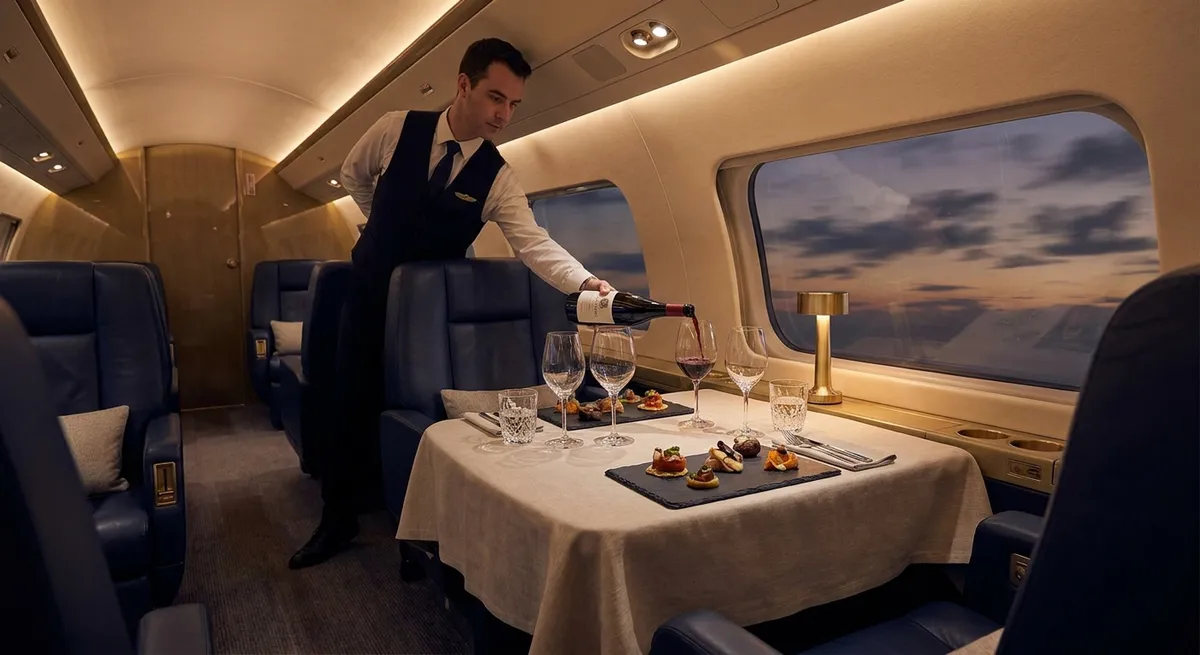
Forward‑thinking airlines and private aviation caterers now collaborate with chefs who design “altitude‑aware” menus: sauces with slightly elevated acidity to survive muted taste buds, textures that remain indulgent after reheating, and aromatics chosen not just for flavor but for how they bloom in a pressurized cabin. Wine lists shift, too—structured reds that feel refined on the ground may appear harsh in the air, while fruit‑forward wines and certain sparkling cuvées become unexpectedly elegant at altitude.
For those who know how to ask, an unspoken tier of options often exists: broths designed to rehydrate gently without heaviness, low‑sodium preparations that still feel deeply seasoned, or lighter multi‑course sequences calibrated to land you refreshed rather than overindulged. The connoisseur’s move is not to insist on their usual favorites, but to request the sommelier’s or chef’s “in‑flight recommendation”—signaling an understanding that the rules of the palate quietly change above the clouds.
The Art of the Transitional Meal: Dining as Jet Lag Strategy
Among those who cross time zones as routinely as city blocks, a new discipline has emerged: using fine dining as an instrument of time management rather than mere indulgence.
The most sophisticated travelers do not think in terms of “breakfast, lunch, and dinner” when on the move. Instead, they curate transitional meals—carefully composed experiences designed around where their body clock should be, not simply what the local time suggests. A late‑night arrival might call for a restrained, umami‑rich supper—perhaps a clear consommé, delicately steamed fish, and a controlled portion of complex carbohydrates—chosen as much for circadian alignment as for flavor.
Chefs in high‑end hotels and airport private suites are increasingly adept at this form of culinary jet lag management. Quiet menus, sometimes available only to those who know to inquire, are built around sleep‑friendly ingredients, low‑glycemic sides, and calming herbal infusions rather than aggressive caffeine. Conversely, departure‑lounge breakfasts for travelers heading into a dense workday may lean on targeted energy: high‑quality proteins, precise caffeine delivery, and minimal sugar to avoid mid‑morning crashes.
Luxury at this level is not simply about indulgence; it is about outcomes. An intelligently curated tasting sequence can make the difference between arriving as a guest and arriving as a presence.
Discreet Bespoke: Off‑Menu Conversations for Those in the Know
In the world of fine dining, some of the most exquisite experiences never appear on paper. They begin with a quiet, well‑timed conversation.
Seasoned travelers understand that the real menu is often negotiated—not demanded. A subtle exchange with the maître d’, an email from a travel liaison, or a note sent ahead through a concierge can unlock experiences that feel less like a reservation and more like a collaboration: a progression built around your favorite single ingredient, a plant‑forward tasting designed to pair with a specific rare vintage in your collection, or a menu tailored to a precise two‑hour window before your next departure.
This discretion extends to dietary boundaries. At the highest level, the phrase “no compromise” does not mean ignoring health preferences; it means wrapping them in such refinement that they never feel like limitations. Vegan, low‑FODMAP, gluten‑free, or low‑alcohol preferences, when communicated through the right channels, can result in creative, chef‑driven menus that feel special rather than substituted.
The luxury traveler’s advantage is not entitlement, but literacy. Knowing how to phrase a request—“I’m in your hands, but I would love a menu that feels light, savory, and seawater‑adjacent,” or “Please build around seasonal vegetables, minimal dairy, and restrained sweetness”—gives the kitchen just enough of a framework to do their best work, without reducing the evening to a list of prohibitions.
Curated Continuity: Building a Global Gastronomic Identity
As destinations blur into a well‑stamped passport, a new form of fine dining pleasure emerges: the sense of a coherent culinary identity that transcends geography.
Rather than chasing every new opening, discerning travelers often cultivate a circle of “anchor” experiences across the world: a bar in Singapore that knows precisely how dry they prefer their martini, a hidden trattoria in Rome where the chef remembers their aversion to truffle oil, a ryokan in Japan where breakfast arrives exactly as it did on their previous stay—down to the placement of each ceramic dish.
Technology and hospitality have quietly aligned to encourage this continuity. High‑end hotel groups now share preference data across properties; elite dining establishments record detailed notes on guest interactions; private aviation teams coordinate with ground partners to create seamless narratives. A specific Burgundy enjoyed in New York may reappear, by design, when you arrive in London weeks later—this time paired with a different course, a new expression of a familiar pleasure.
For the luxury traveler, the destination is no longer just a place on the map; it is another chapter in an ongoing private dialogue with the world’s best tables. The reward is not ostentation, but recognition: the sensation of being remembered with precision, not generically welcomed back.
Conclusion
In the rarefied space where fine dining meets sophisticated travel, the true privileges are often invisible: anticipation instead of explanation, precision instead of performance, orchestration instead of excess. What defines this world is not the spectacle of luxury, but its restraint—menus calibrated to altitude, meals aligned with circadian needs, preferences learned over years and silently honored at every table, on the ground and in the air.
For Jet Ready travelers, dining in motion is more than an amenity. It is a private ritual—one that turns every journey into an opportunity to eat not just well, but intelligently, intentionally, and unmistakably in character with the life they lead.
Sources
- How Airplane Cabins Affect Taste and Smell – BBC Future explores how altitude, cabin pressure, and low humidity alter flavor perception in flight.
- Lufthansa’s In‑Flight Culinary Program – Example of how a major carrier designs menus and wine selections for the air, including altitude‑adapted dishes.
- Harvard T.H. Chan School of Public Health – Healthy Eating Plate – Evidence‑based guidance on building balanced meals, relevant to structuring “transitional” dining while traveling.
- U.S. Centers for Disease Control and Prevention – Jet Lag and Travel – Medical perspective on managing jet lag, including the role of meal timing and composition.
- Relais & Châteaux Culinary Philosophy – Insight into how fine dining properties worldwide approach personalization, seasonality, and guest‑centric gastronomy.
Key Takeaway
The most important thing to remember from this article is that this information can change how you think about Fine Dining.