Fine dining is no longer about starched linens and visible opulence. For the most discerning travelers, the table has become a place of quiet precision, discreet privilege, and deeply personal narrative. The most sought-after restaurants today are not simply serving menus—they are choreographing atmospheres where time seems to slow, senses are sharpened, and every detail feels intentionally, almost invisibly, tailored.
Below, five exclusive insights define how luxury travelers are now experiencing fine dining at its most considered and refined.
The Elegance of Being Known Without Being Seen
At the highest levels of hospitality, recognition has become an art form. The finest dining rooms no longer rely on overt displays of status; instead, they cultivate a nuanced, almost invisible familiarity with their guests.
For the well-traveled diner, this means arriving to find the room subtly adjusted around them: a preferred table with the right sightline, a specific chair that accommodates posture or height, lighting tuned softer or brighter based on past behavior. Water is poured still or sparkling without being asked, and a favored spirit quietly appears as a welcome gesture rather than a question.
This is data transformed into discretion—preferences gathered across previous visits, sister properties, or connected concierges, then translated into soft-touch service. Nothing is announced; everything is intuited. For luxury travelers, this level of anticipatory refinement signals that the restaurant sees them not as a “VIP,” but as an individual with a distinct rhythm, palate, and pace.
The Private Language of Non-Public Menus
Beyond the printed menu—however artfully designed—exists a more elusive tier of possibility. The most forward-thinking restaurants increasingly operate with layered offerings: what appears on paper is only the starting point.
For those in the know, there is often a vocabulary that unlocks a more private experience: “off-menu” preparations, legacy dishes that never left the kitchen, or curated progressions built around a guest’s personal obsessions—truffle in early autumn, rare Japanese citrus in winter, or a study in aged beef or single-origin chocolate. This is not about excess; it is about access.
Luxury travelers are beginning to treat their favorite dining rooms as culinary ateliers. Chefs become collaborators, designing tasting arcs around a guest’s travel itinerary, dietary philosophy, or even time zone fatigue. A late-arriving international flight might translate to a shorter, lighter progression emphasizing hydration, clean broths, and gentle acidity, while a celebratory evening might unfold with deeper richness, extended pairings, and slower pacing.
What distinguishes premium dining today is not just the ability to serve great food, but the willingness to quietly re-architect the experience for each individual, often before they ask.
Texture, Acoustics, and the Quiet Engineering of Atmosphere
Fine dining at the top level is as much about what you do not notice as what you do. For luxury travelers accustomed to private villas, suites, and sedans, the true luxury in a dining room is often its acoustic and spatial intelligence.
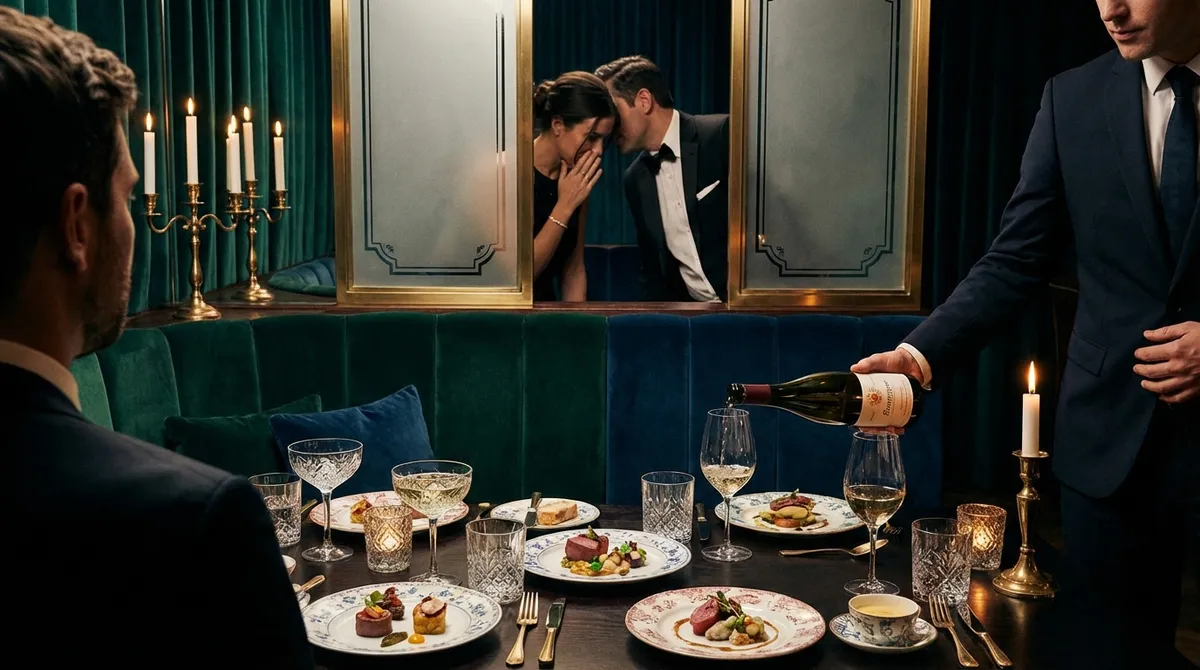
The most coveted tables now tend to sit within a carefully tuned soundscape: enough ambient murmur to feel alive, but with textiles, partitions, and materials that soften aggressive sound. Chairs are chosen not just for design but for the way they support posture over a multi-course progression. Table height, cutlery balance, and even the shape of glass stems are selected to minimize friction and maximize ease.
Lighting, too, is no longer merely “romantic” or “dim.” The finest rooms work in layers—individual pools of illumination at each table, accent lighting for plating, and imperceptible adjustments throughout the evening that respond to natural light, crowd volume, and the unfolding of the meal. The result is an atmosphere that feels both intimate and expansive, where conversations are cocooned, and the visual field is edited to remove distraction.
For the seasoned traveler, this invisible engineering is a quiet luxury: the feeling that nothing jars, nothing competes, and everything flows in a calm, unhurried line from arrival to dessert.
Beyond Pairing: Bespoke Liquid Narratives
Wine pairings are no longer sufficient as the defining beverage experience for those who dine at the highest level. The emerging standard is a fully integrated “liquid narrative” that tracks not just the menu, but the guest’s state of mind, travel fatigue, and personal tendencies.
Leading restaurants now blend classic wine programs with advanced non-alcoholic pairings, low-ABV options, and curated spirits flights that mirror the arc of the meal. Fermented teas, clarified juices, botanical distillates, and aged verjus are handled with the same seriousness as grand cru Burgundy. For the traveler constantly crossing time zones, the sommelier may propose a gentler progression—perhaps beginning with a zero-proof aperitif, segueing into a single glass of something rare and expressive, and retreating back into restorative, non-alcoholic pairings.
What distinguishes this approach at the luxury level is the element of conversation and craft. The finest teams remember a guest’s relationship with alcohol from previous visits—how quickly they drink, their tolerance, their favorite regions—and sculpt the pairings accordingly. The most rarefied experiences might even include cellar “previews,” where a sommelier quietly secures bottles for future visits or special occasions across the guest’s travel calendar, creating a continuity of taste that follows them from city to city.
For the discerning traveler, the glass becomes less a refill and more a curated story—personal, seasonal, and deeply attuned to context.
Time as the Ultimate Luxury: Pacing, Ritual, and Exit
The most exclusive insight, and perhaps the least visible to casual diners, is the way truly premium restaurants now treat time as their most precious medium. For luxury travelers who live by tightly calibrated schedules, fine dining becomes a rare space where time can be stretched, edited, and respected with exacting care.
This begins before arrival. For a guest attending an evening performance or catching a late flight, pacing is discreetly adjusted without sacrificing quality: courses are rearranged, pauses shortened, and service choreography tightened. Conversely, when the restaurant senses that a table wishes to linger—no incoming reservations, no evident rush—the pacing softens, and the evening decelerates into something closer to a salon than a service.
Equally important is the art of the conclusion. The most considered restaurants no longer view payment and departure as administrative moments, but as the final movements of a carefully scored experience. The check may be handled in a way that requires no signature at the table, coats quietly retrieved before they are requested, transportation confirmed without fuss, and parting gifts tailored to the guest’s journey—perhaps a small pastry for an early flight, a caffeine-free tisane for a late arrival at the hotel, or a handwritten note referencing a dish from the meal.
For luxury travelers, this handling of time—both compressed and expanded, always respectful—signals a restaurant’s true alignment with their world: not demanding attention, but refining it; not consuming time, but giving it back in a more elegant form.
Conclusion
For those who move easily between flagship suites, private lounges, and invitation-only spaces, fine dining has evolved into something uniquely valuable: a rare intersection of craft, privacy, and personalization. The new language of premium dining is spoken softly—in remembered preferences, off-menu possibilities, sensorially tuned environments, bespoke liquid journeys, and pacing that respects the guest’s life beyond the table.
In a world saturated with noise and abundance, the most coveted restaurants are not the loudest or the most visible. They are the ones that receive you with quiet accuracy, serve you with restrained confidence, and send you back into the night feeling both understood and gently surprised. For the luxury traveler, that is the highest expression of hospitality: a meal that feels less like an event, and more like a beautifully curated interlude in a life lived in motion.
Sources
- Michelin Guide – About the MICHELIN Guide - Background on how top restaurants are evaluated and what defines excellence
- World’s 50 Best Restaurants – Insights & Features - Editorial coverage on evolving fine dining trends and guest expectations
- Harvard T.H. Chan School of Public Health – The Nutrition Source: Beverages - Context on beverage choices and non-alcoholic options that increasingly shape modern pairings
- Cornell University School of Hotel Administration – Hospitality Research - Research on service design, guest experience, and hospitality management principles
- Forbes Travel Guide – Fine Dining & Luxury Service Articles - Industry-facing commentary on luxury service standards and high-end restaurant practices
Key Takeaway
The most important thing to remember from this article is that this information can change how you think about Fine Dining.