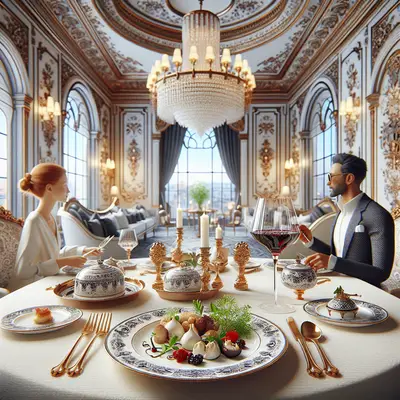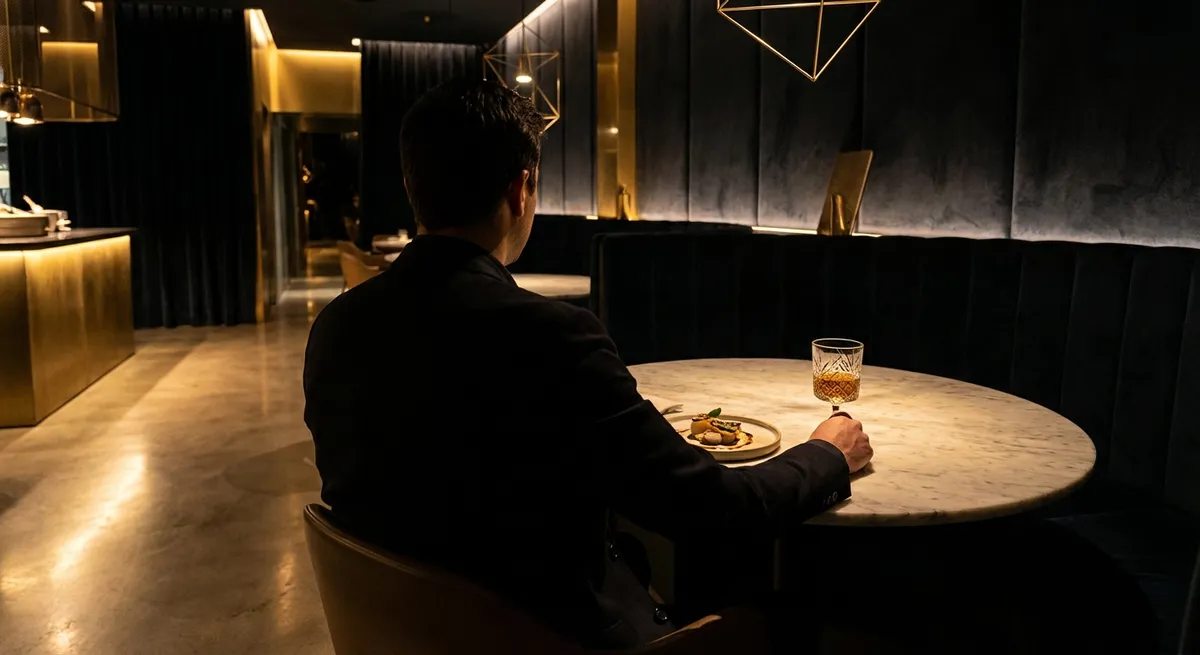
In the upper tier of global travel, fine dining is no longer about conspicuous spectacle. It has become something quieter: a private art form, curated with the same discretion and precision as a tailored itinerary or a bespoke watch. For the luxury traveler, the most meaningful meals are not defined by the price of the wine list or the number of Michelin stars, but by nuance—how a room sounds, how a menu reads, how a chef translates a landscape into three bites.
Understanding these subtleties turns dinner from “a reservation” into a fully composed moment. Below are five exclusive insights that transform fine dining from a performance you watch into a language you speak.
1. Reading the Room: Acoustic Luxury and the New Sound of Discretion
For the seasoned traveler, sound is often the first indicator of whether a restaurant understands true luxury. The most sophisticated dining rooms manage acoustics as meticulously as they manage lighting and linen. What you’re looking for is not silence, but a low, textured murmur—conversation that feels cocooned rather than broadcast.
High-end spaces increasingly employ concealed acoustic panels, fabric-heavy surfaces, and strategic spacing between tables, ensuring that no one ever has to raise their voice to be heard. This is more than comfort; it’s privacy. When a room allows confidential conversation without effort, it signals that the restaurant understands its role not simply as a place to eat, but as a setting for decisions, negotiations, reunions, and quiet celebrations.
Luxury travelers often test this immediately: notice whether you can converse with someone across the table without leaning in; whether service staff modulate their tone at your table; whether the restaurant’s music, if any, is an accompaniment rather than a performance. In the most elevated rooms, acoustics feel almost choreographed—your table exists in its own soundscape.
2. The Menu as a Map: How to Decode a Serious Kitchen in Seconds
Before the first dish arrives, the menu tells a story. To the trained eye, it reveals intent, discipline, and the level of thought behind every plate. Luxury travelers know how to “read” a menu the way a collector reads a catalog.
Subtle indicators matter. A focused menu—often short, seasonally anchored, and calm in its typography—signals confidence. Overly long menus with scattered influences can suggest a kitchen still searching for its voice. Pay attention to how ingredients are described: the finest restaurants favor precision over poetry. Provenance appears where it matters (a particular oyster bed, a heritage breed, a specific farm), but without performative excess.
Another quiet signal: the presence of a few dishes that appear almost too simple. A perfectly roasted poultry, a single fish treated with minimal garnish, or a modest vegetable course can be the truest measure of a kitchen’s technique. Luxury travelers often order at least one “unadorned” dish as a benchmark. If the restaurant can make a single carrot transcendent, you can trust every other plate.
Finally, note how the menu accommodates you. The most refined establishments treat preferences and dietary needs not as inconveniences but as design constraints. Flexibility presented with ease—rather than long explanations—is the hallmark of a confident, guest-centric kitchen.
3. Beyond the Pairing: The Quiet Power of a Thoughtful Beverage Program
For many luxury travelers, the wine list is no longer the sole star of the beverage program. The most forward-thinking fine dining rooms are curating entire liquid narratives—rare teas, low-intervention wines, house-fermented infusions, and non-alcoholic pairings that are as considered as any grand cru.
The real luxury lies in curation rather than volume. An endless, phone-book wine list is less compelling now than a tightly edited selection where each bottle has a story: specific vineyards, winemakers with distinctive philosophies, or allocations secured after years of relationships. This doesn’t have to mean only the most famous labels; often, the most interesting lists are anchored by small producers whose work is quietly revered.
Non-alcoholic pairing programs are becoming a discreet marker of refinement. For travelers who prefer to remain clear-headed—particularly on business trips or before an early flight—these pairings can deliver complexity and ceremony without compromise. Look for house-made ferments, layered infusions, and temperature contrasts that mirror wine’s structure.
A skilled sommelier or beverage director isn’t trying to impress you with encyclopedic knowledge; they are trying to read your mood. Notice how they ask questions: the sophisticated approach centers on how you want to feel (lighter, grounded, adventurous, comforted) rather than what you “usually drink.” This shift—from category to sensation—is at the heart of the modern premium beverage experience.
4. Service as Choreography: The Invisible Architecture of a Perfect Meal
At the highest level, service becomes a form of choreography—precise, rehearsed, and almost entirely invisible. Luxury travelers recognize that the true test of a dining room is not how it performs when everything goes right, but how seamlessly it adapts when preferences shift, timing changes, or something goes off-script.
The first indicator appears within minutes of your arrival: the way staff register your presence and your pace. Some guests want to decompress, others to proceed quickly. The most adept teams adjust in real time—slowing the rhythm if they detect lingering over the aperitif, discreetly accelerating courses if they sense you’re watching the time.
Watch for non-verbal coordination. Plates should arrive and leave in near-silent concert. Refills appear before you ask, but never so frequently that you feel observed. The best service teams have an almost uncanny ability to sense micro-signals: a hand resting on a closed menu, a glance toward the door, a pause in conversation when you’re ready to order.
For the frequent flyer, one of the most luxurious details is continuity. Fine dining rooms that maintain guest profiles—preferred water, bread, temperature of red wine, aversion to certain textures—are effectively reducing friction with each visit. When a team remembers without announcing that they remember, service becomes not a performance but a relationship.
5. The Destination Plate: Sourcing, Sustainability, and Place Without Posturing
Today’s luxury travelers are increasingly attuned to how a restaurant expresses its location and its ethics, but they are wary of gestures that feel designed for marketing rather than meaning. The most compelling fine dining rooms anchor their cuisine to a sense of place with restraint and clarity.
This begins with sourcing, but sourcing on its own is no longer the story. True refinement lies in how ingredients are transformed. A restaurant on a coastal island that insists on flying in strawberries out of season feels tone-deaf; one that allows local shellfish, sea vegetables, and herbs to define its identity is composing a portrait of its surroundings.
Sustainability, too, has evolved from a tagline into a baseline expectation. Luxury travelers quietly note details: how seafood is chosen in line with responsible fishing guides, how plant-forward courses are integrated without being presented as “alternatives,” how waste is minimized through nose-to-tail or root-to-leaf preparation. These elements don’t need loud explanation; a brief, sincere note from the chef or a few thoughtful details on the menu are enough.
The “destination plate” is a dish that could only exist in that place and at that time—the wild herbs only available for two weeks in spring, the dairy from a nearby producer at its seasonal peak, the spice profile reflecting a region’s history. Recognizing these dishes, and choosing them, allows luxury travelers to experience something far beyond generic excellence: they access a culinary moment that cannot simply be replicated elsewhere.
Conclusion
Fine dining, at its most elevated, is not about being seen. It is about entering a meticulously designed micro-world where every element—sound, light, menu, beverage, service, and sourcing—has been refined to support a particular kind of experience: unhurried, precise, and deeply personal.
For luxury travelers, the true privilege is not merely securing a coveted reservation, but knowing how to interpret what’s in front of you. When you can read a menu like a map, hear the sophistication in the room’s quiet, sense the thought behind each pairing, observe the choreography of service, and taste the geography on your plate, you’re no longer a guest at dinner. You are a participant in a private art form that travels with you, from city to city, table to table.
Sources
- [Michelin Guide – What Makes a Restaurant a “High-Quality Dining Experience”?](https://guide.michelin.com/en/article/features/what-is-a-michelin-star) - Insight into the standards and philosophy behind top-tier restaurants
- [The World’s 50 Best Restaurants – Trends in Global Fine Dining](https://www.theworlds50best.com/stories/News.html) - Covers emerging directions in menus, service, and beverage programs
- [Harvard T.H. Chan School of Public Health – Sustainable Seafood Guide](https://www.hsph.harvard.edu/nutritionsource/sustainability/sustainable-seafood-guide/) - Context for responsible sourcing, particularly in seafood-focused fine dining
- [James Beard Foundation – Smart Catch and Sustainable Restaurant Practices](https://www.jamesbeard.org/smart-catch) - Explores how leading restaurants integrate sustainability into high-end cuisine
- [Cornell University School of Hotel Administration – Restaurant Atmospherics and Customer Experience](https://scholarship.sha.cornell.edu/articles/1050/) - Academic perspective on how sound, design, and service shape perceived luxury in dining
Key Takeaway
The most important thing to remember from this article is that this information can change how you think about Fine Dining.