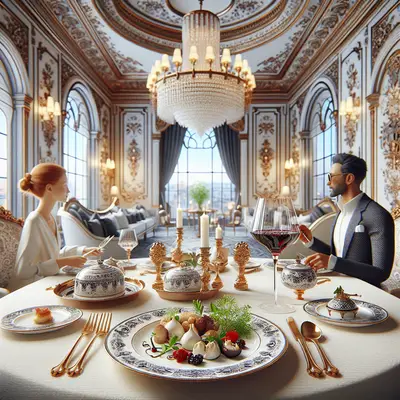
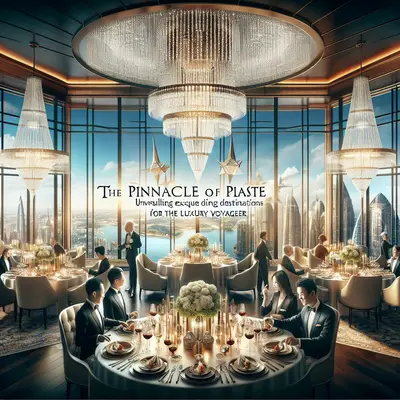
In an age of constant motion and relentless connectivity, true refinement at the table is no longer about spectacle—it is about sanctuary. For the global traveler who moves easily between continents and time zones, fine dining has become a considered intermission, a place where pace is curated as carefully as the plate. This is not about chasing reservations that trend; it is about finding rooms where the air feels calibrated, the conversation unhurried, and the details reveal a quiet, deliberate intelligence.
Below are five exclusive, often-unspoken insights that discerning travelers use to separate the merely excellent from the truly exceptional.
1. The Pace of Service as a Measure of Respect
In serious dining rooms, timing is not logistics—it is language. The most refined restaurants choreograph service to the traveler’s energy rather than to the kitchen’s convenience.
A talented front-of-house team reads the table within the first ten minutes: body language, frequency of glances at a phone or watch, even the cadence of conversation. A traveler arriving off a long-haul flight may receive a more compressed tasting menu, with courses subtly edited or combined, while a guest clearly settling in for an evening will experience elongated pauses designed for reflection and conversation.
Luxury travelers quietly test this: requesting a slight acceleration mid-meal, asking for a pause before the main course, or inquiring whether a particular course can be swapped. In the most accomplished establishments, the answer is nearly always “of course,” delivered without visible strain. The true mark of sophistication is not how a restaurant performs when everything goes according to script, but how gracefully it rewrites the script in real time—without making the guest feel like an interruption.
2. Off-Menu Conversations and the Art of the Unlisted
For those accustomed to premium experiences, the most memorable dishes are often the ones never printed. The menu becomes a starting point rather than a constraint. Luxury travelers know to treat it as a conversation opener, not a contract.
An understated way to unlock a restaurant’s deeper personality is to request something tailored: a lighter, vegetable-forward progression in the middle of a tasting menu; a single, classic dish reimagined; or a regional specialty prepared in a way typically reserved for regulars. The language here matters. Phrases like “If the kitchen is comfortable…” or “Is there something the chef particularly loves to cook tonight?” invite collaboration instead of entitlement.
The finest dining rooms maintain a mental archive of such bespoke requests. Returning guests may find that a previously improvised course has evolved into a refined, personal signature. In these spaces, luxury is not abundance; it is the feeling that the room subtly remembers you, and that the menu can bend quietly to your preferences.
3. The New Codes of Discreet Pairings
For the modern global traveler, pairings have moved beyond the linear progression of wines matched to courses. The most forward-thinking restaurants now consider cognitive load, circadian rhythm, and the realities of travel when building the beverage arc of an evening.
This may appear as carefully structured low-ABV or non-alcoholic pairings that echo the structure and complexity of wine without its weight, particularly appealing after a day of meetings or intercontinental flights. Leading programs are working with fermentations, teas, clarified juices, and aged infusions that mirror wine’s tannin, acidity, and length, while offering far greater control over how the guest will feel the following morning.
Discerning travelers often signal their priorities early in the evening—expressing a preference for lighter pours, balanced ABV, or a mix of alcoholic and non-alcoholic options. The sophistication of the response, and the composure with which the sommelier navigates those boundaries, is a subtle metric of the restaurant’s true level. The new luxury is not overindulgence; it is strategic pleasure calibrated to a demanding itinerary.
4. Textures, Temperatures, and the Intelligence of Comfort
In serious kitchens, luxury resides not only in sourcing but in comfort. For those who cross climates and cultures in a single week, comfort at the table has become its own quiet art form. The most thoughtful chefs design menus that manage sensory fatigue rather than chase shock or theatrics.
Temperature is a powerful, often overlooked instrument. Slightly cooler first courses can reset a body that has spent hours in transit; warmer, deeply savory mid-courses can anchor a guest after a long day of dislocation. Textures are sequenced deliberately—crisp, linear bites to sharpen focus; silken, yielding preparations to signal ease.
Experienced travelers notice whether a meal leaves them energized or depleted. Menus that privilege clear flavors, clean finishes, and controlled richness tend to travel better across time zones. The guest may never consciously note that salt levels are slightly lower in early courses or that acid is carefully modulated throughout the evening, yet they will remember waking up the next day feeling remarkably composed. That sensation is not accidental; it is one of the most refined forms of hospitality.
5. Rooms that Understand Privacy Without Performance
For the global elite, the room itself has become as critical as what appears on the plate. Privacy is no longer about seclusion in a distant corner; it is about being visible but unobserved, present without being on display.
Fine dining spaces that understand this balance use architecture, lighting, and acoustics to create micro-worlds within a single room. Tables may be angled to avoid direct sightlines; banquettes offer partial enclosure without isolation; sound design ensures that neighboring conversations dissolve into a low, elegant murmur. The result is a kind of social camouflage: you can be in one of the city’s most coveted rooms and yet feel as if it were composed solely for your table.
Luxury travelers pay attention to the entry sequence, the way personal details are handled (from coats to dietary notes), and how swiftly the team learns names and then almost disappears. The understated ballet of staff entering and exiting the periphery of vision, the ease with which a potentially intrusive moment is diffused—these are the discreet signals that a dining room has been designed for people whose lives are usually very visible, and who now seek a rare moment of gentle invisibility.
Conclusion
For those who live much of their lives between terminals, time zones, and discrete arrivals, fine dining is no longer a trophy—it is a finely tuned instrument for recalibration. The most accomplished restaurants understand that the modern luxury traveler is not chasing opulence, but coherence: service that respects their time, menus that converse rather than dictate, pairings that care for both palate and tomorrow’s commitments, and rooms that offer privacy without seclusion.
To recognize these subtleties is to move beyond the checklist of “top tables” and into a more nuanced understanding of what it means to dine well while traveling well. In these rare spaces, the evening becomes something quietly powerful: a sanctuary where every detail has been considered so that, for a few unhurried hours, you do not have to.
Sources
- The World’s 50 Best Restaurants – Awards & Articles - Insight into global fine dining trends, restaurant philosophies, and evolving service standards
- Michelin Guide – Official Site - Authoritative reference on high-end restaurants worldwide, including perspectives on service, pairing, and modern fine dining
- Harvard T.H. Chan School of Public Health – The Nutrition Source - Background on balanced eating and how thoughtful menu composition can influence how one feels after a meal
- Cornell University School of Hotel Administration – Hospitality Research - Academic perspectives on restaurant service design, guest experience, and hospitality management
- The New York Times – Food & Wine Coverage - Reporting and critique on contemporary dining culture, beverage programs, and the evolution of luxury at the table
Key Takeaway
The most important thing to remember from this article is that this information can change how you think about Fine Dining.