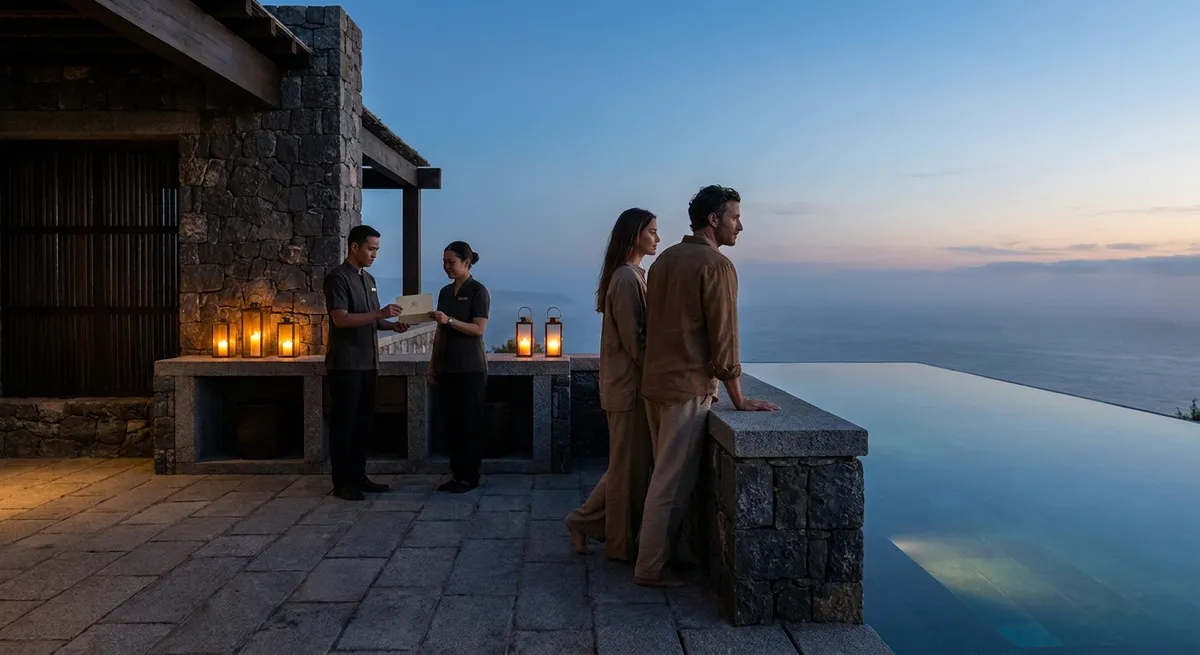
The most coveted resorts in the world no longer compete on chandelier counts or postcard views. Their true currency is discretion, anticipation, and a kind of quiet orchestration that makes even the most seasoned traveler feel personally expected. For the Jet Ready guest, these properties are less about “where” and more about “how” they make you arrive, move, dine, and disappear. This is the modern lexicon of exclusivity: unspoken, deeply intentional, and understood only by those who know where to look.
Below, five exclusive insights into how today’s most sophisticated resorts are rewriting the rules of luxury—often in ways you’ll never see on a brochure, but will feel in every impeccably timed gesture.
1. The Arrival Is No Longer a Moment — It’s a Private Gradient
At the world’s most sought-after resorts, arrival is engineered as a transition, not an event. The aim is to dissolve the fatigue and noise of transit so completely that, by the time you reach your suite, your nervous system has already checked in.
Your name never appears on a clipboard. Instead, guest recognition begins long before you step onto the property—through facial recognition fast-track at select terminals or a preferred FBO partnership, synchronized with the resort’s own security and transport team. Luggage is tagged at the aircraft stairs and vanishes into its own choreography: scanned, pre-screened, and delivered to your wardrobe in a preset configuration.
The car that collects you is not simply “luxury”; it is tuned to your preferences in almost imperceptible ways. Cabin temperature is set to the climate profile of your primary residence. The playlist is not generic lounge music but a curated soundscape matched to your typical streaming patterns—slowed slightly to align with circadian cues if you’ve just crossed time zones. A cool towel and a scent you can’t quite name but immediately associate with exhale: that’s the resort’s olfactory signature, steeped subtly into the leather seats, the spa, and the linens.
At check-in, there is no desk. You are escorted through a sequence of spaces—open-air colonnades, shaded courtyards, carefully framed views—that gradually expand your field of vision and slow your pace. A glass of something rare but precisely in your range of preference appears without being offered. By the time someone discreetly passes you a room key you barely notice, because it feels less like the start of a stay and more like a continuation of a thought you didn’t know you had.
2. Privacy Is Engineered, Not Announced
True exclusivity is never declared in capital letters on a website; it exists in the choices that remove friction from your day without calling attention to themselves. For ultra-high-net-worth travelers, the proof of privacy is in the micro-architecture of how a resort protects movement, information, and access.
Circulation is designed in overlapping but discreetly separated layers. Private villas and top-tier suites are positioned along “soft corridors” that allow you to move from residence to spa to dining to helipad with minimal exposure to public spaces. Housekeeping, in-room dining, and security navigate an entirely different, invisible grid of service back-of-house routes. You rarely see a service trolley, because in the highest tier of exclusivity, logistics have been architected out of your line of sight.
Behind the scenes, there is an increasingly rigorous approach to digital privacy. Resort guest profiles at the most advanced properties are run as encrypted, compartmentalized records with controlled access—your preferences and travel patterns are known intimately by your dedicated team, but not spilled across the entire staff intranet. Room controls, from lighting to media to smart locks, are hardened and regularly audited, reflecting an understanding that privacy in 2026 is as much about cybersecurity as sightlines.
The finest properties also know when not to recognize you. You might appreciate the restaurant maître d’ greeting you by name at breakfast, but on the beach or in the bar, anonymity often signals a deeper respect. The staff understand three distinct arcs—guests who wish to be seen, guests who wish to be protected, and those who shift between the two. The ability to read and respond to that dynamic, without ever asking, is a defining mark of a truly exclusive resort.
3. Personalization Has Quietly Evolved Into Pre-Emption
Mass-market hospitality talks about personalization as a list of options. At the level Jet Ready travelers inhabit, personalization is something more intricate: an anticipatory system that removes the need for you to ask.
It begins with pattern recognition. Your past stays—at sister properties or partner brands—form a behavioral profile more nuanced than “non-smoking, high floor.” If you consistently book early-morning spa appointments on arrival days, the spa director at your next destination has already soft-blocked a window for you before your aircraft has taken off. If your calendar tends to show video calls 36 hours into a trip, the property ensures your suite has a fully equipped workspace, secondary lighting options, and bandwidth prioritized for encrypted communication.
At this level, the minibar ceases to be a standardized assortment and becomes a lightly coded biography: the specific mezcal you ordered once in Oaxaca, the Japanese whisky you had shipped to your home, the house-made kombucha that matches your preference for low-sugar options. Your wake-up call is not a phone ringing, but curtains slowly parting at your optimal wake window, espresso pulling itself at precisely the right moment, and your preferred news sources already queued on the in-room tablet.
The distinction is subtle but critical: you are no longer selecting from a menu of pre-set “luxury” amenities; you are moving through an environment that has been tuned around the way you actually live, think, and recover. The very best resorts view this as an ongoing conversation, not a one-time preference survey. Each stay refines the next, until the destination begins to feel less like a property you visit and more like a private extension of your own operating system.
4. Wellness Is Shifting from Indulgence to Performance Stewardship
The old vision of resort wellness centered on scented candles and generic massage menus. Today’s most advanced properties treat wellness as performance stewardship: protecting and enhancing the way you think, decide, and lead long after you’ve left the property.
Spa programs in this realm read more like integrated clinics than day spas. Some partner with leading medical institutions and longevity labs, offering optional diagnostics such as VO₂ max testing, metabolic analysis, or sleep architecture assessments. Nutrition is aligned with these insights: personalized menus calibrated to support glucose stability, mitochondrial function, or recovery from chronic jet lag.
Even the architecture is enlisted in your recalibration. Rooms are oriented to maximize beneficial natural light exposure; window treatments, circadian lighting, and color temperatures are programmed to nudge your internal clock back into alignment without your conscious involvement. Noise levels are carefully modeled; what you don’t hear—the absence of low-frequency mechanical hums, corridor echoes, or inconsistent ventilation—is as deliberate as any visible design choice.
For those who operate at a high strategic level, there is a growing category of “cognitive wellness” offerings: digital-sabbath configurations that temporarily lock out non-critical notifications, curated reading libraries aligned with your interests, soundscapes tuned to promote either focused work or deep rest. The objective is not to pamper you; it is to return you to your life with a clearer edge, more sustainable energy, and a body and mind recalibrated for the demands that await.
5. Access Has Become the Ultimate Amenity
In a world where most physical comforts can be replicated, what cannot be duplicated is access—access to time, to people, to places that are structurally out of reach for the general market. The most exclusive resorts function as both sanctuary and gateway, leveraging their position, partnerships, and guests’ trust to unlock experiences impossible to arrange independently.
This might be aviation-adjacent: priority access to peak-season slots at congested private terminals, or guaranteed hangar space in destinations where capacity is functionally sold out. It may be cultural: a private viewing of a museum collection after hours, accompanied by the curator who sourced it, or a dinner held in a historic property never open to public reservations.
Nature-based access is increasingly elevated: permissions to enter protected marine zones with marine biologists rather than generic tour guides; sunrise landings on remote sandbars or alpine plateaus, using the resort’s own fleet or vetted partners, where all environmental impact has been modeled and mitigated in advance. In the context of growing environmental regulation and crowding at marquee destinations, such access is less about extravagance and more about insulation from the diminishing returns of mass tourism.
The most sophisticated properties understand that access also means shielding. When required, they facilitate discreet medical consultations, legal counsel, or crisis-management support via specialized partners—with a level of confidentiality that respects the stakes involved. In this sense, the resort becomes a node in a global network of capability: a place where your world can quietly expand or safely contract, depending on what your life demands at that moment.
Conclusion
Exclusive resorts have entered a new era in which luxury is measured less in visible opulence and more in the subtlety of what you do not have to endure: queues, questions, decisions, interruptions, exposure. For the Jet Ready traveler, the most valuable properties are those that understand your life at altitude—its pace, its pressures, its privacy requirements—and translate that understanding into a precise choreography of space, service, and access.
The real distinction now lies between properties that perform luxury and those that interpret you. The former offer spectacle; the latter offer calibration. And for a guest who arrives by jet, collects countries as casually as receipts, and values time as their rarest asset, it is this calibration that quietly defines where they will return, again and again.
Sources
- American Hotel & Lodging Association – 2024 State of the Hotel Industry - Industry report outlining current trends in luxury, personalization, and guest expectations
- Forbes Travel Guide – What Makes a Five-Star Hotel - Criteria and standards that highlight how top-tier properties differentiate service and privacy
- Cornell Center for Hospitality Research - Research publications on hotel operations, personalization, and guest behavior analytics
- Mayo Clinic – Jet Lag: Symptoms and Causes - Clinical insight into circadian disruption that informs advanced wellness and recovery programs
- U.S. Department of Transportation – Business & Private Aviation Overview - Background on private aviation infrastructure and constraints relevant to exclusive resort access and logistics
Key Takeaway
The most important thing to remember from this article is that this information can change how you think about Exclusive Resorts.