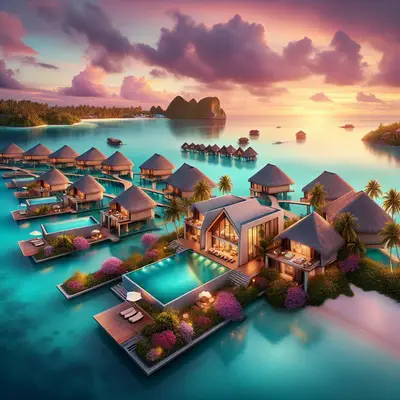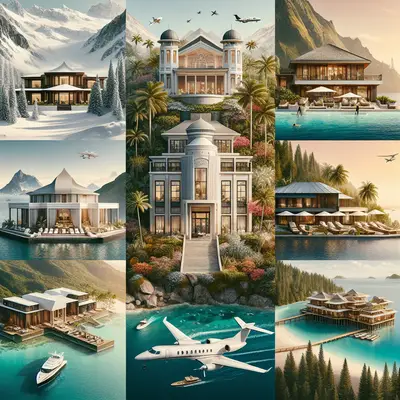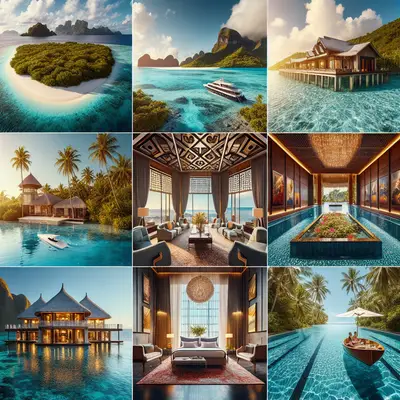
In the rarefied world of high-end travel, “exclusive” is no longer shorthand for price point or postcode. For the truly global traveler, it speaks to orchestration: the way a property manages to feel both invisible to the wider world and exquisitely attuned to the individual guest. Exclusive resorts have become the private operating systems of a certain kind of life—places where time, space, and service are quietly rewritten to a more considered code. What follows is not a catalog of destinations, but a lens on how these properties are evolving—and five subtle insights that seasoned luxury travelers increasingly look for but rarely name aloud.
Beyond the Room Key: Architecture as Emotional Technology
At the highest tier, architecture is no longer about grandeur; it is about calibration. The most coveted resorts now deploy space as emotional technology, using light, proportion, and sightlines to induce a sense of refuge that goes far beyond design trends.
Corridors are softened to remove visual noise before you reach your suite. Thresholds are engineered so that a single step changes the soundscape—from curated ambient sound to the silence of thickened glass, acoustic insulation, and concealed mechanical systems. Suites are zoned not simply into “living” and “sleeping,” but into gradients of privacy: a terrace that feels public enough for breakfast yet private enough for a late-night call to another time zone; a study niche carved away from the main space so that work, if it must intrude, feels contained.
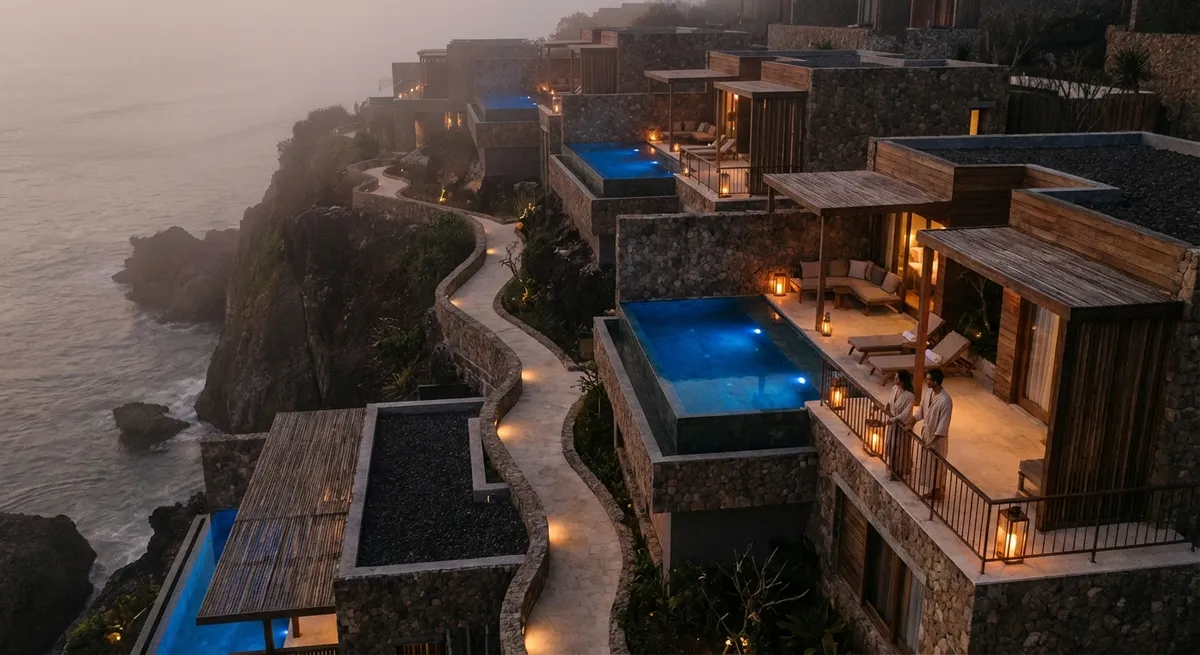
Landscape design serves as the final wall. Vegetation is layered to shield terraces from neighboring eyes without sacrificing horizon lines or star views. Pathways are intentionally meandering not for aesthetic drama, but to create a sense of psychological decompression between public spaces and private villas. To the practiced guest, these are not decorative choices; they are the primary evidence that a property understands how privacy actually feels, not just how it photographs.
The Invisible Concierge: Anticipatory Service as an Art Form
In exclusive resorts, genuine luxury is less about how many staff are visible and more about how seamlessly they disappear. The contemporary standard is anticipatory service: actions taken before the guest has articulated a need, yet without crossing the boundary into intrusion.
The finest properties now maintain individual preference profiles that go far beyond pillow menus and dietary notes. They track patterns that matter on a deeper level: whether you consistently dine late after long-haul arrivals; how many minutes you typically spend at breakfast before a meeting; which spa treatments you choose after flights versus at the end of a stay. These data points quietly inform timing—fresh towels appear after you’ve left for a walk, not while you are in the shower; room service never calls to “check in” because a sensor has already registered that you’ve opened the delivery cabinet.
Crucially, anticipatory service is paired with restraint. The best butlers and guest experience teams move through a choreography of absence. Turndown is scheduled to coincide with your dining reservation, not arbitrarily. Housekeeping learns after day one that you prefer the curtains left slightly open at night for the view of city lights or the sea’s faint shimmer. Names are remembered, but never used as a performative flourish in every sentence. The result is an experience that feels less like being managed and more like being quietly protected from friction.
Time as the Ultimate Amenity
Exclusive resorts increasingly understand that the most scarce resource for their guests is not money, but sovereign control over time. The most sophisticated properties therefore build entire operational models around protecting the guest’s temporal autonomy.
Rigid schedules are quietly dismantled. Breakfast windows stretch late into midday without sacrificing quality; wellness programs are offered in private, on-demand formats rather than only at fixed class times. Check-in and check-out become conceptual rather than literal—your suite is ready when you land, regardless of hour, and departure is negotiated around your flight, not a printed policy.
Even logistics are re-engineered to compress or gently expand time as desired. Dedicated fast-track airport clearance and private transfer lounges collapse transit into a nearly continuous experience. Conversely, some properties curate deliberate temporal pauses—an arrival ritual that takes ten quiet minutes, a tea service offered instead of a rushed welcome drink, a sunset viewing platform where nothing is “scheduled,” yet everything is prepared.
For the guest who lives by the minute in the outside world, this recalibration is more than convenience; it is a restoration of agency. The most exclusive resorts are those that can subtly re-teach you what it feels like to own your hours again.
Five Discreet Insights for the Sophisticated Luxury Traveler
Within this landscape, there are markers—rarely advertised, always telling—that seasoned travelers use to gauge whether a resort truly operates at the highest tier. Five insights, in particular, separate the merely expensive from the genuinely exceptional:
The Silence Test
In truly exclusive properties, silence is actively engineered. It is noticeable not only in suites, but in transitions: elevator lobbies, pathways at night, spa corridors. Mechanical hums are absent, doors are softly weighted, landscaping is designed to diffuse sound from pools and restaurants. If you can step outside your villa and hear only natural soundscapes—waves, wind, rustling leaves—the property has invested in acoustic privacy, one of the least visible but most luxurious forms of design.
Micro-Localization Without Performance
The most refined resorts integrate their locale in a way that feels lived-in, not theatrical. This may appear as locally commissioned textiles rather than generic “ethnic” motifs; a wine list that privileges serious regional producers over global trophy labels; spa treatments built on indigenous knowledge yet delivered with clinical rigor. The clue is subtle: the property does not feel like a stage set. Culture is present, but not performed at you.
Operational Discretion as a Design Principle
Watch how the resort moves, not just how it looks. Back-of-house circulation that is completely invisible, laundry never seen in transit, gardens maintained without daytime disruption—these are signs of a property that has invested in operational infrastructure for the sake of guest serenity. If you rarely witness the maintenance of the experience, you are likely in a place that takes its promise of ease seriously.
The Depth of the Network, Not Just the List of Amenities
At this level, what matters is not whether the resort has a yacht, but what happens when you ask for something slightly outside the script: a last-minute change to an inter-island flight, a private viewing at a local gallery, a specialist doctor on discreet call, a sunrise departure that requires customs to accommodate an unusual hour. The answer is rarely “no”; instead, it is “allow us a moment.” The true amenity is the property’s network—its ability to mobilize relationships quietly and effectively on your behalf.
A Thoughtful Exit, Not Just a Grand Arrival
Many luxury experiences peak at arrival and taper off at departure. The finest resorts reverse this arc. The last 24 hours are designed with as much care as the first: packing assistance without intrusion, a late checkout arranged before you ask, a light, flight-conscious menu suggested unprompted, car amenities tailored to your next leg (cold-pressed juice after wine country, hydrating mists after a desert stay, restorative snacks post-long-haul). Departure becomes a final act of guardianship, not an administrative necessity.
Craft, Not Spectacle: The New Language of Exclusivity
The contemporary exclusive resort is moving away from spectacle—towering lobbies, aggressive brand signatures—and toward a quieter form of mastery. Materials are chosen for how they age, not just how they appear in their first season. Technology is integrated to be felt, not seen: adaptive lighting, air and water purification, touchless entry systems, and encrypted in-suite connectivity all operate beneath the surface.
Sustainability, at this tier, is treated as an obligation rather than a marketing line. Energy systems are upgraded not merely for certification, but for comfort—stable temperature ranges, excellent air quality, natural ventilation where appropriate. Relationships with local communities are structured around enduring partnerships: long-term employment, serious sourcing agreements, and co-developed conservation programs. Guests may not see the full architecture of this work, but they feel the assurance of staying in a place that is thinking in decades, not seasons.
Ultimately, the luxury of an exclusive resort today lies in its ability to edit: to remove friction, noise, and spectacle until what remains is a distilled experience of place and self. For the traveler accustomed to being constantly visible, constantly scheduled, and constantly connected, these resorts offer something increasingly rare—a space where life can run at its proper tempo, and where excellence announces itself not with volume, but with near-perfect quiet.
Conclusion
Exclusive resorts, at their most evolved, are no longer simply destinations; they are finely tuned instruments, designed to recalibrate how discerning travelers inhabit space, time, and attention. Their true value emerges not in overt displays, but in the nearly imperceptible layers of thought that shape every step, view, and interaction. For those navigating a global life at speed, these are the places that offer not just rest, but refinement—a chance to experience what it feels like when every detail, seen and unseen, is aligned in your favor. In that alignment lies the new definition of exclusivity: not who can enter, but how precisely the world outside can be held at bay while you are within.
Sources
- [Forbes Travel Guide: What Makes a Hotel Truly Luxurious](https://www.forbestravelguide.com/about/ratings) - Outlines criteria and standards used to evaluate high-end hotels and resorts
- [Condé Nast Traveler Readers’ Choice Awards](https://www.cntraveler.com/the-bests/readers-choice-awards) - Highlights top-rated luxury resorts worldwide and emerging trends in high-end hospitality
- [Virtuoso: Luxury Travel Insights](https://www.virtuoso.com/travel/articles) - Offers expert commentary on evolving preferences of affluent travelers and the future of luxury travel
- [Cornell Center for Hospitality Research](https://scholarship.sha.cornell.edu/chrresearch/) - Provides academic research on hospitality design, service models, and guest experience optimization
- [World Travel & Tourism Council – Luxury Travel Report](https://wttc.org/research/insights) - Examines global luxury travel patterns, traveler expectations, and the economic impact of high-end tourism
Key Takeaway
The most important thing to remember from this article is that this information can change how you think about Exclusive Resorts.