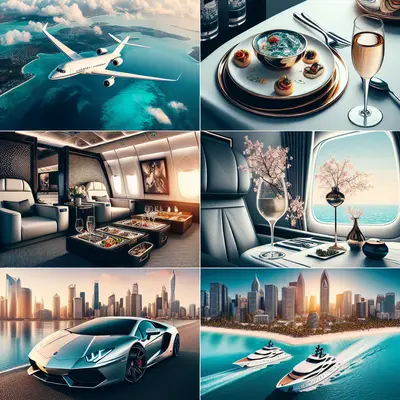
Luxury travel today is less about opulence on display and more about the quiet precision with which a journey is composed. The most discerning travelers aren’t chasing bucket lists; they are curating a personal cartography of taste, ritual, and memory. From the way a hotel room is lit at 5:00 a.m. to the provenance of the olive oil on the table, every detail becomes part of a larger narrative: one of ease, intentionality, and subtle distinction.
Below are five exclusive insights shaping the way sophisticated travelers design and experience their journeys now—often invisible to the casual observer, yet unmistakable to those who know what to look for.
1. The Architecture of Time: Designing Journeys Around Your Natural Rhythm
For seasoned luxury travelers, the true premium is not the suite category or the flight class; it is the right to move through time on their own terms. Instead of packing itineraries with obligations, they engineer their trips around their personal circadian rhythm and cognitive peak hours.
This begins long before departure. Private aviation and flexible premium fares are chosen not merely for comfort, but to calibrate time zones to the traveler’s natural energy curve. A late-morning transatlantic crossing becomes preferable to the “classic” red-eye if it preserves mental clarity upon arrival. On the ground, private transfers are scheduled to accommodate a deliberate decompression window—time to shower, recalibrate, and reset the nervous system before any social engagement.
At the destination, day structures are intentionally asymmetric: critical meetings or key cultural experiences occupy the traveler’s sharpest hours, while low-stakes activities fill the less alert moments. Concierge teams are increasingly briefed not only on preferences but on patterns: when the guest prefers silence, when they are most receptive to conversation, when they want the city to recede and the room to become the world. The result is a journey that feels unhurried yet high-functioning, where time itself has been curated as carefully as any restaurant or suite.
2. Sensory Editing: Curating the Invisible Layers of Comfort
The most memorable luxury experiences are often those that recede into the background, creating a sensation of effortless rightness. This is the realm of sensory editing—the fine-tuned orchestration of light, sound, scent, and texture that defines whether a space feels merely impressive or genuinely restorative.
Lighting is no longer just about ambience; it is a wellness tool. Travelers are seeking hotels and villas with sophisticated circadian lighting systems that subtly shift color temperature and intensity throughout the day, supporting sleep quality and mood. Materials are chosen for how they feel at 2:00 a.m. in bare feet, not just how they photograph at check-in. High-thread-count sheets are expected; now the conversation has moved to the breathability of the weave, the sourcing of the cotton, and the sensation of the fabric in varying climates.
Noise management has become another silent differentiator. True luxury is the ability to experience a bustling city from a suite that is acoustically serene, or to stay in a remote retreat where the only audible sound is the landscape itself. The elite traveler notices the difference between generic “spa music” and a soundscape crafted for the specific architecture and surroundings of a property.
Scent, too, is no longer an afterthought. Signature fragrances now extend beyond lobbies into bespoke in-room profiles, with some hotels offering fully personalized scent menus. For ultra-frequent travelers, familiar olfactory cues—whether brought from home or replicated by a favored brand—become a portable anchor, allowing any space to feel instantly inhabitable.
3. The New Provenance: When Every Detail Has a Story Worth Telling
For those at the top end of the market, authenticity has matured beyond rustic aesthetics and “hidden gems.” The new luxury lies in verifiable provenance—knowing not only that something is rare or beautiful, but where it comes from, who made it, and why it matters.
This ethos is rewriting everything from minibar selections to in-room amenities. The elevated traveler now expects the olive oil on their bread plate to have a traceable estate, the ceramics in their suite to be from a regionally significant artisan, the coffee beans in their French press to be responsibly sourced and roasted with intent. Menus increasingly read like short essays, tracing ingredients from specific microclimates and producers, transforming a meal into an annotated map of the region.
Beyond dining, partnerships with local ateliers, galleries, and heritage custodians are becoming a refined marker of quality. A private visit to a family-owned textile workshop or a behind-closed-doors wine library tasting carries more weight than standard sightseeing. The true allure lies in participating—however briefly—in living traditions, rather than merely consuming them.
For the sophisticated traveler, these details are not about performative storytelling on social media, but about personal resonance. The artifact brought home—a knife from a historic cutler, a fragrance blended to match a particular garden in bloom, a book inscribed by a local historian—serves as an index of specificity, proof that the journey engaged deeply rather than skimmed the surface.
4. Intelligent Discretion: Seamless Service That Anticipates, Not Interrupts
At the highest level, luxury service is increasingly defined by its ability to be present without being conspicuous. The performance of hospitality has shifted from visible choreography to an almost invisible system of anticipatory care, guided by data, intuition, and a refined understanding of boundaries.
Discerning travelers now expect every interaction to feel purposeful, not perfunctory. Check-in at the desk is replaced by a quiet arrival ritual in-suite; housekeeping is coordinated around the guest’s actual patterns instead of rigid schedules; dining teams remember not only allergies but the tempo at which the guest prefers to eat and converse. The best properties cultivate staff who can read micro-signals: a closed laptop, a slightly adjusted chair, a half-finished drink—each becomes information about what should happen next, or what should not.
Technology supports this discretion rather than overwhelming it. Profile systems allow preferences to follow guests across properties or journeys, while communication channels are streamlined into a single, elegant thread instead of multiple apps and calls. Yet the premium traveler is increasingly sensitive to over-automation; they value the efficiency of digital tools but reject anything that replaces human discernment.
The ultimate mark of intelligent discretion is this: the journey seems to unfold with uncanny smoothness, but the guest is never made aware of the complexity behind the scenes. Airport formalities are expedited without fuss, table changes occur as if pre-planned, weather disruptions are mitigated with options that feel like upgrades rather than compromises. The traveler experiences only the surface—a serene, uninterrupted line—while the machinery runs silently below.
5. The Private Atlas: Building a Personal Network of Sanctuaries
For those who travel frequently and at a high level, the world is no longer a chain of isolated trips; it is a private atlas of spaces, people, and micro-rituals that link their journeys into a coherent whole. Luxury is increasingly defined by continuity—by the feeling of being at home in multiple cities and landscapes, anchored by a personal network of sanctuaries.
These sanctuaries are highly individualized. For some, it’s a particular hotel floor where the light falls just right in the late afternoon, a members’ club with an unspoken understanding about privacy, or a restaurant where the corner table is “theirs” even when booked at the last minute. For others, it may be a specific spa treatment in a certain city, a trusted driver who knows to keep the car silent, or a villa that is always held for them during a particular season.
Over time, these touchpoints form a kind of soft infrastructure: familiar bar teams who know their guest’s preferred nightcap, concierges who become long-term collaborators rather than one-off problem solvers, property managers who pre-stock a residence with the books, music, and groceries the traveler hasn’t had to request in years. The experience is not about brand loyalty in the traditional sense, but about relational continuity.
This private atlas also offers a psychological benefit: in a hyper-fluid, global life, it creates a sense of belonging. Cities are no longer anonymous; each has its own micro-community of professionals and spaces that recognize and receive the traveler in a particular way. The world becomes not a series of arrivals, but a rotation through a network of places where they are already, in a quiet and particular sense, known.
Conclusion
The future of luxury travel is being written in subtleties: the architecture of time rather than the size of the suite, the calibration of light instead of the spectacle of the lobby, the story behind the object rather than the logo on it. For the most discerning travelers, true luxury is the capacity to move through the world with ease, coherence, and a deep sense of being precisely where they are meant to be.
As you design your next journey, the question is not only where you will go, but how finely you will tune the invisible details: the rhythms that support you, the stories you choose to engage with, the sanctuaries you invest in over time. In that quiet geometry lies the difference between a trip taken and a life elegantly traveled.
Sources
- [UNWTO Tourism Data Dashboard](https://www.unwto.org/tourism-data) - Global tourism statistics and trends, including high-end travel behavior
- [Virtuoso Luxe Report](https://www.virtuoso.com/travel/luxury-travel-reports) - Insights from a major luxury travel network on evolving preferences among affluent travelers
- [Skift Research: The Future of Luxury Travel](https://research.skift.com/report/the-future-of-luxury-travel/) - Industry analysis on how luxury travel is shifting toward personalization and authenticity
- [McKinsey & Company: The New Dynamics of Travel](https://www.mckinsey.com/industries/travel-logistics-and-infrastructure/our-insights/the-travel-industry-turned-upside-down-insights-analysis-and-actions-for-travel-executives) - Examination of emerging travel patterns, premium segments, and evolving expectations
- [Harvard Business Review: The Neuroscience of Trust](https://hbr.org/2017/01/the-neuroscience-of-trust) - Relevant research on trust and human interaction that underpins why discreet, anticipatory service resonates so strongly with high-end travelers
Key Takeaway
The most important thing to remember from this article is that this information can change how you think about Luxury Travel.