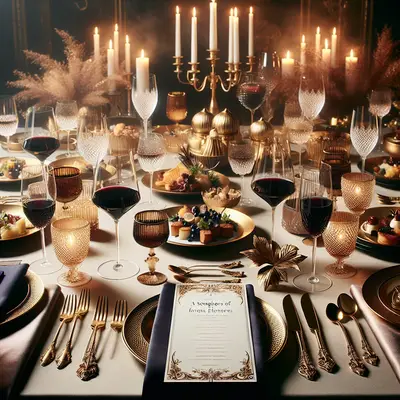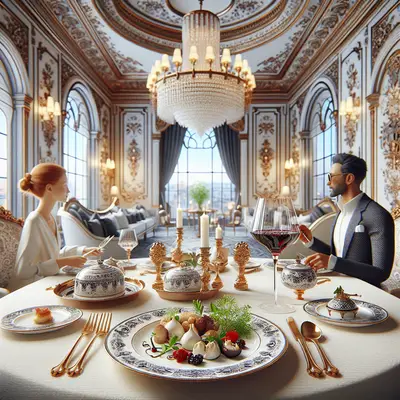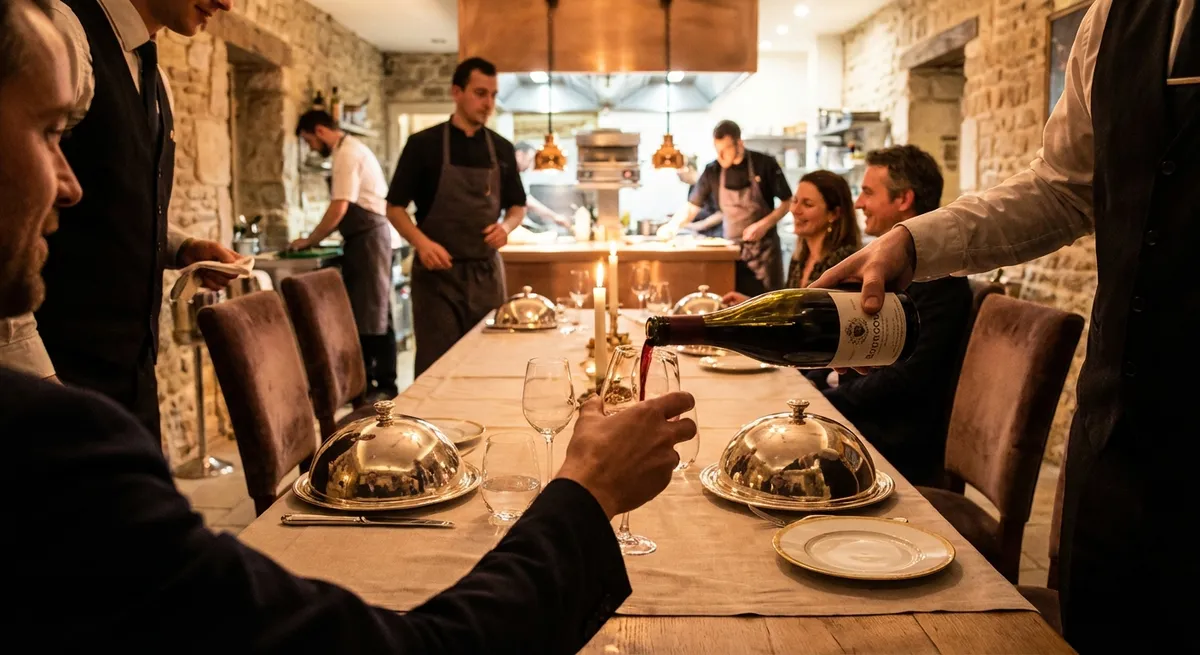
In the world of serious travel, fine dining is less about spectacle and more about calibration. It is where choreography, craftsmanship, and culture converge for a few carefully edited hours. For the luxury traveler, the true pleasure lies not only in what arrives on the plate, but in the invisible architecture behind it: the timing, the silence, the intelligence of the room. This is the discreet theater of fine dining—a space where the most memorable details are often the ones that never need announcing.
The Architecture of Invisible Service
At the highest level, service becomes a kind of quiet architecture: structural, precise, yet almost imperceptible. The finest dining rooms train their teams not only in technical skill, but in spatial intelligence—how to read a table, a conversation, a pause in eye contact.
Cutlery is replaced between courses without interrupting a discussion. A guest’s dominant hand is noted within minutes. The pace of wine service adapts not to a rigid pairing schedule, but to the tempo of the table. A sommelier will delay pouring a particularly aromatic white until voices soften and the table’s attention naturally gathers.
Luxury travelers quickly learn that this invisible service is a barometer of quality. The best rooms calibrate themselves around you: air subtly cooled as the room fills, light adjusted as dusk falls, music imperceptibly dimmed the moment plates arrive. The art lies in never needing to ask.
The Chef’s True Signature: Restraint, Not Complexity
In a global dining scene enamored with theatrics, the more telling measure of a great kitchen is restraint. At the top level, chefs understand that the most premium experiences express clarity, not noise.
A single scallop, perfectly caramelized, with a broth that has taken three days to build, says more than a dish overloaded with techniques. The finest ingredients—bluefin tuna from a single respected fish market, wild turbot from icy northern waters, A5 wagyu whose provenance is traceable back to a specific farm—are treated with near-monastic focus.
For the luxury traveler, this becomes a quiet code: order the most deceptively simple item on the menu. A plain-sounding consommé, a minimalist vegetable course, a restrained dessert. In great dining rooms, these are often the dishes that reveal the kitchen’s discipline, sourcing, and confidence with unadorned flavor.
The Global Palette: Reading a City Through Its Best Table
For those who travel often, a city’s most thoughtful dining room can function as a decoding tool. The right restaurant doesn’t just serve a meal; it translates the city’s priorities—its tempo, its anxieties, its pride—onto the plate.
In Tokyo, the finest counters express an obsessive precision and seasonal reverence that border on spiritual practice. In Copenhagen, the best kitchens interrogate locality and sustainability with near-academic rigor. In Mexico City, serious dining rooms fold street food techniques and ancestral ingredients into elevated narratives without losing their soul.
Booking a single, carefully chosen dinner at this level offers a shortcut into a city’s cultural psyche. The menu reflects local agriculture and climate; the wine list reveals the city’s openness to the world; the design and soundscape speak to how the city wants to see itself. For the attuned traveler, reading between those lines can be as rewarding as the meal itself.
Five Quiet Insights for the Luxury Traveler
Within this world, certain subtleties are rarely written on the menu but deeply understood by those who travel for dining.
1. The Best Seat Is Rarely the Most Obvious
Corner banquettes with a full view of the room, the counter seat nearest the plating pass rather than the chef, the table slightly set back from the panoramic window—these are the positions that offer both privacy and perspective. Serious diners will often request a specific part of the room, not for visibility, but for control: of noise, of sightlines, of proximity to the heart of the operation.
2. Off-Menu Is Where Trust Lives
In top-tier rooms, the most memorable dishes often never appear in print. For repeat guests or those who have clearly done their homework, chefs may quietly offer a test dish, a work-in-progress course, or a hyper-seasonal ingredient in quantities too limited for the menu. The key is not to demand, but to signal openness—asking for “what the kitchen is most excited about today” can unlock this world.
3. The Cellar Is a Passport, Not a Trophy Cabinet
An exceptional wine program is not merely a parade of grand labels. Look for lists that move with nuance between iconic estates and smaller, characterful producers; that place equal respect on aged classics and precise, terroir-driven newcomers. Luxury travelers value programs that can pivot: thoughtful non-alcoholic pairings built with teas, ferments, and distillates; half-bottle options for surgical pairing; by-the-glass offerings from serious vintages, enabled by modern preservation systems.
4. Time Is the Ultimate Luxury Ingredient
Truly premium meals are structured around tempo, not simply duration. A dining room that can gently extend your experience when a conversation deepens, or subtly compress service when it senses fatigue from a long-haul flight, demonstrates a level of attentiveness that transcends hospitality. Luxury travelers increasingly value flexibility: the ability to slow the tasting menu at a pivotal course, or to convert a lengthy progression into a sharper, edited sequence without loss of coherence.
5. Precision in Comfort Is the New Decadence
Beyond caviar and truffles, the most sophisticated diners now look for mastery in comfort—elevated broths, perfectly cooked rice, a flawless piece of bread with cultured butter, a closing broth or tisane that leaves the body feeling restored rather than exhausted. In an era of constant movement, the finest meals understand that their responsibility is not only to impress, but to leave you better prepared for what follows: an overnight flight, a deal-making breakfast, another city.
Designing Evenings That Travel Well
For those who live largely in transit, the challenge is not just finding extraordinary meals, but integrating them intelligently into an already demanding itinerary. A three-hour tasting menu before a red-eye flight has different demands from a long lunch between meetings or a destination dinner at a resort where time is abundant.
Smart luxury travelers now plan dining as part of their performance strategy. They’ll choose lighter, vegetable-forward menus when crossing time zones, or book the main gastronomic experience on the second night, once their body has adjusted. Pre-dinner, they may opt for a single, impeccably made martini or a precise zero-proof aperitif rather than a cascade of cocktails, allowing the wine pairings to carry the narrative.
The most advanced restaurants understand this and adapt. They’re prepared to adjust serving sizes for travelers arriving from another major meal, to remove entire beverage pairings in favor of hydration and lighter pours, to coordinate with hotel concierges and drivers to guarantee a seamless exit. When done correctly, the evening becomes an asset to the trip, not an indulgence that must be recovered from.
The Afterglow: When a Meal Follows You Home
The finest dining experiences extend well beyond the final course. A considered farewell gift—house-baked bread for the next morning, a small jar of a signature condiment, a printed card with brewing instructions for the tisane you loved—anchors the memory in the day after. The hotel wake-up call, the airport lounge coffee, the first meeting of the next day all still carry an echo of the night before.
For the luxury traveler, this afterglow is invaluable. It is what distinguishes a memorable evening from a meaningful one: the feeling that, for a few hours, your life in transit was not simply interrupted by a beautiful meal, but subtly recalibrated by it. The best dining rooms understand that their role is not merely to orchestrate a moment, but to leave a trace—quiet, lasting, and unmistakably refined.
Conclusion
Fine dining, at its highest expression, is no longer about flamboyant gestures or Instagram theatrics. It is an intricate, disciplined conversation between traveler, place, and craft. For those who move constantly between cities and time zones, the restaurant becomes a rare fixed point: a controlled environment where everything—from the angle of a chair to the arc of a menu—has been designed to support a specific, elevated state of being.
In this discreet theater, luxury reveals itself through nuance: the seat that feels inevitable, the dish that seems both inevitable and entirely surprising, the service that appears only at precisely the moment you realize you need it. These are the experiences that endure long after boarding passes have been discarded and hotel keys returned. They are the quiet benchmarks by which a truly premium life in motion is measured.
Sources
- [The World’s 50 Best Restaurants – Official Site](https://www.theworlds50best.com/) - Global reference for top dining rooms, trends, and chef philosophies
- [Michelin Guide – Official Website](https://guide.michelin.com/) - Authoritative resource on starred restaurants, service standards, and culinary evaluations worldwide
- [CIA – The Culinary Institute of America](https://www.ciachef.edu/culinary-arts/) - Educational insight into professional culinary training, technique, and fine dining fundamentals
- [Harvard T.H. Chan School of Public Health – The Nutrition Source](https://www.hsph.harvard.edu/nutritionsource/) - Research-based information on balanced eating, useful for understanding lighter, performance-minded dining choices
- [Forbes Travel Guide – Five-Star Restaurants](https://www.forbestravelguide.com/award-winners) - Independent ratings and descriptions of luxury restaurants and service standards across the globe
Key Takeaway
The most important thing to remember from this article is that this information can change how you think about Fine Dining.