Fine dining has evolved far beyond starched linens and tasting menus printed in calligraphy. For the modern luxury traveler, the most memorable tables are less about spectacle and more about an almost invisible precision—an orchestration of time, temperature, light, and tone that feels both effortless and inevitable. The experience is no longer simply “being served”; it is being understood, often before a word is spoken.
For the traveler who collects restaurants the way others collect stamps, the difference between “excellent” and “exceptional” now lives in subtleties. Below, five exclusive insights reveal what truly defines a remarkable dining room today—and how to recognize, and quietly request, the most elevated version of it.
1. The Art of the First Five Minutes
The most sophisticated dining rooms understand that the experience begins before you sit, sometimes before you even enter. Your arrival—how you are greeted, how swiftly the room seems to “make space” for you, how naturally the staff attunes to your pace—sets a tone you will feel for the rest of the evening.
Watch how the host manages your first impression. Are you parked at a bar for a perfunctory “moment” that stretches indefinitely, or guided seamlessly to a perfectly prepared table? A quietly elevated restaurant will have already considered sound (no jangling glassware at the threshold), scent (no clashing aromas of cleaning products or overly aggressive florals), and sightlines (no harsh glare, no direct blast from the kitchen pass).
A refined traveler can subtly influence this opening movement: note your preferred arrival time and pace in advance, request a specific style of seating (banquette, corner, lower traffic), and, when appropriate, let the restaurant know whether you are seeking a slow, conversational evening or a more concise service. The best houses treat this as choreography, not complication.
2. Menu Design as a Private Conversation
In elevated dining, the menu is less a list of dishes and more a quiet negotiation between your curiosity, your time, and the kitchen’s point of view. Tasting menus, à la carte options, and off-menu “whispers” all function as different dialects of the same language: how far you are willing to travel with the chef on a given night.
Discerning guests look beyond the obvious signatures and ask a different question: “How does the menu invite me to trust this kitchen?” Are there seasonal anchors that show respect for locality? Is there a balance of textures, temperatures, and intensities, or is it a parade of richness with no reprieve? The most sophisticated restaurants build in moments of lightness, silence, and surprise—an intermezzo that resets the palate, a single perfectly ripe fruit, a restrained broth that arrives after a particularly complex course.
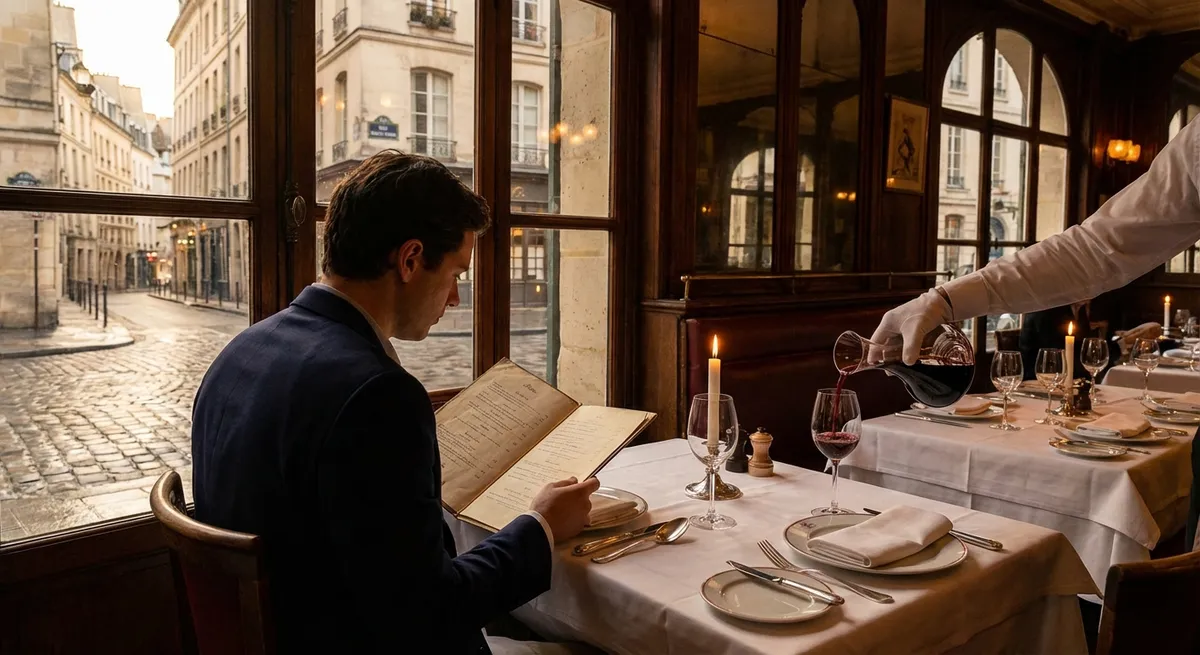
Luxury travelers also know that the real dialogue begins once you engage your server or sommelier with intention. Rather than asking what is “popular,” ask what the chef is quietly proud of tonight, or which dish reveals the kitchen’s personality. These questions invite nuance—and often unlock unlisted preparations, half portions for shared tasting, or micro-courses that appear as though they were always meant to be there.
3. Service as Invisible Architecture
In the best dining rooms, service does not announce itself; it shapes the evening like an invisible framework. You notice it in the ease with which items appear and disappear, in the way water is never aggressively topped up mid-sentence, in the simple assurance that nothing will need to be asked for twice.
Elite travelers understand that true luxury service is not about constant attention, but calibrated attention. The markers are subtle: a captain who adjusts their formality to your table’s mood; a team that remembers your handedness and places cutlery accordingly; a server who notices when the energy of the conversation shifts and postpones a tableside explanation to avoid cutting into a private moment.
The highest level of service translates unspoken signals. A single glance at a watch may prompt the quiet acceleration of pacing. A nearly untouched glass might lead to a discreet check-in—“Would you like to pivot to something lighter?” The key insight: the dining rooms worth returning to practice service less as performance and more as emotional cartography, reading the topography of your table in real time.
4. Pairings Beyond the Glass
Wine pairings are no longer the only, or even the most interesting, metric of a restaurant’s sophistication. The modern fine dining landscape has embraced an expanded set of pairings: non-alcoholic infusions, aged teas, low-intervention wines, fortified aperitifs, and even temperature-driven water programs designed to match certain courses.
For luxury travelers, this is where a restaurant’s depth becomes evident. Is the sommelier merely reciting vintages and regions, or are they speaking in textures—salinity, tension, lift, length? Do non-drinkers receive a thoughtful, structured pairing that mirrors the arc of the meal, or a generic juice blend as an afterthought?
The most advanced programs treat pairing as an architecture of sensation. A lightly oxidative wine might bridge a roasted course and a smoked element in the next. A chilled oolong could cleanse the palate after rich dairy more effectively than a heavy dessert wine. Travelers in search of nuance can ask not only what pairs “best,” but what pairs “most interestingly,” inviting the team to propose combinations that illuminate the dish rather than simply accompany it.
5. Atmosphere as Curated Privacy
At the highest tier, fine dining is less about being seen and more about feeling safely unseen—free to relax, to speak candidly, to linger without the subtle pressure of turnover. Atmosphere, for the discerning traveler, is the alchemy of acoustics, spacing, lighting, and the restaurant’s unspoken stance toward your time.
Listen to the room: can you clearly hear your companion without raising your voice, while nearby conversations recede into a soft blur? Notice the lighting: are faces flattered, colors true, screens and flashes politely discouraged? Examine the spacing: are tables thoughtfully staggered to avoid direct sightlines into neighboring plates—and private moments?
Seasoned luxury travelers often cultivate a quiet rapport with maitre d’s and reservation teams at their preferred addresses. Over time, this yields the most coveted luxury of all: predictably good tables, tailored atmospheres (subtler lighting, specific corners), and the gentle assurance that, even in a fully booked room, your experience unfolds as if it were the only one.
Conclusion
Fine dining, at its most refined, is less an event and more a distilled expression of hospitality: a series of considered decisions that allow you to feel entirely at ease, entirely yourself, and yet subtly elevated above the everyday. For the luxury traveler, the true markers of excellence are rarely the ones printed on a guide or announced with fanfare. They are embedded in the first five minutes, in the unspoken conversation of the menu, in the invisible architecture of service, in pairings that rethink what a meal can be, and in an atmosphere that protects your time and privacy.
To travel well today is to recognize these details, to cultivate relationships with the houses that honor them, and to understand that the finest tables are not defined by what they display, but by how elegantly they disappear behind your experience.
Sources
- Michelin Guide – What Makes a Restaurant a MICHELIN Star Restaurant - Insight into how the Michelin Guide evaluates fine dining and hospitality
- World’s 50 Best Restaurants – The Voting and Selection Process - Explains criteria and philosophy behind ranking leading global restaurants
- Harvard T.H. Chan School of Public Health – The Nutrition Source: Dining Out - Context on menu composition, balance, and how courses can be structured thoughtfully
- Court of Master Sommeliers – Service Standards - Provides benchmarks for world-class beverage service and pairing philosophy
- Cornell University School of Hotel Administration – Restaurant Atmospherics and Customer Experience - Research on how lighting, sound, and layout influence perceived quality in fine dining
Key Takeaway
The most important thing to remember from this article is that this information can change how you think about Fine Dining.