There is a moment, just after arrival, when a resort quietly reveals its true caliber: the way a staff member anticipates your pace, the silence of a door that closes without a sound, the temperature of the room set exactly as if you had chosen it yourself. For discerning travelers, these details are not indulgences; they are indicators of a deeper design philosophy. The world’s most exceptional resorts are not simply beautiful places to sleep—they are finely tuned environments, choreographed to make you feel subtly, consistently, and intelligently cared for.
Below, five exclusive insights decode how to recognize, select, and savor the kinds of resorts that operate at this elevated level—those that understand luxury as a private conversation rather than a performance.
1. How a Resort Designs Your Time Without Owning Your Day
The most sophisticated resorts are not selling you a schedule; they are curating a rhythm.
Instead of crowding your inbox with rigid itineraries, they orchestrate options that flex around your natural tempo. Breakfast is not a time slot but a window; spa treatments are quietly shuffled to accommodate an impromptu dip in the pool or a lingering conversation over a late check-out lunch. Look for properties that assign a dedicated experience curator or butler who learns how you like to move through a day—whether you are an early-morning hiker, a late-dinner conversationalist, or someone who prefers a day fractured into small, sensory pleasures.
The real hallmark: the absence of friction. Transfers happen while you linger over coffee. A requested table by the window simply appears at the right moment. The resort’s role is not to make you busy; it is to make you unhurried, without ever feeling idle. Luxurious resorts excel when they preserve your sense of agency, while quietly removing everything that feels like administration.
2. The Silent Language of Design: What Your Suite Is Really Telling You
Step into a suite and look beyond the obvious beauty. In the world’s best resorts, design is less about spectacle and more about subliminal comfort.
Notice the placement of outlets and lighting: Are they exactly where your hand reaches when you’re half-asleep? Are the switches intuitive, or do you need a manual to turn off the bedside lamp? This is not trivial—it’s an index of how deeply the resort considers your experience. Premium properties think about light temperature at sunrise and sunset, how fabrics feel on bare skin after a day in the sun, and whether your view is curated to reveal something new at different times of day.
Materials tell a story as well. Natural stone that remains cool in warm climates, acoustically treated walls that mute hallway noise, heavy drapery that blocks the first hint of dawn if you choose to sleep in. The best resorts balance local authenticity with global standards of comfort: handcrafted ceramics set beside precision-engineered fixtures, native woods treated to age gracefully rather than simply photograph well.
If the suite feels both unmistakably of its place and intuitively designed for your habits—without you having to think about it—you are likely in a property that understands luxury beyond the surface.
3. Service as a Quiet Form of Intelligence
At exceptional resorts, service becomes a soft form of data science combined with genuine human intuition.
Staff remember how you take your coffee, but they also know when not to ask if you’d like another drink. Housekeeping learns your patterns within a day: refreshing the room only when you’re at breakfast, never when you’re returning from the pool. If it feels as though the property has a sixth sense about your movements, it’s because the best resorts invest heavily in both training and systems—guest profiles, pre-arrival questionnaires, and inter-departmental communication that prevents you from repeating yourself.
What separates good service from excellent service is restraint. A truly premium resort is not constantly asking, “Is everything okay?” It is quietly making sure nothing needs to be asked. Allergies are remembered across outlets. If you mention a preference once—say, a predilection for still water over sparkling—it becomes part of your stay’s invisible architecture.
Watch for subtle calibrations: the staff member who shifts from formal to familiar address over time, the team that recognizes when you want conversation and when you want to disappear behind your book. This is service as emotional intelligence, not choreography—and it is one of the clearest signs that you’re in the right place.
4. Crafting Privacy: More Than Just a “Private Pool”
Privacy at a true luxury resort is not a line item on a brochure; it is a structural principle.
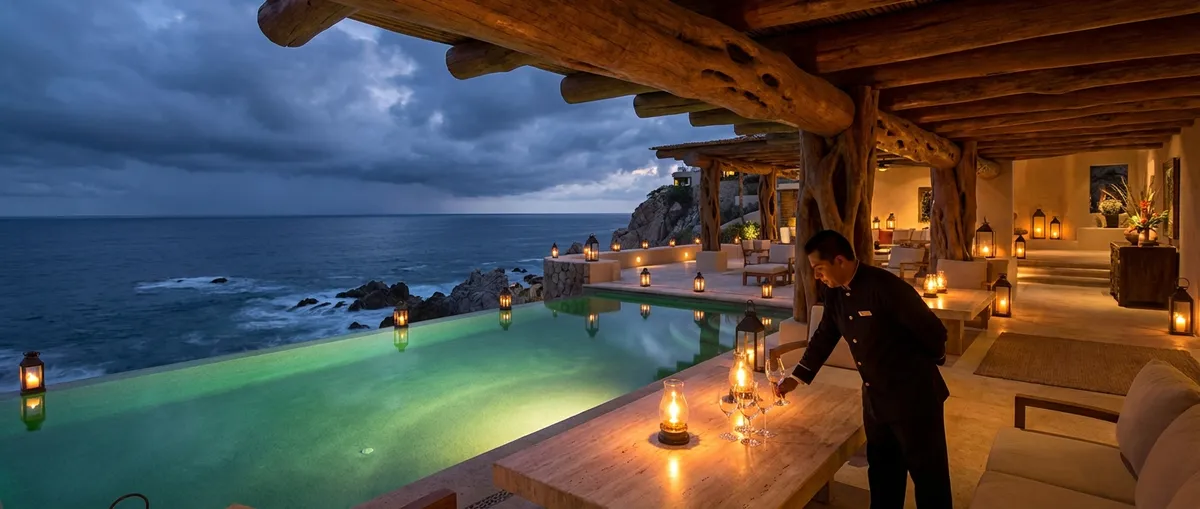
It begins with spatial planning: villas angled so that terraces are shielded from view, pathways that allow you to move through the property without feeling observed, discreet arrivals and departures for those who need them. Soundscapes matter, too. The pool may be full, but if landscaping and layout ensure that conversations dissolve into ambient murmur, your sense of seclusion remains intact.
Consider how the resort manages visibility. Do staff appear exactly when needed and recede when not? Are there secluded corners of the beach or garden that feel as though they were designed for one or two people, not a crowd? High-end properties often collaborate with landscape architects and acoustic consultants specifically to shape these experiences—so that the rustle of palm leaves, the hush of a water feature, or the position of a cabana naturally creates emotional and physical distance from others.
The rarest luxury is to feel alone when you want to be—and gently connected when you choose to be. The finest resorts engineer that feeling with precision.
5. Beyond Amenities: The Depth of a Resort’s Ecosystem
The most compelling resorts are not just places to stay; they are ecosystems with depth—a constellation of relationships, stories, and capabilities that you only fully appreciate once you’re immersed.
One dimension is culinary. It’s not just whether there’s a “signature restaurant,” but how the property sources, experiments, and adapts. Is the bread baked in-house? Do chefs collaborate with local farms and fisheries? Can the kitchen accommodate a spontaneous, off-menu dinner built around a local ingredient you admired at breakfast? These are indicators that you’re not just consuming amenities; you’re participating in a living, evolving culture of hospitality.
Another dimension is access. Partnerships with local experts—marine biologists, art curators, winemakers, historians—signal that experiences are not off-the-shelf. When a resort arranges a private tasting inside a normally closed cellar, an after-hours museum walkthrough, or a sunrise visit with a conservationist, it is drawing from a deep network, not a transactional vendor list.
Finally, consider resilience and responsibility. Increasingly, sophisticated travelers look for properties that invest in sustainability and community engagement in substantive, not performative, ways: renewable energy integration, meaningful local employment, conservation programs with measurable outcomes. The very best resorts understand that long-term luxury depends on the health of the environment and culture around them—and they operate accordingly.
Conclusion
For those who travel at a certain level, choosing a resort is less about room categories and more about alignment: with your rhythm, your expectations, and your definition of ease. The properties that merit repeat visits—those you recommend quietly, to a small circle—are not merely beautiful or famous. They are finely engineered experiences that respect your time, your privacy, and your intelligence.
When evaluating your next stay, look beyond the obvious: the infinity pool, the design-forward lobby, the accolades. Instead, pay attention to how the property designs your day without dictating it, how it uses space and sound to protect your privacy, how service adapts to who you are rather than who you’re supposed to be. That is where true resort excellence reveals itself—quietly, consistently, and unmistakably.
Sources
- Forbes Travel Guide: What Makes a Luxury Hotel – Outlines the standards and criteria Forbes uses to rate luxury properties, including service and design elements.
- Virtuoso: Defining Luxury Travel Today – Explores modern luxury traveler expectations and how high-end properties are evolving to meet them.
- Condé Nast Traveler – Gold List: The Best Hotels & Resorts – Curated list of top global resorts with detailed descriptions of service, design, and guest experience.
- American Hotel & Lodging Educational Institute – Provides insight into professional hospitality training, including service excellence at high-end properties.
- UNWTO: Tourism and Sustainability – Discusses the growing importance of sustainability and community impact within premium hospitality and resort development.
Key Takeaway
The most important thing to remember from this article is that this information can change how you think about Exclusive Resorts.