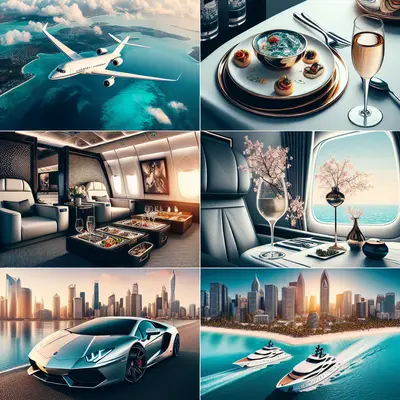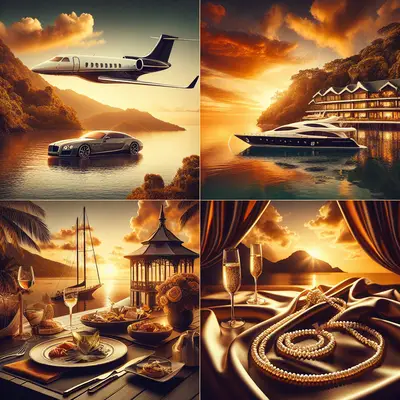
Luxury travel today is less about price tags and more about precision—of time, of space, of sensory detail. It’s the quiet confidence of knowing the chef can recreate a dish you loved three years ago, or that your car is already idling curbside the moment your glass leaves the table. For travelers who move easily between hemispheres and time zones, the true luxury is a journey so considered that it seems to anticipate you.
Below are five exclusive insights shaping how the world’s most discerning travelers design their next escape—subtle, powerful shifts that separate a pleasant trip from a flawlessly orchestrated experience.
1. Curating Time, Not Just Itineraries
The most sophisticated travelers no longer begin with “where,” but with “when” and “how long.” They are curating tempo rather than lists of must-see landmarks. A week in a single city, with deep familiarity of three neighborhoods, now outranks a whirlwind of passport stamps.
This approach leads to intentionally “unfilled” time, protected with the same seriousness as a business meeting. A late-morning window to do nothing becomes non-negotiable; a sunset hour is reserved purely for a walk, a terrace, a view. Elite travel advisors and concierge teams increasingly design journeys around energy curves—factoring in jet lag, preferred sleep hours, and even natural light patterns at a destination.
This temporal curation extends to seasonal nuance. The most coveted experiences are often off-calendar: arriving just after the social season ends, staying just before temperatures officially “improve,” lingering in that quiet intersection between local life and lingering charm. The result is a journey that feels intensely personal, never generic, and almost impossible to replicate.
2. The New Geography of Privacy
Privacy has become its own form of currency—and nowhere more so than in luxury travel. It is no longer enough to have a suite on a high floor; discerning guests now look for architectural privacy (line of sight, sound insulation, controlled access), digital privacy (discreet data handling, minimal online footprint), and social privacy (staff who remember faces but never overstep).
This has transformed what “location” means. A penthouse overlooking an iconic landmark may be less desirable than a courtyard-facing suite with no direct neighbors. Waterfront villas that once advertised “unbroken sea views” now quietly emphasize private docking, secure transfer routes, and invisible security perimeters. The goal is not secrecy for its own sake, but ease: moving through a property or destination without friction, spectacle, or performance.
At the highest level, privacy is baked into design. Separate entrances for certain floors, in-suite check-in, direct access from car to room, and hyper-discreet staff training create an environment in which the traveler can exhale the moment they arrive. The most admired properties blend all this with a sense of place, proving that seclusion need not feel sterile or disconnected.
3. Immersion by Invitation, Not Consumption
The era of “doing” a city in three days is quietly fading. In its place: immersive, invitation-only experiences that emphasize reciprocity rather than consumption. Today’s refined traveler is less interested in collecting experiences and more interested in entering existing circles—of artisans, winemakers, architects, conservators, and chefs—without disturbing their integrity.
This might mean a private after-hours visit with a museum curator, not as a photo opportunity but as a conversation about restoration, acquisition, and cultural stewardship. It could be an afternoon in a perfumer’s lab, where you observe work in progress rather than assembling a token “custom scent.” Wine tasting becomes a vertical exploration of a single parcel over decades, guided by the family who farmed it, rather than a hurried tour of a dozen labels.
Luxury operators who cater to this mindset are redefining access. They act as cultural interpreters rather than gatekeepers, ensuring that introductions are appropriate, welcomed, and context-rich. The traveler, in turn, approaches each experience with discretion and respect—arriving as a guest, not a consumer. In the best cases, what begins as an “experience” becomes an ongoing relationship, revisited on future journeys with evolving depth.
4. Precision Wellness in Transit, Not Just On Arrival
Wellness used to be something that happened at the destination: a spa day, a retreat, a special program. Now, for the most sophisticated travelers, wellness has migrated into every stage of the journey—especially transit. Long-haul flights, late-night arrivals, and rapid time zone shifts are treated as design problems, not inevitabilities.
The focus is shifting from generic indulgence (another massage, another steam room) to highly precise interventions tailored to the individual. Travelers coordinate with nutritionists or physicians before departure to structure in-flight hydration, meal timing, and sleep cycles. Wearables and health apps are quietly integrated with concierge services, enabling them to suggest light exposure, movement, or meal types aligned with a traveler’s circadian rhythm and goals.
On arrival, the most forward-thinking hotels and private clubs no longer simply offer treatments—they offer recovery protocols. This may include in-room light therapy, tailored minibar contents (electrolytes, specific teas, targeted supplements), guided breathing sessions on arrival, or access to cold-plunge and contrast therapy at unconventional hours. The ultimate luxury is landing in a new time zone and feeling not depleted, but recalibrated—able to enjoy the destination immediately, without sacrificing long-term well-being.
5. From Personalization to Pattern Memory
Personalization has become a baseline expectation in luxury travel. The real distinction now lies in sophisticated “pattern memory”—properties and advisors who understand not only what you prefer, but how your preferences evolve over time.
This is more nuanced than a note that you like sparkling water or a certain pillow type. It’s recognizing that you order room service breakfast only after night flights, that you prefer a specific table position (corner, banquette, line of sight to the entrance), that you tend to book active experiences early in a trip and slower ones at the end. It’s anticipating that on your third stay, you may be ready to explore a new neighborhood, a new architect, a new chef.
The most capable teams handle this quietly, without turning hospitality into a performance of how much they know about you. They capture and refine patterns in ways that feel invisible: your preferred pacing of conversation, your appetite for suggestions, your threshold for interaction. Over time, this builds a sense of continuity across geographies—stepping into a hotel in Tokyo or Lisbon and feeling not that they “know everything about you,” but that they somehow understand how you travel.
This is where technology and human judgment meet. The data may sit in a system, but the interpretation is entirely human. The reward is a seamlessness so gentle it never calls attention to itself. Journeys begin to feel less like isolated events and more like chapters in a continuous, thoughtfully authored narrative.
Conclusion
For travelers who view the world as both a playground and a portfolio of meaning, luxury is no longer a static category. It is a living language of details: how time is arranged, how privacy is protected, how access is granted, how the body is supported, how memory is honored.
The quiet revolution in premium travel is not about more excess, but more exactness. Those who understand this grammar—who prioritize pattern over novelty, depth over display, and ease over spectacle—will find that the world still has an abundance of experiences reserved not for the loudest, but for the most attentive.
Sources
- [Virtuoso Luxe Report 2024](https://www.virtuoso.com/travel/articles/virtuoso-luxe-report-2024) - Insights from a global luxury travel network on evolving high-end traveler preferences
- [Forbes Travel Guide: Trends in Luxury Travel](https://www.forbes.com/sites/forbes-travel-guide/2023/10/24/top-travel-trends-for-2024/) - Overview of current patterns in premium travel, wellness, and personalization
- [Skift Research: The Rise of Transformative Travel](https://skift.com/2023/05/17/the-rise-of-transformative-travel/) - Industry analysis on immersive, experience-driven journeys and changing expectations
- [Harvard Business Review: The Value of Customer Experience, Quantified](https://hbr.org/2014/08/the-value-of-customer-experience-quantified) - Explores how remembered experiences and pattern recognition drive loyalty in premium services
- [CDC: Managing Jet Lag for International Travel](https://wwwnc.cdc.gov/travel/page/jet-lag) - Evidence-based guidance on circadian rhythms and strategies that inform modern wellness-focused travel planning
Key Takeaway
The most important thing to remember from this article is that this information can change how you think about Luxury Travel.