Fine dining is no longer about white tablecloths and hushed conversations alone. For the modern luxury traveler, it is an intricate choreography of provenance, intention, and discretion—a global language spoken quietly from Tokyo counters to Parisian salons. At Jet Ready, we see the best tables in the world not as destinations, but as instruments: each one capable of tuning a journey to a finer frequency. What distinguishes an ordinary “great meal” from a truly world‑class dining experience is often invisible to the casual eye. For those who travel well, these nuances are the entire point.
Below, five exclusive insights that separate the merely excellent from the memorably exquisite—details that seasoned travelers already look for, and that elevate every reservation into a studied experience.
1. Sourcing as Story: Reading the Menu Between the Lines
The world’s most compelling restaurants now treat sourcing less as a marketing line and more as a narrative backbone. The quietly exceptional menus are not just lists of ingredients; they are curated cartographies of relationships with small producers, coastal fisheries, mountain foragers, and heritage farms.
For the luxury traveler, the key is learning to read what is not explicitly written. A menu that names a particular oyster bed, a centuries‑old cheesemaker, or a single organic grower in a remote valley is signaling more than pedigree—it is a declaration of philosophy. It suggests the chef is in constant dialogue with the land and sea, building menus around micro‑seasonality rather than trend cycles.
When you sit down, a discreet but informed question—“How long have you been working with this producer?”—often reveals the true depth of a restaurant’s commitment. Answers that involve visits to the farm, seasonal collaborations, or adjusting dishes in response to a fisher’s morning call are usually a more reliable indicator of quality than any star rating. In the finest rooms, provenance is not performative; it is the spine of the experience.
2. The Unlisted Experience: Beyond the Printed Menu
At the top tier of fine dining, the most memorable moments are often never printed. These are the “off‑score” compositions: unlisted dishes, personalized detours, or quiet accommodations that only reveal themselves to those who know how to ask.
Many serious restaurants maintain a mental reserve of unscripted touches—an extra course for a returning guest, a classic regional dish prepared off‑menu, or a simplified version of a signature plate for someone arriving from a long‑haul flight. For well‑traveled guests, the art lies in giving the team just enough information to orchestrate something particular: a gentle note ahead of time explaining your preference for lighter, seafood‑leaning menus; an indication that you collect interpretations of a specific dish across cities; or a mention of a dietary limit paired with what you love rather than a list of prohibitions.
The most refined dining rooms use these details to shape a parallel experience that feels almost bespoke. The very best will remember you: the way you preferred a certain garnish in Hong Kong, your fondness for a particular digestif in New York, your reluctance for heavy sauces in Dubai. Over time, your relationship with the restaurant becomes a quiet conversation that picks up exactly where it left off, regardless of the continent.
3. Service as Quiet Intelligence, Not Theater
In a world increasingly saturated with performance, advanced luxury travelers gravitate toward service that feels like quiet intelligence rather than choreographed spectacle. The difference is subtle but unmistakable.
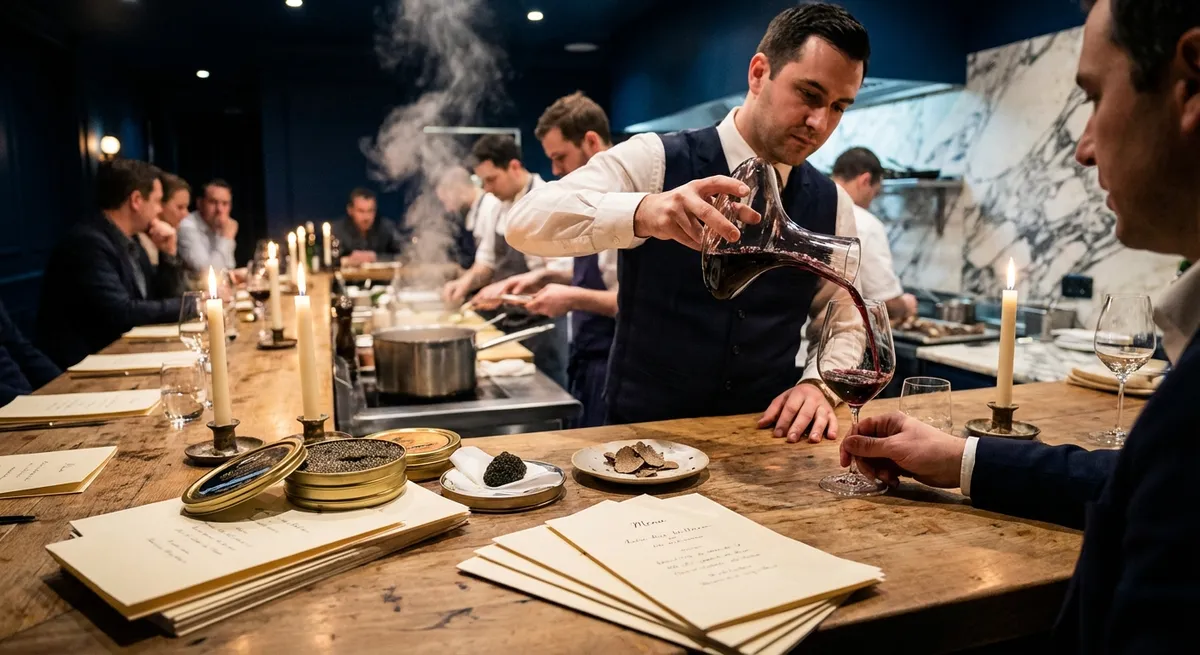
Theater announces itself. True service anticipates rather than interrupts. It’s the way a sommelier shifts from technical vocabulary to evocative, sensory language after noticing your eyes glaze over at the mention of tannins. It’s the discreet adjustment of pacing when the team realizes you are fresh off a red‑eye and conversing softly, or the silent appearance of a lighter stem glass after you react positively to the first wine’s aroma.
At this level, service teams operate less like attendants and more like readers of micro‑signals. They observe which hand you favor, where your gaze lingers on the menu, your comfort with ritual, your appetite for conversation. For the traveler accustomed to premium environments, the mark of excellence is a dining room that never needs to ask, “Is everything all right?” because it has already adapted to ensure that it is.
4. The Architecture of Atmosphere: Acoustics, Light, and Pace
Luxury travelers know that atmosphere is not ambient music and candles; it is an architecture of choices. The most refined restaurants obsess over acoustics, temperature, seating geometry, and the interplay of natural and artificial light long before a single plate is designed.
Listen first: in a truly exceptional room, conversations exist in soft pockets—audible to you, but never intelligible beyond your table. This is not accidental; it is controlled sound absorption and intelligent table spacing. Lighting, too, is considered: the ability to read the menu without strain, to see the color of a wine, yet still feel cocooned in warmth and privacy.
Attention to pace is another sign. Courses should arrive with a rhythm that matches your evening—neither hurried nor languid. Watch how the restaurant adapts when you linger over a course, step outside for a brief call, or engage deeply in discussion. The best rooms subtly recalibrate, ensuring the meal feels unbroken and unforced. For those accustomed to premium hotels and well‑run cabins, the sensation is familiar: a sense that invisible hands are constantly refining the environment in your favor.
5. Pairings as Cartography: Beyond Wine Lists and Into Worlds
Wine lists in serious restaurants now read more like atlases than inventories, and the most forward‑looking dining rooms treat pairings as miniature journeys that mirror, complement, or gently challenge your own. For the luxury traveler, this is an opportunity to experience regions, methods, and producers that are often difficult to access, even on the ground.
The true test is the sommelier’s ability to calibrate the experience to your level of curiosity. If you indicate you are comfortable moving beyond the classic French and Italian axis, many will open doors to volcanic terroirs, lesser‑known Eastern European regions, or quietly extraordinary New World producers working in low‑intervention styles. Increasingly, non‑alcoholic pairings—meticulously crafted infusions, fermentations, teas, and distillations—are given the same architectural rigor as wine flights, appealing to travelers who want clarity in the evening yet still crave complexity.
The conversation you have around pairings is often as revealing as the glasses themselves. In top‑tier rooms, there is no pressure to demonstrate knowledge; instead, you are invited into a dialogue. The most memorable experiences arise when you grant your sommelier a simple, evocative brief—“I want this progression to feel like dusk by the sea,” or “I prefer elegance to power”—and let their expertise translate mood into glass.
Conclusion
For those who move easily between cities, aircraft cabins, and private lounges, fine dining is not a trophy event—it is a finely tuned lens through which to experience the world. The sourcing behind a single dish, the invisible flexibility of a service team, the acoustic design of a dining room, the unlisted gestures, and the cartography of a pairing flight all speak a language that transcends borders.
When approached with intention, each reservation becomes more than a meal: it is a study in how a culture chooses to express its highest form of hospitality. Jet Ready exists in that space—where the table is not simply where you end your day, but where the day’s journey reaches its most considered expression.
Sources
- Michelin Guide – The Fundamentals of Fine Dining – Overview of key elements that define high‑end restaurant experiences, from service to atmosphere
- World’s 50 Best Restaurants – What Makes a Restaurant Truly Great? – Insights from top chefs on sourcing, creativity, and hospitality
- Harvard T.H. Chan School of Public Health – Sustainable Seafood Guide – Context on responsible sourcing and its impact on menu decisions
- Court of Master Sommeliers – Role of the Sommelier – Explanation of how sommeliers shape guest experience through curated beverage programs
- Cornell University School of Hotel Administration – Restaurant Atmospherics and Customer Experience – Research on how design, acoustics, and ambiance influence perceived quality in dining environments
Key Takeaway
The most important thing to remember from this article is that this information can change how you think about Fine Dining.