There is a point in every journey when the world softens: the aircraft door opens, the air shifts, and you feel—instantly—that everything has been quietly arranged in your favor. Luxury travel today is less about opulence on display and more about the orchestration of these nearly imperceptible moments. For the discerning traveler, true luxury is not louder, bigger, or brighter. It is quieter, more deliberate, and meticulously attuned to the way you actually want to move through the world.
This is the invisible art of arrival—and the travelers who understand it are designing experiences that feel as though they were always meant to be.
The Silent Tier Above First Class
The most astute luxury travelers have long recognized a simple truth: the “class” printed on a boarding pass is only the beginning of the story. Increasingly, the real differentiation lies in what happens before and after the flight—doorside, curbside, and airside.
Discerning travelers now treat commercial first and business class cabins as essential infrastructure, not as the experience itself. Private terminal access, invitation-only lounges, and airline-run chauffeur services create a buffer from the noise and friction of the airport. Companies such as PS at LAX, Lufthansa’s First Class Terminal in Frankfurt, or Emirates’ chauffeur-driven transfers in select cities illustrate the shift: the rarest luxury is being concealed from the crowd, even in the midst of a major international hub.
These travelers rarely move through a public check-in line or wait at a general security gate. They arrive at a discreet entrance, are escorted through private security, and are driven to the aircraft in a dedicated vehicle, often boarding last—with no announcement, no fanfare, and no rush. The seat itself may resemble those of other premium passengers, but their experience of getting there is utterly different. The privilege is not just the product; it is the seamlessness that frames it.
Architecture of Stillness: Choosing Hotels by Atmosphere, Not Address
For many, hotel selection still begins with location, brand, and room category. The more sophisticated traveler begins somewhere else entirely: with atmosphere. They are not simply booking a place to sleep; they are curating the emotional architecture of their stay.
The question is no longer “How close is this hotel to the city center?” but “What kind of stillness does this property offer at 7 a.m., at noon, at midnight?” Does the lobby hum discreetly, or does it perform for social media? Do suites feel like stage sets or like private residences you never want to leave? Is the view merely impressive, or does it reframe how you register a city or landscape?
This traveler studies the seams: corridor soundproofing, elevator placement, the ratio of suites to standard rooms, terrace privacy, and whether housekeeping appears unannounced or intuitively vanishes when you return. The finest hotels in the world are increasingly those that understand that a guest may value the ability to disappear more than the ability to be seen.
Here, refinement is measured in details that never appear in a hotel’s marketing copy: the quality of light at sunrise through sheer curtains, the discretion of staff who remember preferences without ever seeming to take notes, the absence of background music when silence would feel more honest. It is an architecture of stillness designed for people who carry fast, visible lives and crave a space where nothing requires performance.
The Curated Middle: Beyond Private Jets vs. Commercial Flights
Luxury aviation is no longer a simple binary between private jets and commercial cabins. The most informed travelers inhabit a more nuanced middle, choosing not just the class of travel but the rhythm of it.
Some routes justify a fully private aircraft: multi-stop itineraries in regions with limited commercial connectivity, or confidential trips where security and time sensitivity eclipse all other concerns. But a rising cohort prefers a blended approach—combining top-tier commercial flights with on-demand charter legs, shared private flights, or exclusive interline agreements that allow limousine-to-jet transfers without ever touching the public terminal.
These travelers analyze journeys holistically. A ten-hour overnight in a well-configured business class suite, followed by a 45-minute private hop directly to a remote island, can deliver a more restful and efficient experience than a fully private long-haul with multiple tech stops. They consider aircraft type, cabin layout, and likely load factor as carefully as they consider Michelin stars or private villa design.
They also understand that the most valuable asset is not the plane—it is time. The best itineraries honor circadian rhythm, minimize immigration friction, and avoid unnecessary connections, even if it means flying into a secondary airport with a superior arrivals experience. The journey is treated not as a cost of travel but as an integral chapter of the trip, designed to protect the traveler’s energy and clarity.
Taste as a Map: Using Gastronomy to Navigate a Destination
For the true luxury traveler, food is no longer an accessory to the itinerary; it is the structure of the experience itself. But this is not about ticking off the world’s most famous tasting menus. It is about using gastronomy as an intelligent framework for understanding a place.
Rather than booking restaurants solely by ranking or acclaim, these travelers look for culinary narratives that reveal the destination’s priorities: a chef’s commitment to small producers, a hotel’s relationship with local fishermen, a vineyard’s approach to soil and climate. They may dine at a renowned restaurant one evening, then spend the next afternoon in the kitchen of a family-run establishment, learning how everyday dishes carry centuries of memory.
They also treat hotel F&B programs as a crucial litmus test. A property that offers thoughtful, regionally anchored menus for in-room dining at odd hours signals a deep respect for the guest’s reality—jet lag, late meetings, early departures—while still expressing the character of the place. This is the inverse of generic “international” menus: cuisine becomes both comfort and context.
In this world, reservations are not simply bookings; they are time-stamped experiences arranged around light, appetite, and energy. A late lunch at a clifftop restaurant timed to the softest part of the afternoon, a pre-dawn coffee ritual with a view that slowly reveals itself, a final nightcaps-only visit to a bar known for quietly precise service—each becomes a way of mapping the destination through taste without ever chasing spectacle.
Bespoke Stillness: Designing Recovery Into Every Itinerary
The most exclusive insight among truly seasoned travelers is not a destination or a product—it is an understanding of personal capacity. They design their journeys around recovery with the same deliberation they apply to suites, jets, or tables.
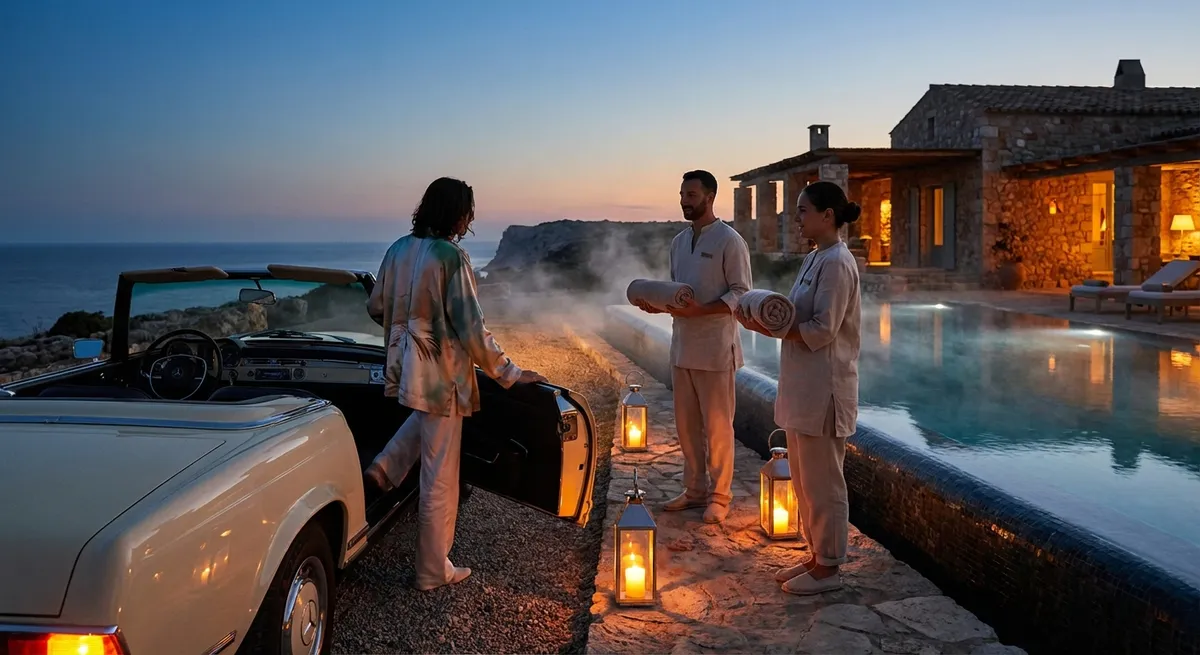
Instead of counting how many cities or resorts they can “fit” into a week, they ask how much stillness is required to arrive fully in each place. A long-haul arrival might be followed not by a dense afternoon of activities but by a private spa session, a quiet in-suite meal, and a full reset of sleep and hydration. Meetings or social commitments are then scheduled for the day when the traveler’s mind is fully present, not simply physically on the ground.
This often involves a disciplined refusal to over-schedule. The most refined itineraries now feature deliberate blank spaces—half-days with nothing planned but potential. These are not mistakes in planning; they are carefully placed invitations for serendipity or deep rest. And the properties best attuned to this class of traveler respond in kind: flexible check-in and check-out, wellness facilities that accommodate unusual hours, and staff trained to read energy levels, not just itineraries.
Luxury, in this sense, becomes the freedom to move at the pace at which you can actually absorb the experience—not the pace at which it can be documented.
Conclusion
The new language of luxury travel is spoken softly and designed precisely. It is not about how many privileges can be stacked, but about how intelligently each moment of the journey is shaped. From private terminal arrivals that erase the chaos of airports to hotel environments engineered for stillness, from nuanced aviation choices to gastronomy as cartography, and itineraries with built-in recovery, the most refined travelers are crafting experiences that feel intimately calibrated rather than aggressively curated.
To travel this way is to understand that the rarest luxury is not excess, but alignment—the quiet certainty that everything around you has been arranged to honor how you prefer to live, move, and feel, wherever in the world you are.
Sources
- Lufthansa First Class Terminal & Lounge – Details on private terminal services and how select airlines elevate the pre-flight experience
- PS at LAX – Official Site – Example of private terminal services that redefine commercial air travel arrivals and departures
- U.S. Department of Transportation – Air Travel Consumer Guide – Authoritative information on air travel rights and considerations for premium travelers
- Cornell Center for Hospitality Research – Hospitality research, including insights on service design, guest experience, and hotel operations
- World’s 50 Best Restaurants – Official List – Reference for destination-worthy gastronomy and global culinary benchmarks
Key Takeaway
The most important thing to remember from this article is that this information can change how you think about Luxury Travel.