Luxury travel is no longer defined by square footage, thread count, or the number of Michelin stars on your itinerary. For today’s most discerning travelers, true luxury is measured in something far rarer: the quiet continuity between where you live, where you stay, and how you move through the world. It is the feeling that—from the moment you leave your front door to the moment you return—your life remains intact, uninterrupted, and exquisitely orchestrated.
This is the invisible thread: a standard of travel in which every city, every suite, and every seat in transit feels like an extension of a life already running at its highest resolution. Below are five insights that define this new tier of luxury—details that rarely appear in brochures, yet quietly determine whether a journey feels merely expensive or genuinely exceptional.
1. The Luxury of Continuity: Designing a Travel “Home Graph”
For the genuinely well-traveled, luxury is the absence of reset. Check-in should not feel like starting over; it should feel like resuming a familiar chapter in a different city.
Sophisticated travelers increasingly curate what might be called a personal “home graph”: a network of hotels, residences, and private clubs around the world that share a common design language, service philosophy, and technological backbone. Your preferred mattress type, pillow density, in-room lighting levels, minibar profile, and even coffee order are not re-entered at every stay—they are remembered, anticipated, and quietly executed.
This is why many choose to anchor their travel lives around a small constellation of brands or ultra-high-end independents aligned with their aesthetic values. A Paris pied-à-terre hotel with Haussmann façades but rigorously modern interiors; a Tokyo address that understands both omotenashi and your need for a standing desk; a New York suite where your fitness routine follows you via the exact same equipment you use at home.
The most refined itineraries are therefore not built city by city, but through the deliberate selection of a “family” of properties and services that speak the same language, so that the traveler never has to translate their preferences twice.
2. Precision of Time: Engineering a Frictionless Journey
At the top tier of travel, the true scarce commodity is not money; it is unbroken, high-quality time. A sophisticated itinerary is defined less by where you go and more by how seamlessly you move between points.
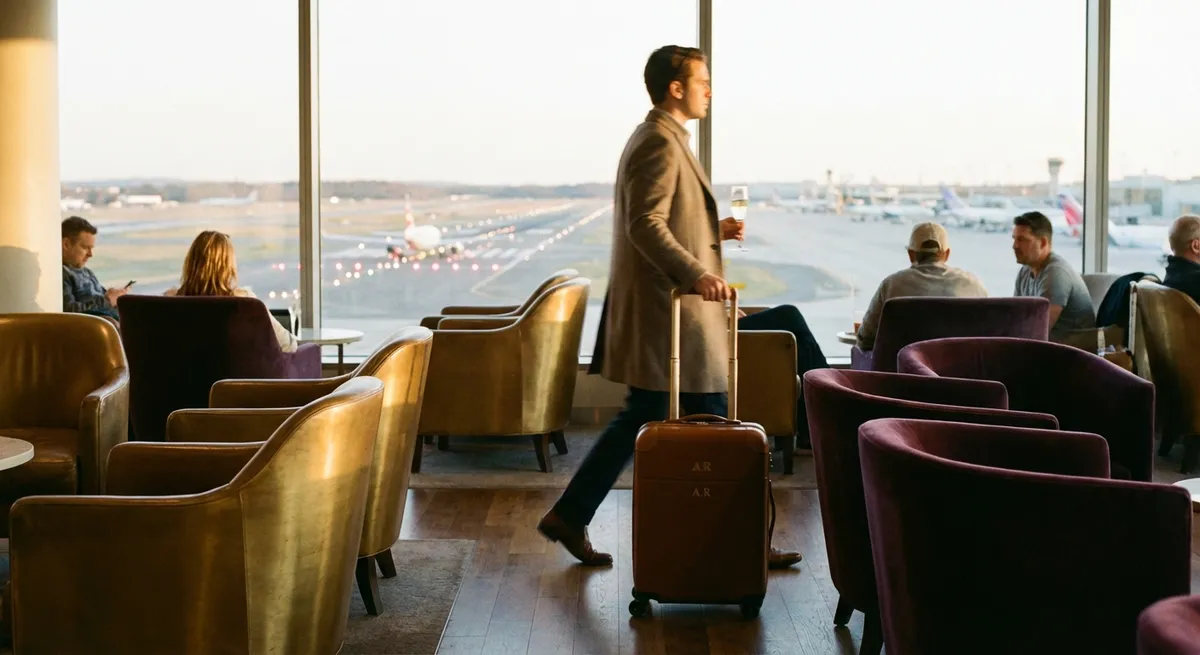
Discerning travelers increasingly treat time as a design material, using it with surgical precision. This manifests in ways that are nearly invisible from the outside: choosing flight times that optimize circadian rhythm and productivity rather than just convenience; structuring transfers to eliminate idle waiting; layering private and semi-private services (from fast-track immigration to airport concierge meet-and-greet) so that walking through terminals feels like moving through a series of private corridors rather than crowded public spaces.
The most elevated experiences are built backward from your ideal daily rhythm. When do you do your best strategic thinking? When do you prefer to eat lightly, and when do you indulge? What kind of environment do you need immediately after a long-haul flight—silence and a dark room, or a short, structured reset with daylight, stretching, and a precisely calibrated meal?
Luxury, in this lens, is not just arriving quickly; it is arriving in a condition that allows you to be immediately present, awake, and capable of actually enjoying where you are.
3. Elevated Privacy: Crafting Layers of Visibility and Discretion
In the modern luxury landscape, privacy is no longer as simple as “seen” or “unseen.” It is a layered architecture of visibility, managed with intention.
At the highest levels, privacy is designed in concentric circles. The outer ring might be the public-facing version of your travel—social posts, restaurant appearances, open-table reservations. The intermediate ring includes those who need to know where you are in order to support you: a trusted travel advisor, security team, or personal assistant. At the core is a small subset of properties, drivers, and service professionals who are granted a deep but silent understanding of your patterns, needs, and non-negotiables.
Refined travelers do not merely tolerate privacy policies; they actively audit and select for them. They gravitate toward hotels with discreet back-of-house circulation routes, restaurants that can host without spectacle, and aviation providers with robust data and identity protection frameworks. Digital privacy is weighed as carefully as physical seclusion: end-to-end encrypted communication with concierges, minimal over-sharing of live locations, and tight control over booking information that reveals future movement.
True luxury is not anonymity; it is control over when and how you appear in the world, with whom, and on what terms.
4. Sourcing Authenticity: Quiet Access Over Public Headlines
As luxury experiences have become more visible and Instagrammable, their perceived exclusivity has paradoxically declined. The most sophisticated travelers have quietly stepped away from spectacle in favor of something subtler: access that is unadvertised, untheatrical, and not designed for public consumption.
This might mean an early museum entry guided by a curator rather than a “VIP tour” badge; a private tasting with a winemaker whose name never appears on the official event calendar; or an after-hours atelier visit arranged through a personal introduction, not a commercial concierge. The common thread is that these experiences are structured around genuine expertise and shared values, not marketing language.
Such access is rarely available via simple online queries. It accumulates over years of trusted relationships with independent advisors, fixers, and local insiders—people who themselves move comfortably in both global and hyper-local circles. The traveler’s role is not merely to consume, but to approach each encounter with respect, curiosity, and discretion, in recognition that what is being offered is not a product, but a temporary entrance into someone else’s world.
At the peak of the market, luxury no longer means, “I can get in anywhere.” It means, “I am invited into places that do not need me at all.”
5. The Curated Interior World: Protecting Your Mental Atmosphere
The most underrated dimension of luxury travel is psychological: the preservation of your inner atmosphere as you cross borders, time zones, and cultural contexts.
For seasoned travelers, this means meticulously curating the sensory and cognitive inputs that accompany movement. Noise is filtered at multiple levels: silent vehicles, noise-canceling systems that actually match your hearing profile, and an intentional control over what you listen to, read, or watch in transit. Lighting is treated as therapy, not decoration; circadian-supportive light in cabins and hotel rooms becomes a quiet but powerful tool for maintaining clarity and mood.
Equally important is the curation of digital exposure. Instead of defaulting to the infinite scroll, high-end travelers often maintain a “travel library”—carefully chosen books, longform articles, offline playlists, and courses that align with the mindset they wish to inhabit throughout the journey. They consciously limit reactive digital engagements (breaking news, social disputes, overflowing inboxes) during key transition windows, protecting those hours as rare, high-quality thinking time.
At this level, luxury travel is not about escaping one life for another; it is about sustaining a coherent internal world that remains calm, deep, and focused, irrespective of where you wake up.
Conclusion
The future of luxury travel lies less in opulence and more in orchestration. The rarest privilege is not simply to go anywhere, stay anywhere, or dine anywhere—but to maintain a continuous, high-quality version of your life as you move through the world.
Continuity over novelty. Precision over excess. Privacy over performance. Access over spectacle. Interior coherence over external display.
For those who live much of their lives between cities and time zones, this is the new benchmark: a travel life so thoughtfully constructed that distance dissolves, borders blur, and every arrival feels less like a departure from yourself and more like an elegant extension of who you already are.
Sources
- Virtuoso: The Future of Luxury Travel - Industry perspective on evolving expectations in high-end travel
- McKinsey & Company – The Travel Industry Turned Upside Down - Analysis of changing traveler behavior and premium segment dynamics
- Forbes – Why Privacy Is The Ultimate Luxury In Travel - Exploration of privacy as a core pillar of modern luxury experiences
- Condé Nast Traveler – What Luxury Travelers Want Now - Insights into current high-end traveler preferences, from authenticity to access
- Harvard Business Review – The Value of Time - Research-backed perspective on time and energy management, relevant to designing frictionless journeys
Key Takeaway
The most important thing to remember from this article is that this information can change how you think about Luxury Travel.