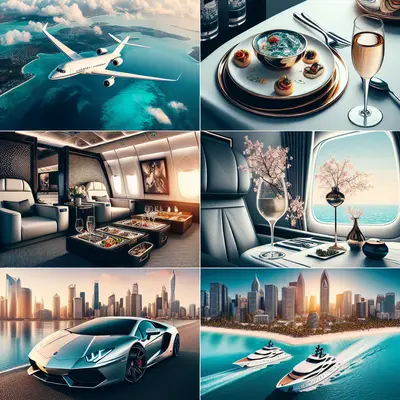
For a growing circle of discerning travelers, luxury is no longer defined by logos, lobbies, or loyalty tiers. It is measured in silence between waves, in the precision of a perfectly timed arrival, in the sense that an entire ecosystem—people, place, and time—has conspired to create something exquisitely unrepeatable. This is the new quiet elite of luxury travel: less about being seen, more about feeling profoundly, privately catered to.
Jet Ready’s audience understands that the most coveted experiences rarely appear in glossy brochures. They live in the details: the way a hotel handles your jet-lagged arrival, the unlisted table in a restaurant that never “officially” has availability, the art of moving through the world as if the itinerary were bending itself around you. Below, five under-the-radar insights shaping luxury travel for those who prefer their indulgence off the record.
1. The Itinerary Has Gone Invisible
The most sophisticated trips today are choreographed so seamlessly that the traveler rarely sees the choreography at all. Instead of receiving a rigid, hour-by-hour schedule, guests are increasingly presented with a framework—key anchors like a private tasting, a gallery visit, or a yacht transfer—while everything else flexes in real time. Intelligent back-end planning anticipates mood, energy levels, and jet lag, so options quietly appear rather than being imposed.
High-end concierges now coordinate with private aviation teams, drivers, chefs, and guides via discreet digital backbones, constantly reshuffling details so the guest experiences the illusion of effortlessness. Wake later than expected? The river cruise is silently moved by an hour, and a private guide casually suggests a perfectly timed detour. This invisible itinerary respects the traveler’s spontaneity while guaranteeing that every “unplanned” moment is, in fact, carefully engineered. The result: the rare sensation that the world is adjusting to you, rather than the other way around.
2. Micro-Privacy Has Replaced Grand Seclusion
The old paradigm of luxury privacy was simple: go remote, go big, go gated. Today’s sophisticated traveler wants something more nuanced—what might be called micro-privacy. This is not total isolation; it is a meticulously curated level of control over how, when, and with whom you interact. The magic lies in knowing you can disappear at will, without ever feeling disconnected.
This might take the form of a members-only lounge inside an already exclusive resort, a villa wing with its own staff and entrance, or sailing itineraries designed to arrive at a destination just after the cruise ships depart. Thoughtful properties now offer staggered check-in windows to avoid lobby congestion, “off-hours” spa experiences, or private dining zones that feel integrated rather than cordoned off. The most refined service teams actively read social cues—whether a guest wants conversation or complete invisibility—and adjust their presence accordingly. Micro-privacy, at its best, allows travelers to inhabit the world fully while never feeling observed by it.
3. Culinary Access Has Become the New Black Card
For the ultra-discerning guest, luxury dining is no longer about simply securing a coveted reservation; it is about gaining access to layers of experience that are never made public. The true status marker is not the restaurant everyone is posting, but the dining room no one is allowed to photograph, the menu that doesn’t officially exist, or the chef who cooks off-hours purely for a single table. Culinary access has quietly become its own currency.
High-level travel planners now maintain private networks of chefs, sommeliers, and restaurateurs who are willing to close their doors early, host a pre-service tasting, or design one-off menus around a guest’s personal history or preferences. A seemingly modest bistro may open its cellar for a vertical tasting unavailable to regular patrons. A renowned pastry chef may meet your jet on the tarmac with warm viennoiserie timed to your arrival. These moments are rarely broadcast; their power lies in the intimacy of knowing the experience was crafted for you, and only you, with no expectation of public proof.
4. Time Optimization Has Become the Ultimate Indulgence
The freshest expression of luxury is not a specific destination, but the way in which your time is treated as the most precious resource in the itinerary. This extends far beyond private jets and priority lanes. Subtle, elevated time optimization means frictionless transitions, where each leg of the journey feels like a continuation of the last, rather than a logistical interruption. The reward is not just speed, but calm.
At the very top end, this may mean airside meet-and-greets that bypass terminals entirely, private customs clearances, or in-villa immigration processing in select destinations. On the ground, it manifests as drivers trained to anticipate your preferred routes and pacing, spas prepared to treat you the moment you arrive, or experiences scheduled for precise light conditions and crowd flows. Instead of cramming itineraries, expert planners leave intentional white space—windows of unscheduled time that naturally collect serendipity. When time is handled with such care, the traveler experiences an almost cinematic continuity, moving from jet to car to suite to sea without ever feeling hurried.
5. Cultural Discretion Is the New Benchmark of Taste
In an era of hyper-visibility, luxury travelers are increasingly defined by how discreetly they engage with the cultures they visit. Flaunting access or treating local traditions as set pieces feels outdated; the new benchmark of taste lies in quiet, deeply respectful immersion that leaves minimal footprint and maximal goodwill. The most sophisticated guests don’t collect destinations—they cultivate relationships.
This might mean visiting a revered artisan after hours, with no social media allowed; contributing to a local conservation or cultural preservation fund as a condition of access; or participating in experiences guided by local custodians rather than external “experts.” Leading properties now vet experiences not only for quality but for cultural integrity, ensuring that guests are invited as temporary stewards rather than spectators. Luxury, in this context, becomes the ability to enter private worlds without distorting them—and to depart leaving nothing behind but gratitude and support.
Conclusion
For Jet Ready’s travelers, the future of luxury is less about escalation and more about refinement. It is not the loudest suite, the highest floor, or the most photographed pool that defines true indulgence, but the elegance with which every interaction is orchestrated: the invisible itinerary, the gentle guardrails of micro-privacy, the quiet privilege of culinary access, the reverent handling of your time, and the cultural discretion that signals genuine sophistication.
The quiet elite of luxury travel are not chasing the next big spectacle; they are editing. Editing noise, friction, exposure, and excess—until only what is essential, rare, and deeply personal remains.
Key Takeaway
The most important thing to remember from this article is that this information can change how you think about Luxury Travel.