Fine dining at the highest level is less about spectacle and more about orchestration—a quiet, seamless sequence of gestures, decisions, and details that most guests never fully see. For luxury travelers, the most memorable meals are rarely the most elaborate; they are the most considered. What distinguishes an exceptional restaurant from a merely excellent one is not just what appears on the plate, but how every moment around that plate has been designed.
For the discerning guest, understanding this invisible architecture opens a different kind of appreciation. It becomes less “going out to dinner” and more entering a world where time, attention, and taste are being curated with surgical precision. Below, five exclusive insights reveal how to read and navigate that world with the ease of a true insider.
The Preludial Moment: Reading the Room Before the Menu
Before a single bread course arrives, the experience has already begun. The most accomplished fine dining rooms stage a subtle prelude long before the first bite: the acoustic temperature, the distance between tables, the angle of your chair to the room, the unobtrusive check of your comfort level.
Seasoned travelers notice how top-tier restaurants deploy arrival as a statement of intent. The placement of your table signals the house’s intuition of your preferences—some guests are naturally given a discreet corner with a sight line of the entire room, others are placed closer to the bar’s energy if their profile suggests they favor atmosphere over privacy.
Details that matter at this level are rarely accidental: the weight of the chair, the tactility of the linen, the temperature of the water poured immediately upon seating. These choices indicate whether the restaurant values longevity of the experience (comfort for a multi-course menu), theatricality (heightened visuals, central placements), or understated calm.
For the traveler, arriving ten minutes early transforms this from routine to ritual. It allows a quiet reading of the space, a moment to calibrate expectations, and—crucially—a chance to establish rapport. An understated comment about the lighting, the glassware, or the artwork can open a more nuanced conversation with the host or sommelier and subtly signal that you are attuned to the level at which they operate.
The Language of the Menu: Beyond Courses and Descriptions
At the high end, a menu is not simply a list of dishes; it is a narrative that reveals the chef’s priorities, the sourcing philosophy, and their understanding of time and place. Luxury travelers can decode this narrative to make better choices, and sometimes to step beyond the printed page entirely.
Pay particular attention to the structure: whether there is a single tasting menu, a short à la carte section, or a series of “chapters” (snacks, signatures, seasonal, reserve ingredients). A single tasting menu suggests a chef who wants to control the arc of the evening; a more modular approach indicates flexibility and a willingness to tailor.
The vocabulary matters too. A menu that names specific producers—single-origin chocolate, heritage farms, precise coastal areas—signals a commitment to traceability and seasonality, often validated by independent sustainability guides and awards. A more minimalist style, listing only main elements, may indicate confidence that the service team will provide context at the table rather than on the page.
For those comfortable in this environment, the most rewarding experiences often come from gentle inquiry. Asking, “Is there anything the kitchen is particularly excited about this evening that isn’t listed?” is a quiet key to possible off-menu tastes—early-season ingredients, last-of-the-season specialties, or experiments the chef is refining. These small digressions from the standard path often become the most memorable moments of the meal.
The Cellar as Compass: Navigating Pairings with Precision
In truly serious dining rooms, the wine list is less a catalogue and more a map of the restaurant’s worldview. The structure of the list—how regions are prioritized, whether emerging producers share equal space with established estates, how vintages are distributed—tells you what the restaurant considers important.
A strong Champagne selection, for example, not only speaks to celebration, but to a belief that high-acid, textural wines are versatile partners across a tasting menu. A deep showing of grower-producers suggests an interest in nuance and terroir; a focus on iconic maisons indicates a reverence for classic luxury.
The most exclusive insight, however, rarely sits on the printed page. At this level, informed guests engage the sommelier as a collaborator rather than a vendor. Sharing your preferences in terms of texture, weight, and mood (“I’m looking for something precise and vertical, not lush,” or “I’d like a red that whispers rather than speaks loudly”) gives the sommelier latitude to work within the cellar’s quietest treasures—older vintages with limited stock, lesser-known appellations that drink far above their price, or bottles resting off-list.
For those who prefer a measured approach, considering half-bottles, Coravin pours, or custom pairings for only a portion of the menu allows you to experience the logic of the cellar without committing to a full progression. The true luxury is not abundance; it is the feeling that every glass has a reason to be there.
Service as Discreet Theatre: Sensing, Not Showing
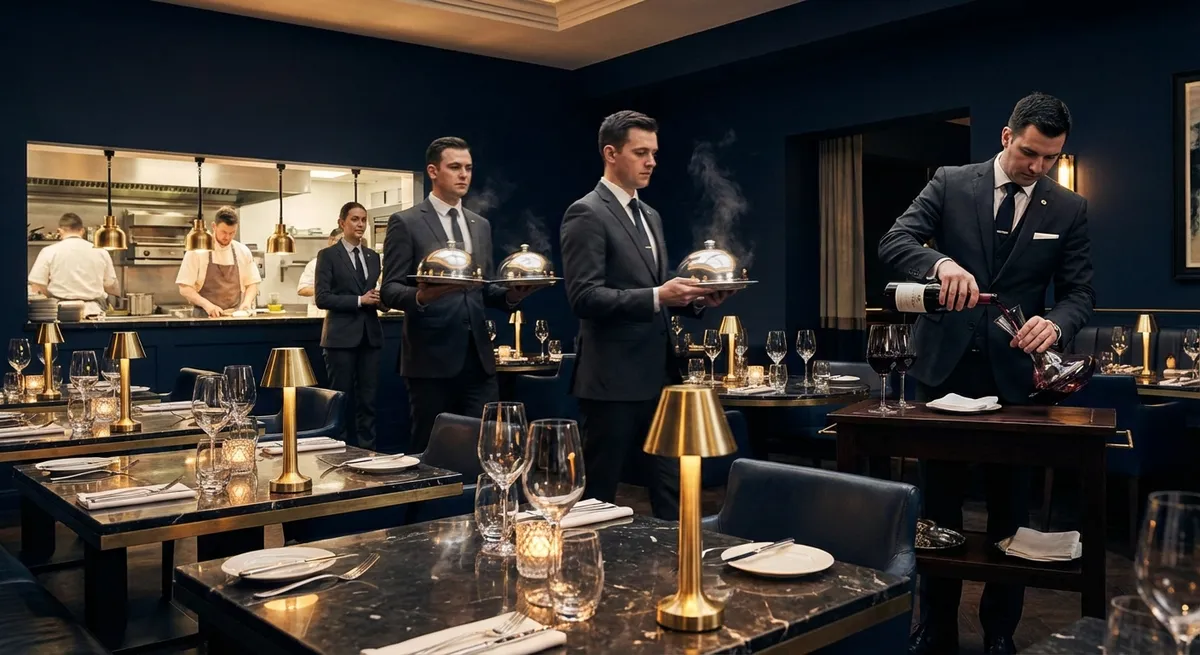
Exemplary service in fine dining is not about visibility—it is about anticipation. The most refined teams understand that their role is to adjust the guests’ relationship with time: to remove friction, to edit interruptions, and to create a sense that everything happens precisely when it should, with no visible effort.
Experienced travelers often notice small indicators of this capability within minutes. The timing of the first interaction, the way dietary preferences are confirmed without formality, the immediate resolution of any minor discomfort—these reveal whether the service team is operating at a merely professional level or at a truly choreographed one.
A polished room will quietly track your rhythms: the pace at which you sip your wine, how quickly your table falls into conversation after each course, your body language between plates. Courses will either accelerate or decelerate in response; explanations will lengthen or shorten; refills will be timed to your natural pauses rather than imposed on them.
The art, for the guest, is to meet this finesse with clarity. Expressing early whether you prefer a brisk or lingering pace, whether you enjoy detailed dish descriptions or a more restrained approach, allows the team to calibrate around you. When expectations and capability align, the result is an evening where you feel neither managed nor left alone, but precisely accompanied.
Memory as Craft: How the Best Restaurants Design What You Take With You
At the uppermost tier, a restaurant’s true measure is not the complexity of a dish, but the durability of its memory. Exceptional dining rooms understand that what you recall weeks later is rarely a perfect recitation of courses; it is an impression made of carefully designed anchors.
These anchors are often understated: a recurring flavor that appears in different forms throughout the menu, a particular serving vessel that returns for the final sweet course, or a signature bread and butter pairing that quietly punctuates the experience. They create continuity and make the evening feel authored rather than assembled.
Luxury travelers who dine frequently across cities and continents tend to recognize and value these narrative threads. They also appreciate that the most memorable dinners anticipate future encounters. A handwritten note accompanying a menu copy, a recipe card for a sauce or garnish you admired, or an invitation to revisit a specific seasonal dish at another time of year—all of these extend the restaurant’s presence beyond its walls.
For the guest, the ultimate refinement lies in reciprocation: sending a brief message after a particularly resonant meal, noting a single moment that stayed with you, or returning months later and referencing a detail from your last visit. The best houses remember, and they use that memory to shape an even more precise experience the next time you sit down.
Conclusion
Fine dining at its most elevated is not a display but a dialogue—between chef and guest, terroir and technique, service and silence. For luxury travelers, understanding the subtleties behind the menu, the cellar, the room, and the pacing transforms a beautiful meal into a crafted encounter.
The five insights above—arrival as prelude, menus as narratives, cellars as compasses, service as discreet theatre, and memory as craft—offer a framework for seeing what others miss. In the end, the rarest luxury is not merely access to the world’s best tables; it is the ability to inhabit them with discernment, and to leave with a sense that the evening was made precisely, and quietly, for you.
Sources
- [Michelin Guide Official Site](https://guide.michelin.com/) - Global reference on fine dining standards, restaurant evaluations, and service expectations
- [The World’s 50 Best Restaurants](https://www.theworlds50best.com/) - Insight into leading restaurants worldwide and evolving trends in gastronomy
- [James Beard Foundation](https://www.jamesbeard.org/) - Covers excellence in culinary arts, including chefs, sustainability, and service
- [Cornell University School of Hotel Administration](https://sha.cornell.edu/faculty-research/research/) - Hospitality research, including studies on service design, guest experience, and restaurant operations
- [Harvard T.H. Chan School of Public Health – The Nutrition Source](https://www.hsph.harvard.edu/nutritionsource/) - Provides context on ingredients, sourcing, and health-conscious approaches relevant to modern fine dining
Key Takeaway
The most important thing to remember from this article is that this information can change how you think about Fine Dining.