Luxury travelers no longer chase just the “best restaurant in the city.” They seek something rarer: rooms where every detail seems to anticipate them, where the menu feels more like a conversation than a performance, and where time itself appears to slow down between courses. Fine dining, in its most evolved form, has moved beyond spectacle into precision, restraint, and profound intentionality. What distinguishes a merely excellent meal from an unforgettable one is rarely visible on the plate alone.
Below, five exclusive, often unspoken dimensions of contemporary fine dining that discerning travelers are quietly prioritizing—and how to recognize them the moment you’re seated.
1. The Art of Pre-Vetted Menus: When the Restaurant Knows You Before You Arrive
For the world’s most astute restaurants, the experience begins long before a guest walks through the door. Luxury travelers who dine at the very top tier often discover that their preferences, dietary notes, and even pacing habits have been discreetly documented across visits, seasons, and sometimes continents.
This is more than an annotated guest profile. In leading dining rooms, advance intelligence informs which section of the room you’re seated in, which menu sequence you’re shown, and whether the sommelier approaches with a quiet half-bottle or a structured pairing. For frequent travelers, this creates continuity across multiple cities: the same chef may send a variation of a dish you loved three years ago, reimagined with the current season’s produce and the local terroir.
The true luxury is that this never feels like a system—it feels like instinct. The restaurateur remembers that you dine light at lunch, or that you prefer your tasting menus without excessive sweetness toward the end. To tap into this tier of service, refined travelers increasingly share more context in advance: time constraints, mood (celebration versus decompression), preferred intensity of interaction. In the right hands, this information transforms dinner from a menu-driven experience into a fully choreographed evening.
2. Precision Pacing: The New Benchmark of Culinary Hospitality
In a serious dining room, pacing is no longer just “fast” or “slow.” It’s micro-calibrated. How swiftly your first glass arrives, how long you wait before the second course, whether a pause is introduced before the main—these are decisions that quietly determine whether you feel elegantly transported or subtly fatigued.
Elite travelers have begun to judge a restaurant not only by its food, but by its sense of time. In dining rooms at the highest level, the service team notes patterns from the first minutes of your arrival: the speed at which you finish your aperitif, your conversational intensity, even your posture. These signals shape the tempo of the evening—allowing the staff to extend a course when a conversation deepens, or tighten the pacing when they sense you’re decompressing from a long day of travel.
This level of attentiveness suits modern luxury travel, where dinner often needs to align with complex schedules: late check-ins, early departures, and unscripted detours. Discreet guests increasingly communicate their evening’s horizon—“we have an early flight,” or “this is our only long night in the city”—and the most sophisticated dining rooms respond with tailored tempos that preserve both indulgence and rest.
3. The New Language of Pairings: Beyond the Traditional Wine Flight
For years, wine pairings defined ambitious restaurants. Today, refined guests are looking for something more nuanced: pairing philosophies that honor both the cuisine and their personal bandwidth for alcohol, complexity, and experimentation.
High-end dining rooms now build multi-layered pairing programs: classic, avant-garde, non-alcoholic, and hybrid. The hybrid category, favored by frequent flyers and wellness-focused travelers, is especially telling—perhaps a vintage Champagne to open, a single grand cru to carry multiple courses, and then an intricate non-alcoholic infusion to close. The experience feels indulgent, yet considered.
In certain global capitals, the beverage program functions as a quiet atlas of regional craftsmanship. A sake selected from a micro-producer who mills their own rice, a vermouth finished in local oak, or a tea sourced directly from a single mountain plot—all become narrative threads that connect the restaurant to its place. For those who travel often, this offers something more compelling than another “perfect” Napa Cabernet: a curated education in the flavors and makers that truly define a destination, without ever sliding into lecture.
4. The Intelligence of the Room: Architecture, Acoustics, and Social Privacy
The most advanced fine dining rooms today are designed less like restaurants and more like finely tuned instruments. Thoughtful architecture and acoustic engineering now matter as much as the tableware, particularly for travelers who conduct parts of their lives across time zones and in public spaces.
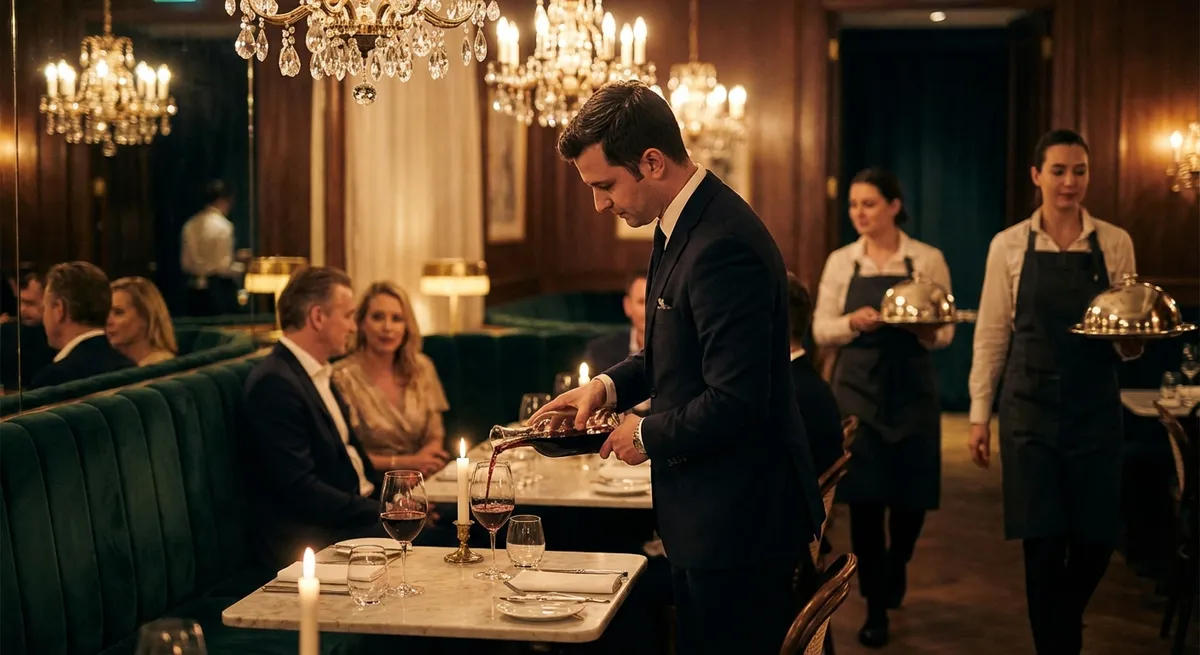
Sound is the new frontier of luxury. In top-tier dining rooms, you’ll notice how quickly external noise disappears once you’re seated. Curated materials—textiles, wood, soft partitions—diffuse conversation just enough that you can speak naturally without being overheard. Tables are angled to avoid direct eye-lines with neighboring parties, and lighting is layered to frame your table like a private stage, while the rest of the room recedes into a flattering blur.
For those discussing sensitive topics—deal points, family matters, future plans—this level of considered privacy is invaluable. Reservation teams at the upper echelon now understand requests like “we’d prefer a more secluded corner” as a standard expectation, not an indulgence. The experience isn’t about isolation; it’s about a quiet sense of control over how visible—or invisible—you choose to be.
5. Craft as Narrative: When a Single Ingredient Tells the Whole Story
The most sophisticated luxury travelers increasingly prefer depth over breadth. Instead of being dazzled by a cascade of rare ingredients, they pay attention to how one element can be elevated, reinterpreted, and contextualized across an entire meal.
In the world’s most thoughtful fine dining rooms, a single ingredient might appear in multiple, almost imperceptible roles: a distillation in the opening cocktail, a subtle note in an amuse-bouche, the focus of a main course, and finally an echo in a mignardise. This repetition is not redundancy; it’s storytelling. It reveals the restaurant’s relationship with its producers, its land, and its season.
This approach dovetails with a broader shift toward sustainability and provenance. Instead of showcasing luxury via excess, top-tier restaurants demonstrate refinement via restraint and precision. A single, perfectly handled vegetable from a known farm, or a fish sourced from a specific day boat, is no longer a footnote—it is the central plot. For the frequent traveler, these stories provide a way to truly remember where they’ve been, long after the itineraries blur together.
Conclusion
For travelers who move seamlessly between continents and capitals, fine dining is no longer just about reserving the most coveted table. It’s about seeking rooms that understand tempo as deeply as taste, that value privacy as much as presentation, and that can translate a city’s character into a sequence of quiet, exquisitely considered moments.
The finest tables in the world today do not shout their excellence. They reveal it gradually—in how they prepare for your arrival, how they manage your time, how they frame your conversations, and how they choose to work with a single perfect ingredient. For luxury travelers attuned to these subtleties, fine dining becomes less a special occasion and more a personal ritual of orientation: a way to feel truly placed, and truly known, wherever the journey leads next.
Sources
- The World’s 50 Best Restaurants – Official List & Editorial - Global benchmark for high-end dining, with insight into evolving trends in fine dining and restaurant philosophy.
- Michelin Guide – Official Site - Authoritative resource on top-tier restaurants worldwide, including evaluations of service, ambiance, and culinary technique.
- Harvard T.H. Chan School of Public Health – “The Nutrition Source: Dining Out” - Context on how evolving guest expectations intersect with wellness and dining choices.
- Cornell University School of Hotel Administration – Restaurant Design & Experience Research - Academic studies on restaurant design, acoustics, and guest perception of luxury environments.
- UNESCO – Intangible Cultural Heritage of Gastronomy - Exploration of gastronomy as cultural expression, supporting the idea of ingredients and culinary traditions as narrative elements.
Key Takeaway
The most important thing to remember from this article is that this information can change how you think about Fine Dining.