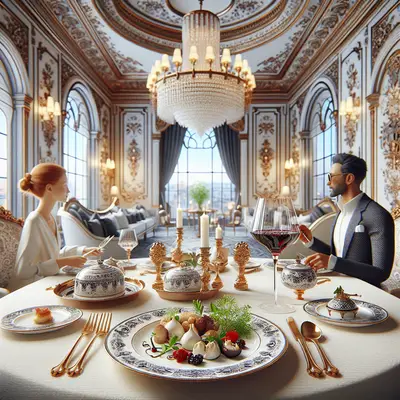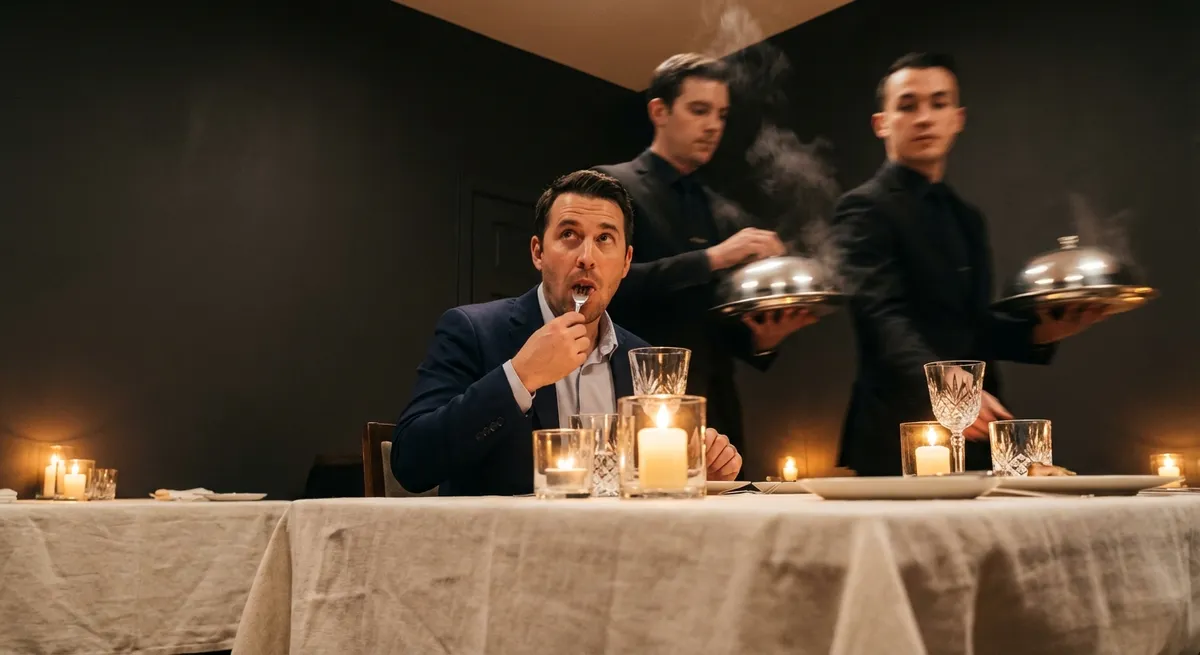
There is a moment, just after the first glass is poured and before the first course arrives, when a fine dining room reveals its true nature. For luxury travelers, that moment is less about spectacle and more about composition: light, tempo, sound, spatial discretion, and the precision of people who understand that true luxury is not what insists on being noticed, but what quietly calibrates itself around you. Fine dining, at its highest level, is no longer a sequence of plates; it is a meticulously orchestrated environment in which every element is designed to feel inevitable, yet never obvious.
1. The Architecture of Acoustics: When Silence Becomes a Service
Seasoned travelers often book the table, but the genuinely discerning book the room. At the rarified end of fine dining, acoustic engineering has become an invisible hallmark of quality — a form of comfort that unfolds before the menu is even opened.
In the world’s most considered dining rooms, sound is layered as carefully as courses. Ceiling baffles are concealed behind hand-plastered finishes; tabletops are chosen as much for how they absorb vibration as how they photograph; even chair upholstery is specified to reduce glassware chatter and cutlery noise. This is why two restaurants with identical menus can feel entirely different: in one, the room hums with a low, warm murmur; in the other, conversation strains against a hard, echoing clatter.
For luxury travelers, this is not a trivial detail. It determines whether confidential business can be conducted without leaning in, whether an intimate celebration feels cocooned rather than exposed, and whether a long tasting menu feels invigorating instead of exhausting. The elite guest increasingly seeks rooms where background music is tuned to the human voice, where subwoofers are tempered, and where the acoustics respect the privacy of a conversation as much as the precision of a sauce.
The quietest rooms are often the most technically complex. Discretion, in this sense, is not the absence of sound but its deliberate sculpting — a silent service you never see, but always feel.
2. Beyond Provenance: The New Lexicon of Ingredient Transparency
For years, provenance has been a luxury refrain: name the farm, the fisherman, the hillside. Today’s most advanced dining rooms have moved beyond simple origin stories into a deeper, more data-rich transparency that appeals to travelers who see dinner as a convergence of ethics, excellence, and information.
Rather than reciting a list of suppliers, progressive fine dining programs now articulate the logic behind their sourcing. A wine pairing may explain not just the appellation, but why the producer’s canopy management suits a changing climate; a fish course might detail catch method, water temperature, and how the restaurant’s buying schedule supports a healthier stock cycle. Guests who move comfortably between private aviation, impact investing, and sustainable philanthropy expect similar dimensionality when it comes to what is on the plate.
This is not performative virtue. It is a new language of trust. The modern luxury diner increasingly evaluates restaurants the way they evaluate brands: by the coherence of their decisions. Dry-aged fish programs, closed-loop vegetable cycles, low-intervention wine lists, and precise waste-reduction methods are not marketing points — they are signs of operational intelligence.
For the frequent traveler, this layered transparency has an added benefit: it transforms dining into a form of local literacy. A menu ceases to be just a list of courses and becomes a discreet briefing on how a region grows, harvests, and thinks about its future.
3. Precision of Tempo: The Invisible Choreography of Service
Time, in fine dining, is the rarest and most misunderstood ingredient. The experienced luxury traveler does not simply want “fast” or “slow” service; they want timed service — a choreography that feels tuned to their own internal rhythm.
At the highest tier, pace is negotiated without words. Staff read the angle of a guest’s body toward the table, the depth of conversation, the level of wine in the glass, the pattern of phone usage. A discreet glance between captain and sommelier may stretch a course by five minutes to allow a deal to conclude; an almost imperceptible delay before clearing dessert may hold a perfect silence between two people who are not finished speaking.
What feels effortless is typically the result of intense calibration. Reservation notes, flight arrival times, and even known morning commitments (an early meeting, a first tee time) can subtly inform pacing. In some places, the kitchen operates with multiple “tracks” — a standard tempo, an accelerated version for travelers catching a later engagement, and an extended, more leisurely arc for long-form celebrations.
For the elite guest who measures their days in tightly managed increments, this nuance is profound. The true luxury is not in the number of courses, but in the sense that the evening has been measured to fit them exactly — never rushed, never lingering a moment too long.
4. Tailored Menus as Personal Cartography
The tasting menu has long been a fixture of fine dining. What distinguishes the most sophisticated rooms today is not the length of those menus, but their pliability — a quiet, data-informed form of personalization that feels closer to bespoke tailoring than to restaurant service.
Frequent luxury travelers often move within a constellation of top properties and dining rooms that quietly remember them. Over time, patterns emerge: a particular aversion to aggressive acidity, a preference for shellfish at the beginning of a meal rather than the end, or an affinity for certain producers or regions. In the most polished establishments, this information is not used to impress with recollection, but to refine what never needs to be asked.
This can manifest in small, telling ways. A menu may dial back smoke or fermentation for a guest known to favor clarity over intensity. A non-alcoholic pairing might be weighted toward savory, tea-based extractions rather than sweet juices for a traveler accustomed to long business dinners. A returning couple might be served a quiet off-menu reprise of a dish from a previous visit, prepared in a slightly more mature, evolved form.
For guests who are constantly in motion, such continuity is rare and deeply valued. It transforms global dining from a scatter of memorable one-offs into a kind of personal cartography — a thread of recognition and refinement running through cities, seasons, and journeys.
5. The Discreet Technology Layer Behind a Seamless Evening
In public, the finest dining rooms still present an analog face: candlelight, linen, silver, the gentle choreography of people rather than screens. Behind the scenes, however, a complex layer of technology increasingly shapes the contours of an exceptional evening — in ways the most discerning travelers are beginning to notice and quietly expect.
Reservation systems now do much more than hold tables; they integrate with property-wide guest profiles, tracking allergies, prior visits, seating preferences, and even historically favored bottle formats. Some kitchens operate with predictive analytics to anticipate order patterns on specific days, minimizing wait times without sacrificing à la minute cooking. Lighting and climate are tuned in real time to room occupancy, the time of sunset, or even the color temperature that best flatters the cuisine and the guests.
From the guest’s perspective, this appears simply as frictionlessness: a favorite apéritif arriving unrequested at just the right moment; a room maintained at a temperature that never causes a jacket to come off or a shawl to go on; a car ready precisely when the last sip of digestif is taken, with no visible signal given.
For luxury travelers who live in homes and move through aircraft subtly enhanced by technology, this discreet digital scaffolding is increasingly non-negotiable. The expectation is not for visible gadgets or spectacle, but for a quietly sentient environment — one that anticipates needs without announcing how it learned them.
Conclusion
For those who move through the world’s most refined spaces, fine dining has become less about culinary bravado and more about the total composition of an evening. Acoustics, sourcing intelligence, tempo, personalization, and quiet technology now operate as an integrated score beneath the surface of the plate.
What distinguishes the finest tables is not their ability to astonish once, but their capacity to create a repeatable sense of rightness — a feeling that everything has been precisely, almost invisibly tuned to the individual across the tablecloth. In this new landscape, luxury is not louder, brighter, or more elaborate. It is simply more exact.
Sources
- [Michelin Guide – What Makes a Michelin-Starred Restaurant](https://guide.michelin.com/en/article/features/michelin-inspectors-restaurant-quality-elements) - Insight into how inspectors evaluate restaurants beyond just the food, including service and ambiance
- [Harvard Graduate School of Design – The Architecture of Sound](https://www.gsd.harvard.edu/2020/03/the-architecture-of-sound/) - Discussion of acoustic design principles that inform refined, comfortable spaces
- [Cornell University School of Hotel Administration – Restaurant Revenue Management and Service Pace](https://scholarship.sha.cornell.edu/articles/836/) - Research on timing, guest experience, and operational decisions in high-end restaurants
- [United Nations Food and Agriculture Organization – Sustainable Seafood Guide](https://www.fao.org/fishery/en) - Background on responsible sourcing practices that inform modern fine-dining seafood programs
- [World’s 50 Best Restaurants – The Rise of Zero-Waste and Closed-Loop Dining](https://www.theworlds50best.com/stories/News/zero-waste-restaurants.html) - Overview of advanced sustainability and ingredient transparency initiatives in top-tier restaurants
Key Takeaway
The most important thing to remember from this article is that this information can change how you think about Fine Dining.