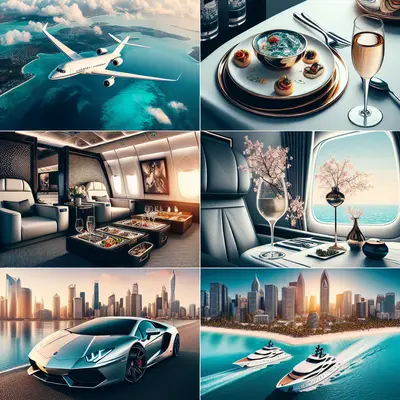
Luxury travel today is less about being seen and more about being exquisitely understood. The private jet on the tarmac, the suite with its own elevator, the chef’s table no one posts about—these are details, not declarations. For the truly discerning traveler, indulgence is measured not in spectacle, but in precision: the way a destination is timed, lit, scented, and orchestrated to feel almost eerily aligned with one’s inner tempo.
What follows is an exploration of contemporary luxury travel through five exclusive insights—the kind of quiet intelligence that separates a pleasant trip from a privately unforgettable one.
The Intelligence of Timing: Traveling in the Half-Light
For luxury travelers, timing has become a design tool, not a constraint. The most coveted experiences now sit just outside the frame of peak demand, in the soft margins where a place reveals its unedited self.
Arriving at a destination slightly off-season—by a matter of weeks, not months—can mean access to spaces and people that are otherwise over-programmed. A Mediterranean island in late September, a Japanese mountain ryokan just before peak foliage, an African conservancy when the crowds have thinned but the wildlife has not: these are micro-windows where the texture of a place changes. The staff is less hurried, the chef has time to linger at your table, the sommelier will open bottles not on any printed list.
Timing also determines how you inhabit familiar cities. A late winter arrival in Paris shifts the city from postcard to private salon: galleries less crowded, tables at bistros that usually require weeks of negotiation, hotel concierges able to secure “impossible” reservations because the truly local spots are no longer strained by volume. By thinking in terms of shoulder hours, shoulder days, and shoulder weeks, the luxury traveler also unlocks an unspoken benefit: discretion. The fewer people in the room, the more the room becomes yours.
Quiet Power: Building an Invisible Ecosystem Around Every Trip
The most refined journeys are powered by an ecosystem you rarely see, but constantly feel. True luxury travel today is less a product and more a choreography—one that extends beyond the hotel or aircraft into a quiet network of fixers, specialists, and hyper-local experts whose sole mandate is to make your preferences feel inevitable.
At the core is a trusted advisor or travel designer who knows your rhythms as intimately as a long-time tailor: how many nights you can comfortably change time zones in a row, what kind of lighting you need to fall asleep on a westbound flight, which hotel brands understand that “late checkout” for you means 6 p.m., not noon. Around them orbit discreet service layers: local concierges, private drivers whose routes avoid not just traffic but visibility, and security teams that read like hospitality professionals, not law enforcement.
This invisible ecosystem anticipates friction points before you encounter them. Documents and visas are handled weeks in advance; medical contingencies are mapped to specific clinics and physicians at the destination; private airport terminals (where available) become your default interface with international travel. The luxury here is not just comfort, but cognitive ease: your attention is reserved for the experience, not the machinery that enables it.
Curated Stillness: Designing Rest as the Ultimate Privilege
The rarest commodity for the global elite is not access, but restoration. Consequently, luxury travel is undergoing a quiet recalibration: itineraries are now being built around deliberate stillness, where recovery is treated with the same intentionality as a Michelin-starred meal or a private villa.
This goes far beyond a spa appointment. High-end properties are collaborating with sleep scientists, nutritionists, and wellness physicians to create environments where every element—from circadian lighting and air filtration to noise thresholds and mattress personalization—is engineered for deep rest. In select resorts, arrival rituals now include sleep profiling, evening menus that reduce inflammation and support melatonin production, and housekeeping teams trained in “silent service” protocols after a certain hour.
The most sophisticated travelers are also learning to design “white space” into their trips: full days with nothing scheduled, or at most a single anchor experience, framed by unstructured time. This is especially pronounced in multi-stop itineraries: instead of a relentless sequence of cities, journeys now build in purposeful interludes—a secluded countryside retreat between two capitals, or a quiet island stay between intense business commitments. The result is a journey that feels composed, not compressed.
Private Access, Public Good: The New Dimension of Responsible Indulgence
A defining shift in contemporary luxury travel is the merging of private access with measurable positive impact. It is no longer sufficient for an experience to be rare; increasingly, it must also be responsibly rare.
In remote safari lodges, private jet journeys to sensitive ecosystems, and exclusive island buyouts, the most advanced operators now embed conservation or community benefit into the very architecture of the experience. A privately guided game drive may be led by a tracker whose training is funded by guest stays; a secluded overwater villa may sit in a marine-protected zone where part of your nightly rate directly underwrites reef regeneration or local fisheries management.
Sophisticated travelers are beginning to ask a new set of questions: not only “How private is this?” but “Whom does this meaningfully sustain?” and “What would this place look like if my money were not here?” The answers increasingly determine which brands earn long-term loyalty. A well-run, conservation-forward camp or resort does more than decorate its sustainability credentials; it offers transparency—impact reports, verifiable partnerships with NGOs or local governments, and pathways for guests to engage without performative philanthropy.
The deepest luxury lies in knowing that your presence in a place is additive rather than extractive, and that the doors opened for you will not close on the communities who made them possible.
The Art of Narrative: Treating Each Journey as a Private Edition
For the upper echelons of travelers, a trip is no longer a sequence of reservations; it is a limited-edition narrative. The most compelling journeys are structured almost like a privately published book: a beginning that calibrates you to a new tempo, a middle that deepens your engagement, and a closing chapter that feels conclusive yet leaves a trace.
The finest travel designers and concierges now think in terms of narrative arcs rather than bullet-point itineraries. A multi-country trip might start with a quiet coastal stay to unwind, build into a culturally immersive city phase with curated access to ateliers, archives, or private homes, and then taper into a reflective retreat designed for integration—journaling sessions, meaningful conversations with local experts, or simply curated solitude with the right view, the right chair, and the right bottle.
These narratives are also layered with recurring motifs: a particular fragrance that follows you from your in-flight amenity kit to your hotel turndown, a local artist whose work appears in different forms across your destinations, a single dish or ingredient that acts as a culinary through-line across countries. Such deliberate echoes create a sense of cohesion and memory—your journey becomes not a collection of places, but a singular, authored experience.
This is the quiet frontier of luxury travel: journeys not merely remembered, but re-readable.
Conclusion
Luxury travel, at its most evolved, is an exercise in calibration. It is the art of adjusting timing, access, stillness, responsibility, and narrative until a journey feels tailored to a private frequency only you can hear. The aircraft, the suites, the reservations—these are instruments, not the music.
For the discerning traveler, the question is no longer “Where should I go next?” but “How precisely can my next journey reflect who I am, how I wish to move through the world, and what I choose to leave behind there?” The answers live in the subtleties: the off-peak arrival, the invisible ecosystem of experts, the engineered quiet, the aligned impact, the considered story. When those elements are in harmony, travel ceases to be an escape and becomes something far rarer—a refined expression of self.
Sources
- [World Travel & Tourism Council – High Net Worth Travelers Trends](https://wttc.org/research/insights) – Industry insights on changing expectations and behaviors among affluent travelers
- [Virtuoso – 2024 Luxe Report](https://www.virtuoso.com/travel/articles/luxe-report) – Data-driven overview of current luxury travel trends, including personalization and off-peak travel patterns
- [Forbes – How Ultra-Wealthy Travelers Are Redefining Luxury Tourism](https://www.forbes.com/sites/forbesbusinesscouncil/2023/08/15/how-ultra-wealthy-travelers-are-redefining-luxury-tourism/) – Analysis of shifts toward privacy, wellness, and impact in high-end travel
- [Conservation International – Tourism and Conservation](https://www.conservation.org/priorities/sustainable-tourism) – Background on how premium travel can be aligned with conservation outcomes
- [Harvard Business Review – The Growing Demand for Experiences over Things](https://hbr.org/2019/08/the-growing-demand-for-experiences-over-things) – Context on experiential luxury and why narrative and personalization matter to affluent consumers
Key Takeaway
The most important thing to remember from this article is that this information can change how you think about Luxury Travel.