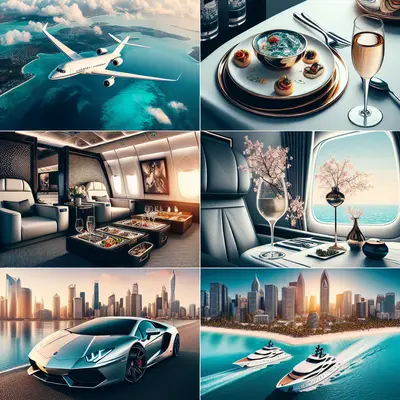
The most sophisticated travelers no longer chase mere opulence; they curate a private standard. It isn’t about the chandelier in the lobby, the number of Michelin stars, or the size of a suite. It’s about a silent calculus: how well a journey reflects their inner life, their time horizon, and their appetite for precision. Today’s luxury traveler edits rather than accumulates—distilling each trip into a handful of unforgettable, deeply personal moments.
Below, five exclusive insights shaping how truly discerning travelers navigate the world—and how to think with the same quiet exactness.
1. Time Is the Ultimate Suite Upgrade
For those operating at the highest levels, time has fully replaced square footage as the most coveted luxury. The world’s most discerning travelers approach itineraries the way a watchmaker approaches a movement: every component must justify its presence.
Instead of over-programmed days, they design journeys with deliberate negative space. A three-night stay may center on one or two anchor experiences—a private tasting in a winemaker’s family cellar, an after-hours museum opening, or a sunrise helicopter drop onto a remote ridge—surrounded by buffers of unscheduled time. This protects the trip from the chaos of weather, delays, or shifting moods, and allows for the improvisation that often yields the most memorable hours.
At the logistical level, this philosophy translates into choices like point-to-point private aviation, private terminals (FBOs), or commercial flights strategically scheduled to protect sleep and minimize transfers. Door-to-door car services, VIP airport facilitation, and luggage forwarding are not indulgences; they are time-reclamation tools. The question guiding every decision is: “Does this protect, enhance, or squander my best hours?” Anything that fails this test is quietly edited out.
2. Privacy Is No Longer About Isolation, But Control
Traditional luxury equated privacy with remoteness—a villa at the end of a peninsula, a suite at the top of a tower. Today’s most discerning travelers define privacy as control over what is seen, shared, and scheduled.
This manifests in layers. At the physical level, privacy might mean properties with concealed arrival protocols, low-profile security, and sightlines designed to avoid exposure—even in public spaces. It can mean villas where staff presence is precisely choreographed: a room reset while you’re at breakfast, a turndown that happens during your evening walk rather than in your line of sight.
Digitally, privacy includes how properties handle data, facial recognition, and geolocation. Sophisticated travelers increasingly ask: Who sees my preferences? How is my profile stored? Which partners have access? They prefer brands with discreet loyalty programs, encrypted booking paths, and the ability to opt out of public recognition. Even within a group, privacy now means the ability to opt into or out of each moment; flexible villas with multiple living zones, independent arrivals, and modular experiences suit this new ethic.
The result is not a life lived in hiding, but one in which visibility is a choice rather than a default. True luxury lies in being able to participate fully one moment and disappear the next—without friction, explanations, or spectacle.
3. Destination Is Secondary to Context and Continuity
The most experienced travelers rarely ask “Where should I go next?” They ask, “What belongs between my last trip and the next chapter of my life?” A destination is valuable not because it is new, but because it clarifies something about who they are becoming.
Context comes first. A demanding professional season might call for a restorative journey, but “rest” for one traveler could mean a clinical-grade wellness retreat with precise protocols, while for another it may mean an unstructured week on a yacht with close friends and no set agenda. The same destination—a Mediterranean coastline, a Japanese mountain town—can play entirely different roles depending on where it sits in the broader narrative of a year.
Continuity is equally important. Discerning travelers often design a quiet through-line: a recurring ritual or motif that subtly links their journeys. It might be a series of stays in properties with serious contemporary art collections, a personal exploration of cold-water immersion around the world, or an ongoing pursuit of regional craftsmanship—commissioning one bespoke piece per trip. This creates a private architecture of meaning that sits above the typical checklist of “things to do” and enables a sense of progression rather than repetition.
Destinations, in this view, are not trophies but chapters. The measure of a place is not how many posts it can generate, but how precisely it answers the question: “Why now?”
4. Hospitality as Quiet Anticipation, Not Constant Attention
For a growing circle of ultra-discerning guests, the highest form of service is not lavish attention, but calibrated anticipation. What feels extraordinary is not the visible choreography of staff, but their near-invisibility combined with uncanny accuracy.
This begins long before arrival, with data used less for marketing and more for micro-adjustments. Pillow menus, room fragrances, minibar curation, and temperature presets all matter—but only when they feel like a continuation of the traveler’s life rather than a generic menu of options. The most advanced properties and agencies track nuanced preferences: whether a guest prefers a room near the elevator or at the far end of the corridor, low or natural lighting in the evening, a single perfect espresso at 07:00 or a carafe of tea left silently outside.
On the ground, excellence in this realm looks like staff who appear precisely when needed and vanish when they are not. Instead of the constant “Is there anything else I can do?”—which forces the guest into the work of decision-making—elite service teams resolve issues before they become visible. If a flight is delayed, the transfer is re-coordinated, the restaurant re-timed, the spa slot quietly held. A favorite table is saved without fanfare; a preferred guide is reserved before the traveler even remembers their name.
The goal is not to astonish but to stabilize—to create a seamless field in which the traveler’s energy is spent not on administration, but on presence.
5. Experiences Are Curated With an Investor’s Discipline
Today’s most sophisticated travelers approach experiences as they do their portfolios: carefully weighted, diversified, and regularly rebalanced. The currency is not money—it is emotional return on investment.
Each trip is built with a mix of “safe assets” and “high-yield, high-variance” moments. Safe assets might be a trusted hotel brand in a complex city, a familiar airline on long-haul routes, or a return to a known destination that reliably delivers ease. These anchor the journey. Around them, the traveler places targeted risk: a remote expedition with uncertain weather, a new culinary frontier outside their typical comfort zone, or an emerging destination where the infrastructure is still maturing.
This investor’s mindset also shapes how travelers work with specialists. Top-tier travel advisors, destination experts, and on-the-ground fixers are treated as a strategic network, not as transaction handlers. Their value lies in asymmetric information: access to opportunities not widely publicized, accurate readouts of local conditions, and the ability to re-engineer an entire plan on short notice.
Over time, discerning travelers audit their experiences. Which moments felt truly expansive? Which became obligations, even if “impressive” on paper? The next itinerary is then refined accordingly. The objective is not to accumulate more, but to narrow the field to the rare experiences that deliver a lasting, compounding sense of depth, perspective, or joy.
Conclusion
The quiet evolution of luxury travel is not about new amenities but about a new intelligence. Time edges out spectacle. Privacy becomes a matter of control rather than distance. Destinations are chosen for their narrative fit, not their novelty. Service reveals its genius not in flourishes but in frictionless anticipation. And experiences are evaluated with the same clarity a seasoned investor brings to a portfolio.
For those willing to think this way, every journey becomes less a temporary escape and more an instrument—precisely tuned to widen the mind, protect the calendar, and refine the way a life is lived.
Sources
- World Travel & Tourism Council – Economic Impact Reports - Data and analysis on global travel trends and the evolving role of premium travel in the world economy
- McKinsey & Company – “The Travel Industry Turned Upside Down” - Insight into shifting traveler expectations and the rise of more personalized, value-driven journeys
- Virtuoso – Luxe Report - Research on high-net-worth traveler behavior, including preferences for time-saving, privacy, and tailored experiences
- Cornell University School of Hotel Administration – Hospitality Research - Academic perspectives on service design, guest experience, and the future of luxury hospitality
- Forbes – “How Luxury Travel Is Changing” - Overview of current trends in luxury travel, including privacy, personalization, and experiential focus
Key Takeaway
The most important thing to remember from this article is that this information can change how you think about Luxury Travel.