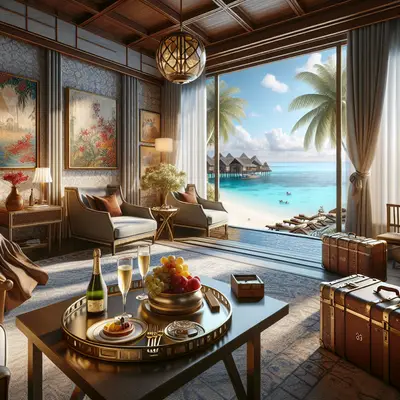
The most compelling expressions of luxury are no longer announced; they are inferred. For the modern traveler who values discretion over spectacle, refinement is found in the quiet calibration of details—how time is protected, how spaces are composed, how choices feel both effortless and deeply personal. This is the world Jet Ready inhabits: a culture of considered travel where premium is not a price point, but a standard of thoughtfulness.
Below, five exclusive insights shaping how today’s most discerning travelers design their journeys—often invisibly, always intentionally.
The Privilege of Time, Not Just Place
For the truly seasoned traveler, destination is no longer the climax; it is merely context. What distinguishes a premium journey is the conscious re-allocation of time—from logistics to living.
Luxury travelers are increasingly investing in services and structures that protect their most finite asset. This can mean pre-cleared immigration channels and private airport transfers choreographed to the minute, but it also extends to how time within the stay is curated: a breakfast that appears only when one emerges from the suite, spa appointments that adjust to a delayed flight without prompting, or restaurant experiences that flow without the friction of menus, payments, or waiting.
The most coveted itineraries today are less about quantity—“how much can we fit in?”—and more about quality of attention: fewer but more resonant experiences, more unhurried mornings, more stretches of deliberate nothingness framed by beauty. The true upgrade is not a better seat or a larger suite; it is the feeling that your time is treated as rare, and never casually consumed by others’ inefficiencies.
Bespoke Without Broadcast: Quietly Tailored Experiences
The premium traveler is no longer impressed by overt gestures of personalization; embossed initials and loud welcome amenities feel dated, almost performative. What resonates now is a quieter intelligence: the sense that the journey has been gently tuned to one’s preferences without ever being announced as such.
Consider arriving to find the in-room minibar edited to reflect your actual habits: a particular sparkling water, a specific tea varietal, the absence of items you never touch. Or walking into a suite already dimmed to your preferred lighting level at that time of day, with the room scent calibrated to a note you once mentioned in passing.
True luxury hospitality increasingly draws on thoughtful data—not to overwhelm guests with choices, but to remove the need for them. Preferences for pillow density, turn-down timing, workout style, or even in-room tech complexity (for some, a fully automated room is a delight; for others, a frustration) are discreetly logged and seamlessly enacted.
The highest form of bespoke service is the one you feel rather than see: a flawless alignment between what you would have chosen and what quietly appears.
The Intelligently Curated Itinerary: Less Checklist, More Narrative
The era of the exhaustive “must-see” checklist is giving way to something more nuanced: journeys composed with the logic of a story rather than a catalogue. Luxury travelers today rarely ask, “What should I see?” Instead, they ask, “What perspective on this place is worth my attention?”
This shift is igniting a new style of curation. Private guides are no longer simply local experts, but narrative designers who frame a city through a particular lens—architecture and urban change in Singapore; post-war design and craftsmanship in Milan; coastal ecology and culinary heritage in the Yucatán. Experiences are sequenced for emotional texture: a morning of sensory immersion at a local market followed by a silent boat crossing; a demanding hike ending in an unlisted vineyard known only to a handful of locals.
The premium traveler values context as much as access. An invitation-only atelier visit feels richer when anchored in a deeper understanding of the craft tradition it represents. A chef’s table becomes more powerful when one understands the region’s agricultural constraints and innovations.
The luxury is not the number of reservations secured, but the coherence of the journey—a narrative that could only have been written for you, in this particular moment, in this particular place.
Elevated Privacy: Designing for Deliberate Distance
Privacy in premium travel has moved far beyond the binary of “public” vs. “exclusive.” The new standard is calibrated distance: enough separation to feel cocooned, enough connection to feel engaged.
Design-forward hotels and retreats are responding with layered privacy. Thoughtfully staggered villa orientations that preserve sightlines to the sea while eliminating direct views into neighboring terraces. Pools carved into the landscape in such a way that guests feel reprieve from the collective, even when technically sharing a space. Lounge seating that allows for presence without exposure.
In the air, privacy manifests as both physical and perceptual: seating configurations that shield without isolating, boarding flows that minimize unnecessary queuing, and cabin environments engineered for acoustic softness. On the ground, it is about the ease with which one can move without spectacle—priority security lanes that feel like quiet passages rather than VIP parades; check-in procedures that occur in lounges, suites, or even in transit, rather than at crowded desks.
The sophisticated traveler values the right to disappear selectively. The goal is not invisibility, but control: the ability to choose when to be in the foreground, and when to let the world recede to a comfortable distance.
Sensing the Invisible: Atmosphere as the New Signature
Among those who travel frequently at the highest level, the most memorable properties often share an elusive quality: a sense of atmosphere so carefully composed that it almost escapes description. This is where the future of premium lifestyle is being defined—not just in amenities, but in how a space feels at 6:30 a.m. versus 11:30 p.m.
Temperature, light, sound, and even texture are being orchestrated with increasing subtlety. A lobby that is calm, almost hushed, in the morning can gradually evolve into a low, convivial hum by early evening, achieved not by increasing volume but by shifting musical tone, scent, and seating configuration. Suites that modulate lighting and shade subtly throughout the day mirror natural circadian rhythms, easing recovery from long-haul flights. Materials are chosen not only for aesthetic value but for how they age, how they respond to touch, how they soften or sharpen acoustics.
For the luxury traveler, these elements become a kind of atmospheric signature—far more enduring than logos or branded trinkets. One remembers how the stone floor felt under bare feet after a late arrival, how the air changed when stepping from corridor to suite, how the balcony’s soundscape—distant waves, faint music, a city’s softened pulse—was framed just so.
When atmosphere is treated as an invisible amenity, the line between travel and dwelling blurs. A stay becomes less about being impressed and more about feeling absolutely, precisely right in one’s surroundings.
Conclusion
Premium travel today is defined less by spectacle and more by intention. It is the considered orchestration of time, space, and attention; the quiet refinement of experiences that feel deeply personal without ever feeling performative. For the discerning traveler, the most meaningful luxuries are often the least advertised: an itinerary that truly breathes, a room that anticipates unspoken needs, a journey that respects both privacy and presence.
In this evolving landscape, the ultimate privilege is not simply where you go, but how thoughtfully your travel is shaped around the life you wish to lead—on the road, in the air, and in the rare, exquisite spaces in between.
Sources
- [World Travel & Tourism Council – High Net Worth Travel Trends](https://wttc.org/research/insights/high-net-worth-travellers) - Insight into evolving expectations and behaviors of luxury travelers
- [Skift Research – The Future of the Guest Experience](https://research.skift.com/report/the-future-of-the-guest-experience/) - Industry analysis on personalization, design, and service innovation in hospitality
- [Condé Nast Traveler – How Luxury Travel Is Being Redefined](https://www.cntraveler.com/story/how-luxury-travel-is-being-redefined) - Editorial perspective on the shift from ostentatious luxury to meaningful, experience-led travel
- [Harvard Business Review – The Value of Customer Experience, Quantified](https://hbr.org/2014/08/the-value-of-customer-experience-quantified) - Research-based discussion of how thoughtful, frictionless experiences create lasting value
- [Cornell School of Hotel Administration – Hospitality Research](https://sha.cornell.edu/faculty-research/centers-institutes/chr/research/) - Academic research on hotel design, service models, and guest satisfaction patterns
Key Takeaway
The most important thing to remember from this article is that this information can change how you think about Premium Lifestyle.