For the discerning traveler, luxury is no longer a matter of thread count or square footage. It is a quiet, deliberate orchestration of privacy, precision, and presence. The most compelling exclusive resorts no longer announce themselves with spectacle; they reveal themselves in coded gestures—how a room is lit at dusk, how a chef responds to a passing preference, how a destination feels entirely yours, even at full occupancy.
At Jet Ready, we view these retreats not as mere getaways, but as finely tuned ecosystems where time, space, and service converge. What follows are five exclusive insights—subtle, often unspoken—that define the true upper tier of modern resort experiences.
1. The Architecture of Discretion
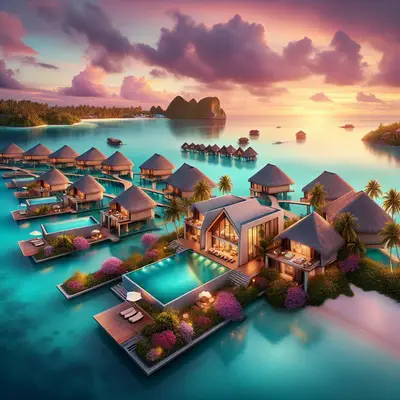
At the highest level of hospitality, luxury is designed to be felt rather than flaunted. The most elevated resorts are increasingly defined by their restraint: architecture that blends into the landscape, signage that is minimal or entirely absent, and circulation paths that allow guests to move without crossing into one another’s orbit unless they choose to.
Discretion begins with spatial separation but goes far beyond it. Sightlines are carefully controlled so that panoramic views are always yours alone, even when the property is fully booked. Landscaping is curated not only for aesthetics, but for acoustic insulation—strategically placed vegetation and water features that dissolve neighboring noise into a soft, constant hush. Your suite might be just steps from a restaurant or spa, yet feel as if it exists in its own self-contained world.
The most sophisticated properties apply this principle digitally as well. Check-in happens in-suite or via secure pre-arrival protocols; preferences are handled quietly, without repeated questions at every touchpoint. The result is a feeling of being completely known and yet never exposed—a balance that defines contemporary ultra-luxury.
2. Time as the Ultimate Amenity
At truly exclusive resorts, the rarest commodity is not space, but time—how it is protected, expanded, and choreographed on your behalf. Elite properties now operate less like hotels and more like finely tuned private clubs, where rigid schedules are replaced by intelligent fluidity.
Breakfast is served when your day begins, not when the restaurant opens. Wellness experiences shift according to your sleep data, jet lag patterns, and even your meeting schedule if you are blending business with leisure. Spa appointments are not simply time slots; they are sequences designed around your energy levels—a deep-tissue massage held back for the second evening, when you’re finally decompressing from transit and time zone shifts.
The most advanced resorts quietly coordinate with aviation and ground teams to ensure that the moment you disembark, your environment is already calibrated: room temperature aligned with your preference, preferred beverages waiting, lighting set not to impress but to ease your system from aircraft cabin to earth. This command of time—its friction, its transitions, its quality—is what truly separates the remarkable from the merely luxurious.
3. The Art of Invisible Personalization
The modern luxury traveler is data-aware and increasingly sensitive to how personal information is gathered and used. The most refined resorts have responded not with more obvious personalization, but with subtler, almost invisible tailoring.
You may never be asked what you like more than once. Your preferred style of service—more conversational or more reserved—is mirrored consistently across butlers, drivers, and waitstaff without a visible handover. Housekeeping understands your rhythm: when you typically leave the suite, how you like your wardrobe arranged, whether you prefer an empty desk or one neatly equipped with stationery and tech essentials.
Culinary programs at top-tier properties now track preference at the level of nuance: not just dietary restrictions, but how adventurous you tend to be with tasting menus, whether you gravitate toward coastal or mountain flavors, if you naturally linger over dessert or move on swiftly to digestifs. The genius lies in the restraint—no one calls attention to the customization. The sensation is not that of being managed, but of being effortlessly anticipated.
4. Curated Seclusion, Not Isolation
Exclusive resorts of the past were often defined by remoteness; today’s finest properties are defined by controlled connectivity. The aim is not to remove you from the world, but to mediate your access to it with surgical precision.
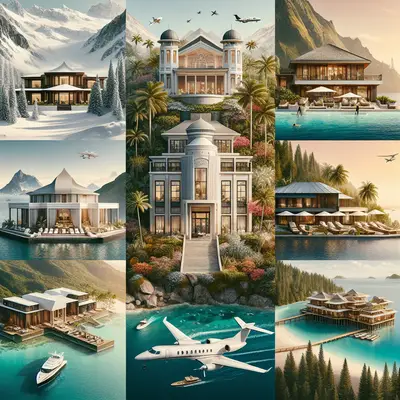
You might be on a private peninsula, a high-altitude plateau, or a discreet urban enclave shielded from street-level chaos—but the infrastructure behind the scenes is hyper-connected. Helicopter transfers, private marina access, or dedicated customs clearances are coordinated so that the world is available the moment you need it, and completely silent when you do not.
The most adept properties understand that luxury travelers are rarely “off” in the conventional sense. They create environments where you can conduct a high-stakes video call at 10 a.m. and be swimming in a completely private cove at 10:45, with no visible transition other than a change of wardrobe. This is curated seclusion: not hiding from the world, but choosing precisely when, how, and on what terms you engage with it.
5. Experiences That Withstand Memory
Beyond the architecture, service design, and seclusion, the true measure of an exclusive resort is how its experiences occupy your memory. The most resonant moments are rarely the most obviously “luxurious.” Instead, they tend to be quiet, textured, and deeply contextual.
A chef arranging a spontaneous, ingredient-led dinner on a jetty when the local catch that day is particularly exceptional. A historian joining you on a seemingly simple afternoon walk, transforming a landscape into a living archive. A wellness practitioner adjusting your program because subtle shifts in your posture or sleep patterns suggest fatigue you never mentioned.
Increasingly, world-class resorts invest in cultural liaisons, naturalists, local artisans, and scholars in residence. The goal is not to checklist “authenticity,” but to create experiences that feel unrepeatable anywhere else—moments that cannot be replicated by merely moving the same amenities to a different coastline. The highest expression of exclusivity is not what you consume, but what stays with you.
Conclusion
The new era of exclusive resorts is defined less by display and more by design—of space, of time, of perception. For the sophisticated traveler, the real luxury is the feeling that every element has been considered: how you arrive, how you move, how you rest, how you remember.
As you evaluate destinations for your next retreat, look beyond obvious markers of opulence. Ask instead: How discreet is the architecture? How intelligently is my time protected? How naturally does personalization appear? How precisely is seclusion curated? And, perhaps most importantly, will this place withstand memory?
The properties that answer these questions well are not just places to stay. They are environments calibrated to your pace, your privacy, and your priorities—quietly, and with intention.
Sources
- Forbes Travel Guide – What Makes a Hotel Truly Luxurious? – Outlines the standards and philosophy behind rating top-tier luxury properties worldwide.
- Virtuoso – Luxury Travel Trends and Insights – Provides perspective on evolving expectations and behaviors among high-end travelers.
- Condé Nast Traveler – Gold List of the World’s Best Hotels and Resorts – Curated examples of properties that embody contemporary luxury and exclusivity.
- Luxury Institute – High-Net-Worth Consumer Research – Offers data-driven insights into what affluent travelers value in luxury experiences.
- World Tourism Organization (UNWTO) – Tourism and Luxury Market Reports – Contextualizes luxury travel within broader global tourism trends and developments.
Key Takeaway
The most important thing to remember from this article is that this information can change how you think about Exclusive Resorts.