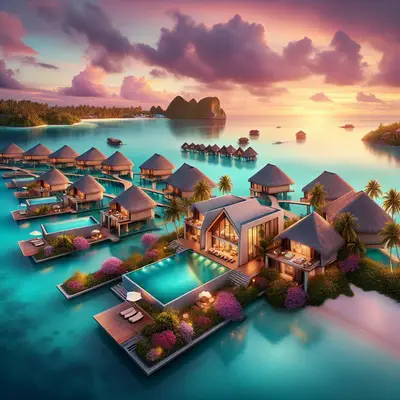
The most coveted resorts in the world are no longer merely destinations; they are finely tuned instruments of atmosphere, discretion, and emotional precision. For the truly seasoned traveler, luxury is no longer defined by thread count or square footage, but by a rare alignment of privacy, anticipation, and quietly choreographed moments that feel almost impossibly personal. In this world, excellence is not announced; it is implied, then confirmed in the smallest of details.
The Architecture of Privacy: Space That Protects, Not Just Impresses
In exclusive resorts, privacy is not a feature; it is the foundation. The most sophisticated properties are now designed less like hotels and more like private compounds, where sightlines, soundscapes, and circulation patterns are engineered to reduce friction and increase ease.
Thoughtful spatial planning means pathways that subtly divert foot traffic away from villas, landscaping that doubles as a visual shield, and arrival sequences that move guests from public to private without a single jarring transition. The most successful resorts understand that a guest’s perception of luxury is directly tied to how rarely they feel observed.
High-end properties are investing in sound-absorbing materials, discreetly placed staff corridors, and villa layouts that separate “public” entertaining areas from deeply private sleeping and bathing zones. Terraces are angled to preserve views without inviting neighboring gazes; plunge pools and outdoor showers are enveloped in greenery, anchored by the sense that the sky is your only audience.
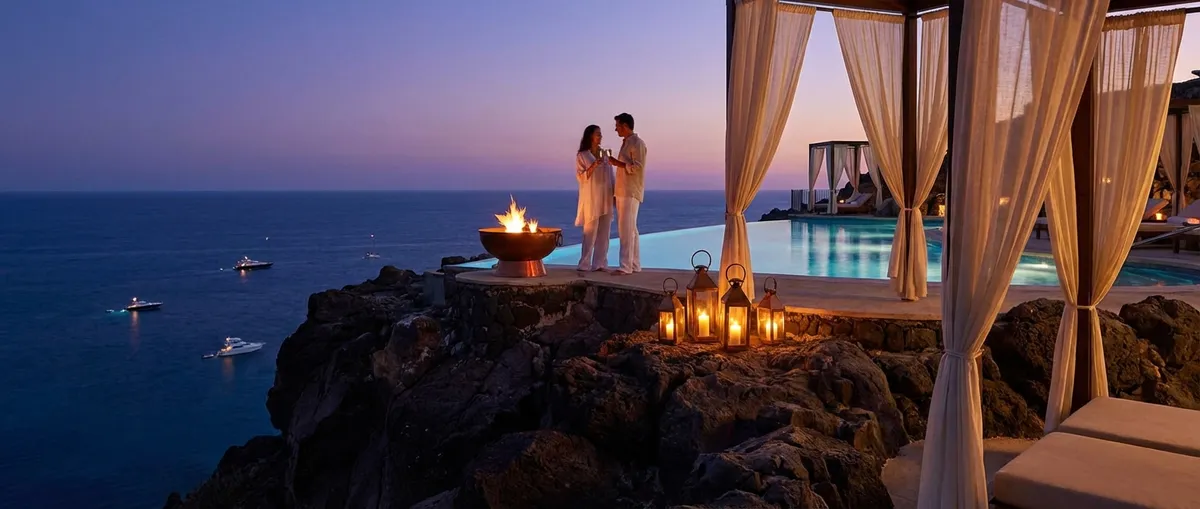
Exclusivity, in this context, is experienced as an almost cinematic solitude—one in which you feel alone, but never abandoned.
Anticipation as a Service: The Subtle Art of Being Expected
At the highest levels of hospitality, the most memorable service feels less like response and more like foresight. Guests of exclusive resorts increasingly expect their preferences not just remembered, but intuitively woven into the experience before a single request is made.
This begins long before arrival. The most refined properties conduct discreet pre-arrival profiling—not in the intrusive sense, but through gentle, well-designed questionnaires, travel advisor insights, and historical preferences from past stays. The result is an environment that feels strangely familiar from the moment you step inside: the correct water temperature in your plunge pool, the minibar curated not with labels, but with your labels, and a pillow menu that reflects what you privately prefer, not what you publicly select.
During the stay, staff are trained to read tempo rather than simply follow protocol. A guest speaking in low tones and reading on the terrace is approached differently from one animatedly discussing the next excursion. Housekeeping timings shift subtly depending on whether the room door has been opened or the curtains drawn. Turn-down service is not just chocolate and linens, but an atmospheric reset tailored to the evening you appear to be having—jazz and soft lighting after a late dinner; herbal teas and blackout perfection after a day of sun-drenched activity.
The luxury traveler today values this quiet choreography of anticipation more than overt displays of opulence. The rarest commodity is to feel, unequivocally, that you are expected—precisely as you are.
Time, Curated: When the Itinerary Becomes Invisible
In the realm of exclusive resorts, the era of the thick binder of activities is over. Sophisticated travelers are not looking for more options; they want fewer, but better, filtered through an understanding of who they are and how they travel.
The most aspirational properties function almost like private members’ clubs in the way they program time. Experiences are not pushed; they are revealed. Morning begins with the gentle suggestion of a coastal hike already adapted to your usual pace, followed by a breakfast timing that intuitively aligns with yesterday’s patterns. Rather than fixed-seat dinners and rigid spa slots, there is a sense that the resort flexes around your natural rhythm.
Crucially, the best resorts also protect unstructured time—what might be called “curated emptiness.” They understand that high-achieving guests live by the calendar at home and crave spaces where nothing is demanded of them. Concierge teams now operate less as reservation desks and more as experience editors, eliminating decision fatigue by offering two or three beautifully considered options instead of long lists.
This intentional shaping of time—stewarded, but never over-programmed—is one of the most precious, if intangible, luxuries on offer: the feeling that your days are unfolding organically, yet always have a graceful next chapter should you want one.
The New Definition of Exclusivity: Fewer People, Deeper Access
Exclusivity used to be about who was kept out. Now, for the most discerning travelers, it is about how deeply you are allowed in—into a place, a culture, a landscape, a chef’s mind, an artist’s process.
Top-tier resorts are forging partnerships with local experts, artisans, and institutions to offer access that cannot simply be purchased—it must be curated. This might mean private access to a heritage site before public opening hours, a tasting in a winemaker’s personal cellar rather than the public tasting room, or a guided night dive with a marine biologist who has personally mapped the surrounding reef.
The number of guests is often deliberately limited not just for privacy, but to maintain the integrity of these experiences. A stargazing session hosted by an astronomer feels qualitatively different when shared with six guests rather than sixty; a chef’s table is transformative when it becomes a candid, unscripted conversation instead of a performance.
True exclusivity is now measured by depth of connection, not height of barriers. The most sophisticated traveler is not just asking, “How private is this resort?” but “How meaningfully does this place let me in?”
Precision in the Details: The Quiet Codes of Modern Luxury
For those well versed in luxury travel, the telltale signs of an exceptional resort are rarely the headline features. Instead, they exist in a series of micro-signals—quiet codes that reveal the level of thought, investment, and culture behind the property.
It might be the exact weight of the glassware, the feel of the door handle, or the seamless integration of technology: lighting, climate, and shades that adjust intuitively without requiring a tutorial. It’s the absence of visual clutter on the bedside table, replaced by only what is necessary and carefully chosen: a carafe of water that is replenished without fanfare, a pen that feels balanced in the hand, a notepad whose paper stock matches the brand’s understated aesthetic.
Sustainability, too, has moved beyond virtue signaling to embedded practice. For the luxury traveler, it is no longer enough that a resort plant trees or eliminate plastic straws. The quiet sophistication lies in desalination systems that you never see, renewable energy grids you don’t need explained, and local sourcing programs so deeply integrated that menus and amenities feel naturally of-place rather than artificially themed.
Staff culture is another subtle yet definitive marker. The most elevated resorts have teams that move with unforced ease—confident enough not to hover, present enough to be found. Titles become less important than personality; interactions feel human, not rehearsed. A single, unprompted acknowledgement of your preference from a staff member you’ve never met before can say more about a property’s DNA than any design feature.
This world is built on the premise that you will notice these details, even if you never comment on them—and that your loyalty is often secured in those quiet, precise decisions that go almost, but not entirely, unspoken.
Conclusion
For the refined traveler, exclusive resorts are no longer measured by spectacle, but by calibration. Privacy without isolation. Service without intrusion. Access without spectacle. The new benchmark of luxury is how seamlessly a property can match its frequency to yours—absorbing your pace, your preferences, and your unspoken expectations until the environment feels less like a place you’ve checked into, and more like a life you might have designed for yourself.
In this evolving landscape, the most valuable insight is simple: what distinguishes a truly exceptional resort is not what it shows you, but how profoundly it understands you.
Sources
- [UNWTO – Global Report on Inclusive and Accessible Tourism](https://www.unwto.org/global/publication/global-report-on-inclusive-and-accessible-tourism) - Context on evolving expectations in high-end and experiential travel
- [Forbes Travel Guide – What Makes a Five-Star Hotel](https://www.forbestravelguide.com/about/forbes-travel-guide-star-rating) - Criteria and philosophy behind top-tier hospitality and service standards
- [Aman Resorts Official Website](https://www.aman.com/) - Illustrative examples of privacy-focused design, curated experiences, and discreet service in ultra-luxury resorts
- [Six Senses Sustainability & Wellness Approach](https://www.sixsenses.com/en/about-us/sustainability) - How leading luxury brands embed sustainability and wellness into the guest experience
- [Cornell University School of Hotel Administration](https://sha.cornell.edu/faculty-research/research/hospitality-research/) - Research and insights on hospitality design, service excellence, and guest experience trends
Key Takeaway
The most important thing to remember from this article is that this information can change how you think about Exclusive Resorts.