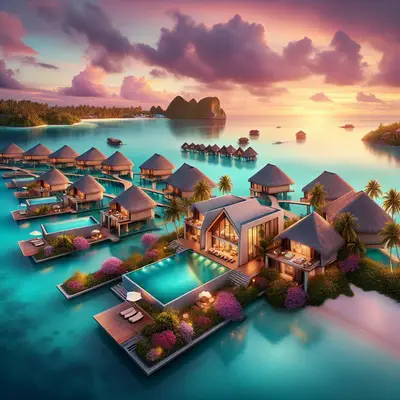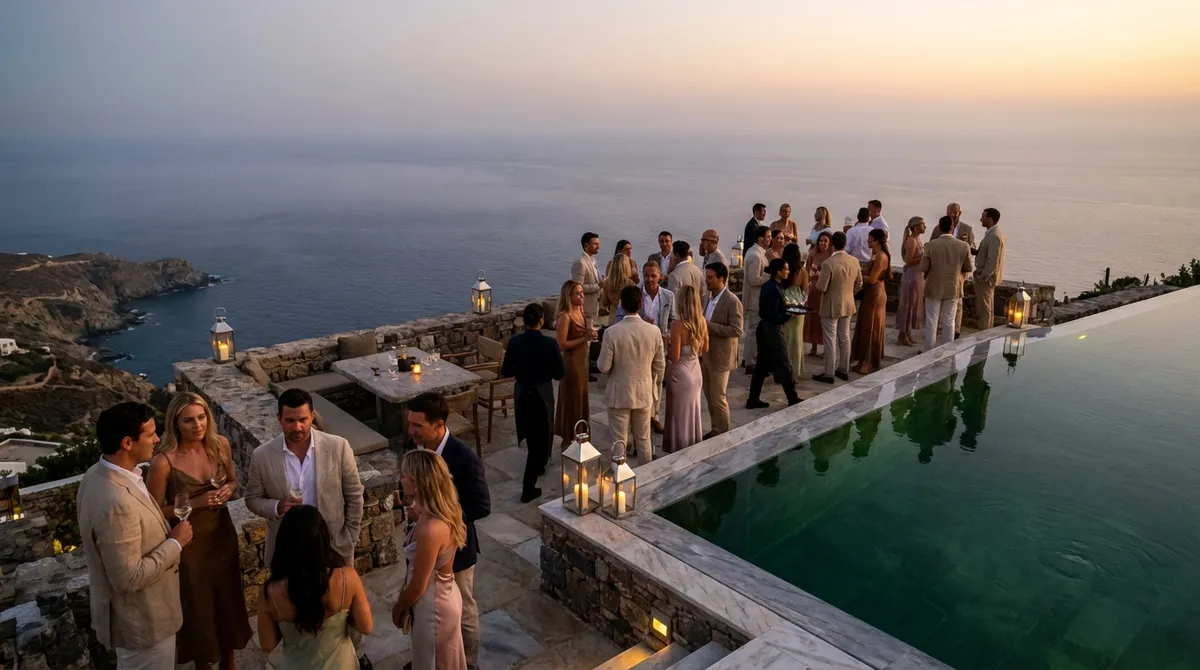
There is a tier of travel that never appears on public booking engines, where room categories are whispered rather than listed and the word “upgrade” quietly ceases to exist. In this world, exclusivity is not about ostentation but orchestration—how seamlessly a resort anticipates the traveler’s unspoken needs, how effortlessly it disappears into the background while choreographing every element of a stay. For the discerning guest, the true luxury is not the view, the villa, or the vintage, but the precision with which it all feels personally, almost privately, arranged.
Beyond the Suite: The Architecture of Privacy
In genuinely exclusive resorts, privacy is not a feature; it is the organizing principle of the entire property. Villas are angled so that sightlines never collide, paths are gently curved instead of linear, and key amenities are discreetly tiered away from the main flow of guests. Architectural decisions are guided by what can’t be seen as much as by what can.
The most sophisticated properties employ landscape, elevation, and distance more than walls and curtains. Dense plantings become natural dividers over time, infinity pools are set just off-axis from neighbors, and glazing is treated to allow for generous light without revealing the interior world of the suite. The result is a form of privacy that feels organic rather than defensive—more like inhabiting your own segment of coastline or hillside than occupying a room in a hotel.
For luxury travelers, this means that the setting itself does the quiet work of protection. Breakfast on the terrace feels entirely your own. A late-night swim is never a performance. The emotional effect is subtle but profound: a retreat that feels less like a visit and more like a temporary private domain.
The Discreet Intelligence of True Service
At the top tier of hospitality, service evolves from responsive to predictive. Staff do not simply remember your name; they remember the tempo of your day. They take note of when you naturally rise, how long you linger over lunch, which wines disappear quickest from your bucket, and whether you prefer conversation or measured distance. Over the course of a stay, a pattern emerges—and the resort refines its responses accordingly.
This is not coincidence; it is a designed system of quiet data gathering that is nonetheless profoundly human. Pre-arrival questionnaires, private profile notes, and internal briefings allow each department—from housekeeping to F&B—to speak a shared, invisible language about your preferences. A certain armchair is angled toward the best afternoon light before you return from an excursion. The spa subtly adjusts the temperature of your treatment room after noticing your reaction on day one. A particular mezcal or Burgundy arrives as if by intuition, when in reality it is the outcome of careful observation.
The elegance lies in restraint. Nothing is announced, nothing is overexplained. For the experienced traveler, this form of intelligence is the clearest marker that a resort understands luxury as calibration rather than spectacle.
Time as the Ultimate Amenity
In truly exclusive resorts, time itself is treated as a luxury material—managed, stretched, and protected on your behalf. Fixed schedules soften into frameworks, and the usual hotel rigidity dissolves. Breakfast that technically “ends” at 11 am quietly appears at noon for a guest who is clearly savoring sleep. A yacht departure is nudged back twenty minutes to accommodate a spontaneous swim. Check-in and check-out become conceptual, not literal.
This fluidity is possible because staffing and capacity are designed with margin, not optimization, in mind. Fewer keys, more personnel, and generous buffer times between services allow the property to adapt to the guest rather than forcing the guest to adapt to the property. For the traveler accustomed to timetables and tight transfers, this softness around time is intoxicating.
The effect is a mental exhale: the sense that nothing essential will be missed if you linger a little longer in the plunge pool, reorder another course, or extend your massage. Time stops feeling like something you manage, and starts feeling like something gently managed for you.
Curation Over Excess: The New Language of Luxury Facilities
The most refined exclusive resorts are moving away from maximalist amenity lists and toward precise, thoughtful curation. Instead of ten restaurants, there may be two—each with a distinct, fully realized identity, a producer-driven philosophy, and a menu that changes quietly with the tide or the harvest. Rather than an enormous spa complex, a property might feature just a handful of treatment suites, each crafted around a particular element, ritual, or tradition.
This restraint is not about less; it is about eliminating the unnecessary. Wine programs focus on small, exacting producers and rare allocations rather than encyclopedic lists. Fitness spaces prioritize natural light, intelligent equipment selection, and expert instruction over sheer scale. Even in-room amenities are chosen for depth of quality rather than volume: a single exceptional robe instead of multiple generic ones, a fragrance program with a bespoke scent profile rather than a standard amenity line.
For the seasoned traveler, this level of discipline signals confidence. The resort is not trying to be everything at once; it is choosing what it can do impeccably, and doing only that.
Five Exclusive Insights Seasoned Luxury Travelers Quietly Share
Within this rarified world, there are certain truths that circulate mostly in conversation between those who have been there, repeatedly, and those just beginning to step into it:
- True exclusivity is measured in capacity, not price.
Properties with a small key count, generous staff ratios, and spatial abundance will almost always deliver a more intimate experience than large-scale “luxury” resorts, regardless of nightly rate. The number of people you do not see is often the clearest indicator of what you are paying for.
- The most desirable inventory is often unpublished.
Many exceptional villas, residences, and special categories never appear on public sites. They are offered only to return guests, through preferred advisors, or by direct relationship with the resort. Building a long-term rapport with a property—or working with a well-connected travel specialist—unlocks a tier of access that cannot be purchased on demand.
- Destination matters less than ownership and management philosophy.
Two resorts on the same coastline can offer radically different experiences. Sophisticated travelers look beyond “Maldives” or “Amalfi” and study ownership structures, management companies, and general manager pedigrees. A property run by a team that values discretion, continuity, and long-term partnerships will consistently deliver deeper, more tailored stays than one driven by rapid volume growth.
- Off-peak is when resorts reveal their true character.
Shoulder seasons and quieter midweeks are when Exclusive Resorts fully express their capabilities. Staff have more time, spaces feel even more private, and the resort stretches to fill the quiet with nuance—extended tastings, spontaneous experiences, and moments that are impossible when occupancy peaks.
- Return visits are rewarded in ways that are never advertised.
The second or third stay is often when a property meaningfully “opens up.” Unlisted experiences are quietly made available—a private supper in the kitchen garden, early access to spa rituals, bespoke off-property excursions assembled through personal relationships. Loyalty here is not about points; it is about being recognized as someone worth curating for.
Conclusion
Exclusive resorts are not simply places to stay; they are finely tuned ecosystems designed to protect your privacy, refine your time, and distill your experience down to what feels essential and deeply personal. The markers of this world are subtle—angled pathways, unspoken service, considered stillness, and an almost studied absence of noise, visual or otherwise. For those attuned to these details, the destination becomes secondary to the quiet certainty that, from arrival to departure, very little will be left to chance and even less will need to be requested.
In the end, what sets these properties apart is not how loudly they announce their luxury, but how softly and precisely they deliver it.
Sources
- [Forbes Travel Guide – What Makes a Hotel Truly Luxury](https://www.forbestravelguide.com/destinations) – Insight into standards, staffing ratios, and service expectations at high-end properties
- [Virtuoso – The Virtuoso Life: Luxury Hotel Trends](https://www.virtuoso.com/travel/articles/luxury-hotel-trends) – Discusses evolving definitions of luxury, personalization, and experiential travel
- [Condé Nast Traveler – Gold List Hotels](https://www.cntraveler.com/gallery/the-gold-list) – Curated examples of top-tier resorts worldwide and what distinguishes them
- [American Express Travel – Global Travel Trends Report](https://www.americanexpress.com/en-us/travel/discover/get-inspired/global-travel-trends) – Data-backed insights on what affluent travelers seek in exclusive stays
- [Cornell University School of Hotel Administration](https://sha.cornell.edu/faculty-research/centers-institutes/cihler/research/) – Research on hospitality operations, service design, and guest experience in the luxury segment
Key Takeaway
The most important thing to remember from this article is that this information can change how you think about Exclusive Resorts.